links for 2007-05-25
-
A YouTubed version of one of Spider Jerusalem’s speeches from Transmetropolitan. (Feels like Trainspotting in a cominc book, on the interweb!) [Via]
-
Hilarious clip showing some of the (glaring) continuity errors in Star Wars!
-
Alex Halavais has some good advice on questions to ask BEFORE you embark on a research degree in Communication (or pretty much any other topic, too!). Perhaps a little negative, but sadly by and large realistic…
-
“Feedburner is in the closing stages of being acquired by Google for around $100 million.” (All your feeds are belong to us!)
links for 2007-05-24
-
Score one for better education: “Google is to ban adverts for essay writing services – following claims that plagiarism is threatening the integrity of university degrees.”
-
The creator of Buffy talks about the horrific “honour killing” of 17-year old Iraqi girl Dua Khalil, which was recorded by a cameraphone and distributed online. Whedon compares this with the mysogynistc trailer upcoming feature film, Captivity.
-
Make your own LOL CATS image with this nifty image generator. Let the procrastination … continue!
-
“The Middle East Times just released an article on the Maledives being the first country to open a virtual embassy in Second Life. “The Maldives thus pips Sweden to the post…”
The 4400 Goes Viral (Marketing)
The 4400 has taken to viral marketing dramatically in order to build the word before the upcoming fourth season of the TV show. According to AdWeek:
To promote the new season of The 4400 on USA Network, Campfire has created a wide-ranging interactive world consisting of 80 videos that run from 30 seconds to five minutes and six Web sites. […] The 4400 follows 4,400 people who are abducted, taken away and then returned to planet Earth. After their return, many of them discover they have superpowers. As the fourth season begins on June 17, the plot follows the development of a drug called Promicin: it gives the users superpowers, if it doesn’t kill them. Three different factions emerge around the drug: pro, anti- and neutral.
On YouTube, for example, one of the show’s stars, Billy Campbell, appears in character as Jordan Collier, advocating Promicin and the decrying the government’s attempts to ban the drug. Here’s Jordan Collier dispatch #3:
Elsewhere on the net, we can find the Promicin Power website, which argues that Promicin is the key to world peace and a sustainable relationship with nature. Here’s one example that looks like it could be have been a United Colours of Bennetton advertisement in a past life:
At the other extreme, there’s also Promicin Terror which sees the drug as the biggest threat to the US since Al Qaeda. Clearly building on the famous ‘Daisy‘ political ad of the 60s (which was recycled in the US debates about the War with Iraq), this is an example of a clip campaigning to ban the drug:
I quite enjoyed the last season of The 4400 and am heartened to see the show’s producers so actively embracing the potential of video-sharing and online word-of-mouth. The clips are a little over-produced, but given the state of a lot of TV advertising today, I’m sure they could easily be mistaken for the ‘real thing’.
Visualising the User-Driven Web
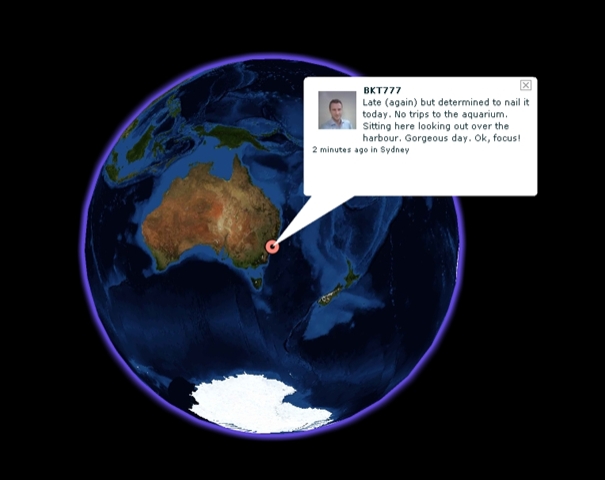
I was just pointed to Flickrvision, and I’m impressed. Flickrvision, and its older sibling, Twittervision, are program mashups by David Troy which combine the visualisation of Google Maps with the user-created data flowing out of Flickr and Twitter. There’s a ‘standard view’ in which individual Tweets or Flickr images are posted on a flat world map, but even more impressive for those visually-minded is the 3D version which inserts Tweets and Flickr photos continually onto a global map (which spins as needs be to show the origin of each post).
An example of Twittervision:
An example of Flickrvision:
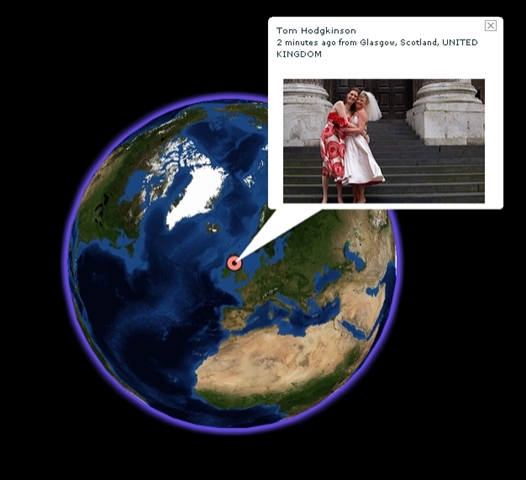
Watching these globes spin, each showing a fragment of life around the world, is incredibly engaging. This is the user-driven web at its most visually enticing. I have to say, were I in charge of a Communications Studies or Media Studies department (which I’m not) and I could find a couple of spare monitors and computers (which, in all fairness, departments probably couldn’t), then I’d leave these running 24/7 in the front foyer; the best advertisement for the studying the user-driven web is watching it happen in all its visual glory, right in front of you!
links for 2007-05-23
-
“A New Zealand city on the receiving end of a tongue-lashing from British comedian John Cleese has hit back by re-naming its rubbish dump after him.”
-
The trailer for the upcoming The Sarah Connor Chronicles TV series, which actually looks okay! It’s nice to see Summer Glau (Firefly, 4400) in another promising TV franchise.
-
The story of fair use (in the US) re-told using snippits of Disney owned films! See also the Stanford Uni Project this comes from.
-
Christian McCrea takes Zizek to task for his exuberant 300 review essay. Lots of quotes from others responding to Zizek, too. Interesting stuff …
-
Amazing street-art installations … all spectres of people amongst the urban decay; very clever stuff!
Searching Blogs Vs Wikis – Australians Prefer Wiki (The World Prefers Blog)
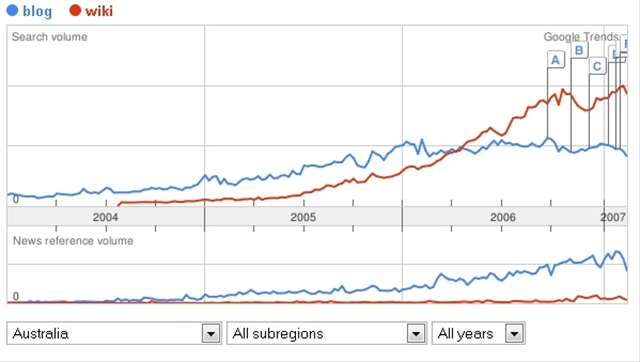
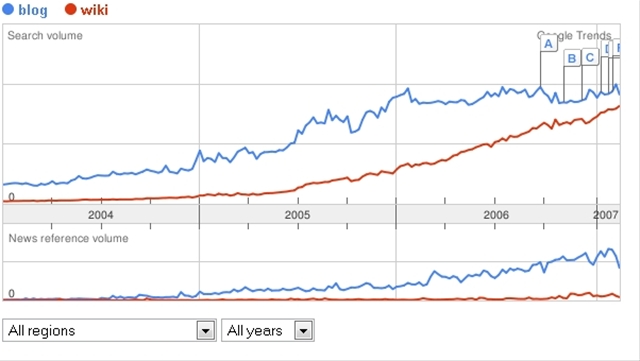
I was playing with Google Trends and their comparison function and noticed that you can now limit searches to regions (ie just Australia, for example). I was playing around looking at the comparative popularity of ‘blog’ versus ‘wiki’ and found something interesting: cumulatively, global searchers are still typing in ‘blog’ more, but in Australia, ‘wiki’ is a more popular term, and has been since the third quarter of 2006. Since there’s no scale on Google Trends, I’ve no numbers attached to these trends, but the results are interesting nevertheless.
Australia is looking for wikis…
While the world is looking for blogs…
[Click either image to expand.]
I’ve no idea why wikis are more popular in Australia … perhaps something to do with Wikipedia? I note in the News trends (the smaller bottom graph), blogs are still mentioned a lot more in the mainstream media. I wonder what it is about wikis and Aussies?

Tama Leaver dot Net by Tama Leaver is licensed under a Creative Commons Attribution-NonCommercial-ShareAlike 4.0 International License.