Annotated Digital Culture Links: March 30th 2009
Links for March 25th 2009 through March 30th 2009:
- Vintage DHARMA ads.[Flickr] – An outstanding set of fan-made ads for the more banal side of Lost‘s Dharma Initiative! By Adam Campbell [Via io9]
- Shooter video games ‘sharpen vision’ [News.com.au] – “Slaying hordes of bad guys in fast-paced video games improves vision, a study has shown for the first time. Far from being harmful to eyesight, as some had feared, action games provide excellent training for what eye doctors call contrast sensitivity, the study found. Contrast sensitivity is the ability to notice tiny changes in shades of grey against a uniform background, and is critical to everyday activities such as night driving and reading. It often degrades with age. The findings, published in Nature Neuroscience, reveal a previously unsuspected adaptability in the brain, and could open the way to new therapies, the researchers said.” (This week, video games are good! 🙂
- When Stars Twitter, a Ghost May Be Lurking – NYTimes.com – “The rapper 50 Cent is among the legion of stars who have recently embraced Twitter to reach fans who crave near-continuous access to their lives and thoughts. On March 1, he shared this insight with the more than 200,000 people who follow him: “My ambition leads me through a tunnel that never ends.” Those were 50 Cent’s words, but it was not exactly him tweeting. Rather, it was Chris Romero, known as Broadway, the director of the rapper’s Web empire, who typed in those words after reading them in an interview. “He doesn’t actually use Twitter,” Mr. Romero said of 50 Cent, whose real name is Curtis Jackson III, “but the energy of it is all him.” … someone has to do all that writing, even if each entry is barely a sentence long. In many cases, celebrities and their handlers have turned to outside writers “” ghost Twitterers, if you will “” who keep fans updated on the latest twists and turns, often in the star’s own voice.” (If you need a ghostwriter for 140chars, you’re not trying!)
- Conroy admits blacklist error, blames ‘Russian mob’ [SMH] – “The Communications Minister, Stephen Conroy, has admitted that Bill Henson images were added to the communications regulator’s list of prohibited websites in error, while blaming the addition of a dentist’s site to the blacklist on the “Russian mob”. Meanwhile, the website of the Federal Government’s censorship body, the Classification Board, was hacked last night and defaced with an anti-censorship screed. The admission by Senator Conroy on ABC television’s Q&A program last night casts significant doubt on the Government’s ability to filter the internet without inadvertently blocking legitimate websites. Q&A was inundated with 2000 questions from the public about the Government’s hugely unpopular policy, and the audience last night ridiculed Senator Conroy by laughing at a number of his responses.”
- YouTube Being Blocked in China, Google Says [NYTimes.com] – “Google said Tuesday that its YouTube video-sharing Web site had been blocked in China. Google said it did not know why the site had been blocked, but a report by the official Xinhua news agency of China on Tuesday said that supporters of the Dalai Lama had fabricated a video that appeared to show Chinese police officers brutally beating Tibetans after riots last year in Lhasa, the Tibetan capital. Xinhua did not identify the video, but based on the description it appears to match a video available on YouTube that was recently released by the Tibetan government in exile. It purports to show police officers storming a monastery after riots in Lhasa last March, kicking and beating protesters. It includes other instances of brutality and graphic images of a protester’s wounds. According to the video, the protester later died.”
Curtin’s Internet Filtering and Blocking
How much does your educational institution filter the internet, especially if you’re at tertiary level (because K-12 filtering has other issues attached to it)? I ask because in my recent shift to Curtin, I’ve discovered the joys of university-level internet filter, something that didn’t happen at my previous institution. The list of blocked or click-thru site (ie not completely blocked, but having a warning message asking if you really need this website) seems to alter week to week. This morning, every time I want to visit Twitter, Plurk, Facebook or even a wordpress.com blog, I have to click through a warning page; every time I reload, I have to click through a warning page. Apart from being highly frustrating, I’m currently redesigning several units which are thematically linked by the concept of web presence; almost everything I want students to look at will have these warnings on the Curtin network. I wonder how many students will get frustrated and give up on the unit? This morning’s blocks so far “¦
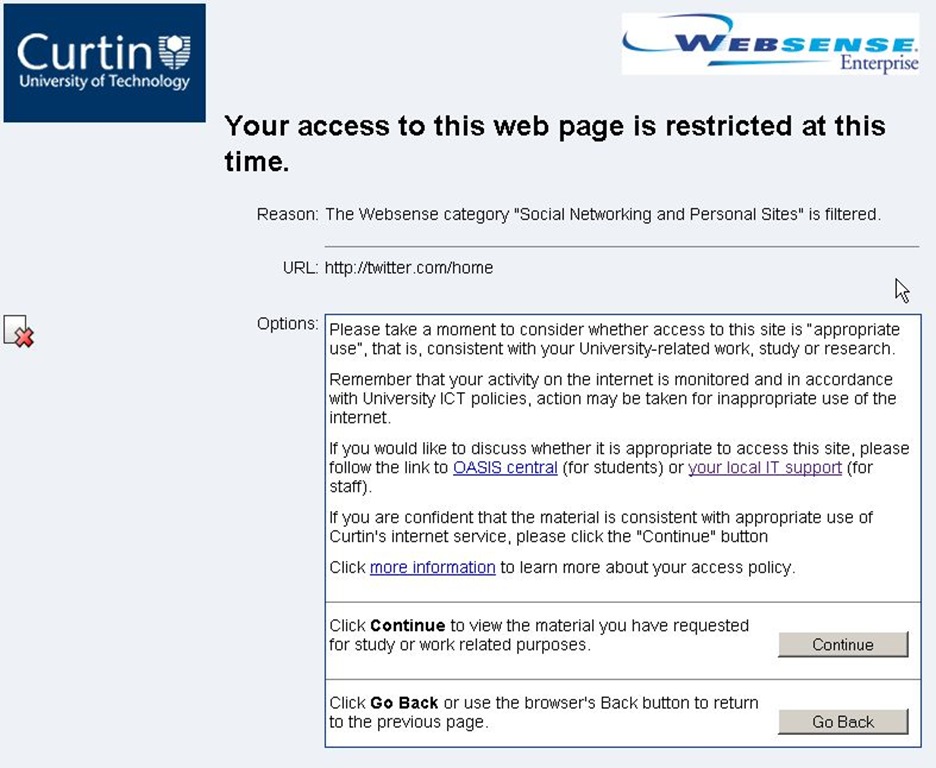
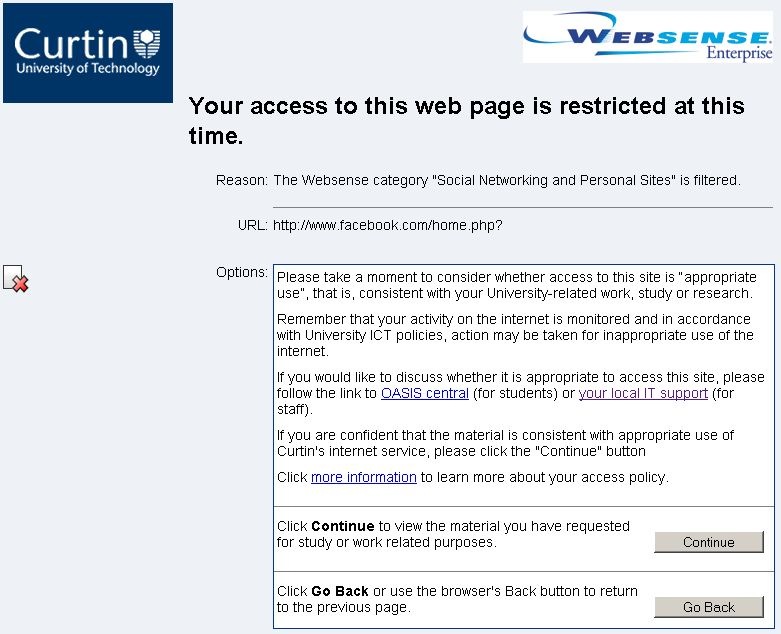
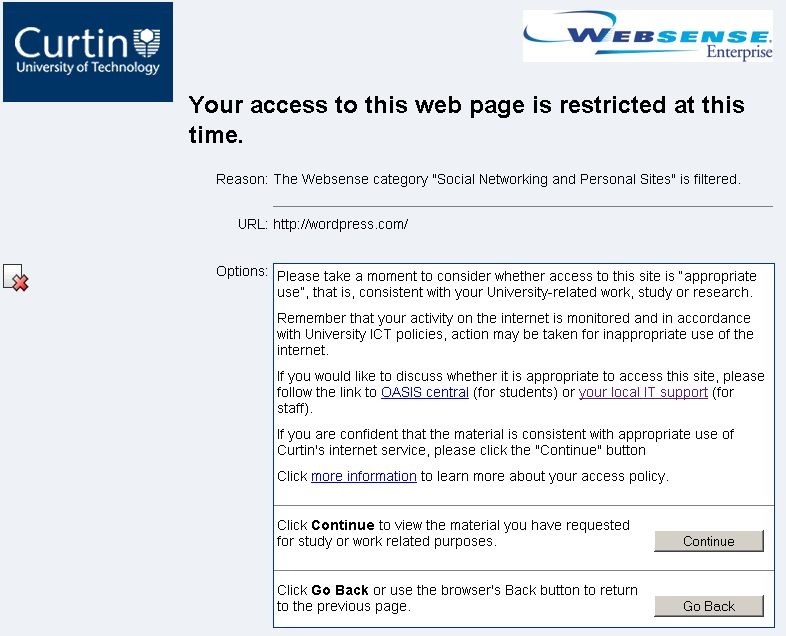
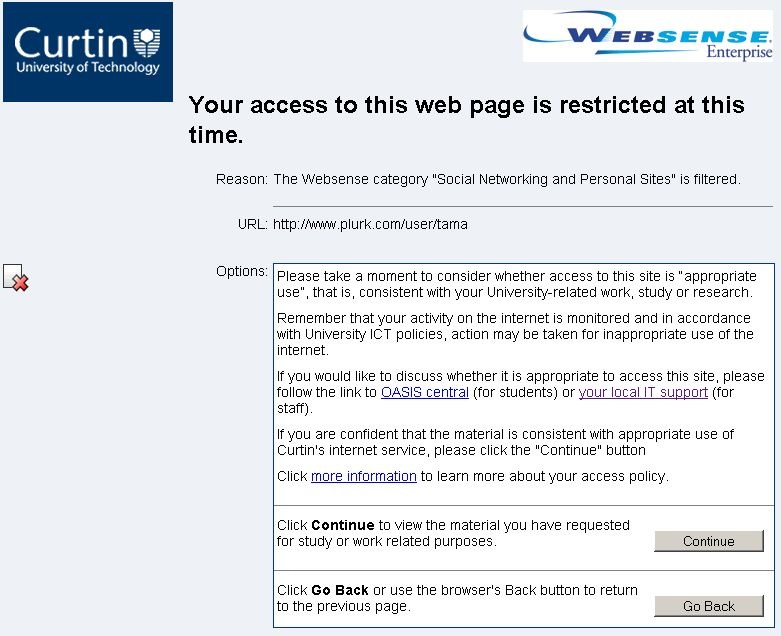
Ironic Update: The first attempt to upload this blog post from my work computer led me to discover that even this website is blocked now:
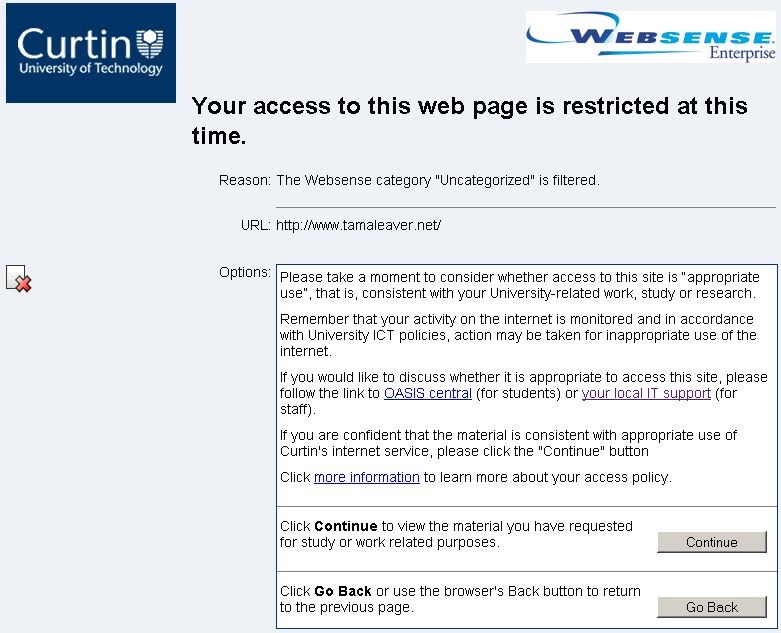
I wonder what sort of hoops I’m going to have to jump through to try and fix this? 🙁
Update 2: Most of the blocking seems to have magically stopped as suddenly as it began about 12 hours ago so, being generous, I’d like to believe this was an accidental blocking “¦ I’d really like to believe that “¦
Annotated Digital Culture Links: March 20th 2009
Links for March 19th 2009 through March 20th 2009:
- The Hugo Awards : 2009 Hugo Award Nominations – Doctor Horrible’s Sing-Along Blog is up for a 2009 Hugo for Best Dramatic Presentation, Short Form. That’s quite an achievement for a web one-off!
- 94% of Facebook users hate new design – web – Technology – theage.com.au – “Facebook’s redesign is getting an emphatic thumbs down from the notoriously change-wary users of the social network. Ninety-four per cent of the nearly 800,000 Facebook users who have voted in a poll on the site said they do not like the changes rolled out in the past two weeks. Only six per cent said they approve the redesign. Among those writing comments alongside the poll, user Nik McCarthy said the change “Pretty much sucks. Better before.– (Interesting use of stats, but, yes, new Facebooktwitter design is silly. Very silly.)
- (fake?) ACMA Blacklist leaked; citizens threatened with prosecution [nic.suzor.com] – Nic asks a very good question: “The list is apparently from late last year, and contains just over two thousand URLs (about double the size of the current list). On the list are some sites which look like they may possibly contain some child sexual abuse material. Unfortunately, there are also a very high number of innocuous sites – dentists, tuckshops, dog kennels, favourite collections of lolcats. Reports are coming out that these sites may have been hacked in the past and found their way on to the blacklist. This raises an immediate problem – what happens when the website owner fixes its security hole and removes prohibited content? How do you (a) find out you’re on the blacklist; and then (b) get your site removed?”
Australia’s Internet Blacklist Leaked
Asher Moses reports today ‘Leaked Australian blacklist reveals banned sites’:
The Australian communications regulator’s top-secret blacklist of banned websites has been leaked on to the web and paints a harrowing picture of Australia’s forthcoming internet censorship regime. Wikileaks, an anonymous document repository for whistleblowers, obtained the list “¦ University of Sydney associate professor Bjorn Landfeldt said the leaked list "constitutes a condensed encyclopedia of depravity and potentially very dangerous material". He said the leaked list would become "the concerned parent’s worst nightmare" as curious children would inevitably seek it out. But about half of the sites on the list are not related to child porn and include a slew of online poker sites, YouTube links, regular gay and straight porn sites, Wikipedia entries, euthanasia sites, websites of fringe religions such as satanic sites, fetish sites, Christian sites, the website of a tour operator and even a Queensland dentist. "It seems to me as if just about anything can potentially get on the list," Landfelt said.
At the moment ISPs and others are sent this list, with the option of implement it for some (or all) customers. The current Rudd government, with Stephen Conroy pushing it, wants this to be an Australia-wide mandatory block list. Misuse of such a list (along with the fact its implementation would slow internet access across all of Australia) is one the main reasons so many people, myself included, find national government level internet censorship abhorrent.
(It should be noted, that as this list was obtained from an ISP, it may contain links which were added only by the ISP, not from the ACMA list. I suspect that most of what’s blocked is from ACMA, especially the non-porn stuff, but the exact nuances aren’t 100% clear yet.)
Update: A story about the leaked list on the ABC is provoking a few comments!
Update 2: Conroy claims that the leaked list is not the official blacklist, although there are “are some common URLs to those on the ACMA blacklist”. Oddly, though, Conroy is still referring the matter to police to investigate who leaked the list “¦ which isn’t the list.
Annotated Digital Culture Links: March 18th 2009
Links for March 13th 2009 through March 18th 2009:
- Fake Stephen Conroy lashes out at Telstra [SMH] – “Telstra’s attempts to cover up the fact that it tried to silence Fake Stephen Conroy have backfired spectacularly. The Telstra employee who created the satirical Twitter profile has told his bosses not to “throw me under the f—ing bus just to make Telstra look social-media savvy”. After it was revealed that the popular Twitter profile impersonating Communications Minister Stephen Conroy was written by senior Telstra employee Leslie Nassar, the postings stopped. Nassar refused to speak to media, saying he was told to direct all comment requests to Telstra’s public relations unit. The Fake Stephen Conroy profile was also disabled for a period before reopening late yesterday. Telstra’s social media adviser Mike Hickinbotham came out to declare that Telstra did not try to shut Nassar up nor tell him to cease making the Fake Stephen Conroy posts. This directly contradicted earlier comments by Nassar, who said he was told by Telstra to stop.”
- Telstra man behind Fake Stephen Conroy [SMH] – “A web prankster impersonating Communications Minister Stephen Conroy on Twitter has been outed as a Telstra staff member. The staffer has now been silenced by the telecommunications giant, perhaps out of fear that the revelations will further increase tensions between Telstra and the Government, which has excluded Telstra from the bidding process to build a $10 billion-plus national broadband network. The satirical “Fake Stephen Conroy” profile, which has now been wiped, sparked almost as much discussion online as Senator Conroy himself. It primarily lampoons the Government’s proposed mandatory internet filtering scheme. Following an online manhunt that turned up a long list of suspects, Fake Stephen Conroy decided to turn himself in before he could be outed.
“OK, so here it is; Fake Stephen Conroy = Leslie Nassar,” he wrote yesterday.” (‘Twas fun while he lasted! 🙂 - Journalism students ‘don’t read papers’ [ABC News (Australian Broadcasting Corporation)] – “The journalists of the future are rapidly moving away from traditional news services, saying they are impractical compared to new media. A survey of Australian journalism students found 90 per cent of students do not like reading the newspaper, preferring to source news from commercial television or online media. Professor in Journalism and Media Studies at the Queensland University of Technology, Alan Knight, conducted the survey and says despite an aversion to newspapers, 95 per cent of students are very interested in following the news. “At this stage commercial television is still the favoured source, but online is rising pretty rapidly,” he said.” (I read most of my newspapers online, too. That said, i really hope some of the journalism students of today and thinking of ways to ensure that quality journalism is economically viable in the future!)
- Gervais + Elmo = Hilarity on ‘Sesame Street’ [YouTube] – The funniest thing you’ll see today – Ricky Gervais and Elmo taking an interview to a place Sesame Street realyl shouldn’t go! And, as Waxy says, they have the same laugh!
The Future Newspaper … Isn’t?
Clay Shirky’s ‘Newspapers and Thinking the Unthinkable’ has been getting a fair amount of attention in the past few days and his central point is ringing true for most people: the traditional revenue model of the newspaper is so dead that it might just be time to admit that in many cases news will need to find (a) new platform(s) of choice. It is worth noting, though, that Shirky is not downplaying the important role journalists have to play in our society; what he has resoundingly challenged is whether collecting their daily output on printed paper has much of a future. Indeed, Shirky’s conclusion is worth noting:
Society doesn’t need newspapers. What we need is journalism. For a century, the imperatives to strengthen journalism and to strengthen newspapers have been so tightly wound as to be indistinguishable. That’s been a fine accident to have, but when that accident stops, as it is stopping before our eyes, we’re going to need lots of other ways to strengthen journalism instead.
When we shift our attention from ‘save newspapers’ to ‘save society’, the imperative changes from ‘preserve the current institutions’ to ‘do whatever works.’ And what works today isn’t the same as what used to work.
I concur; the world at large needs good journalism, but many good journalists will need to find a new home and it’s likely a new medium, too. On March 12, the New York Times posted this visualisation:
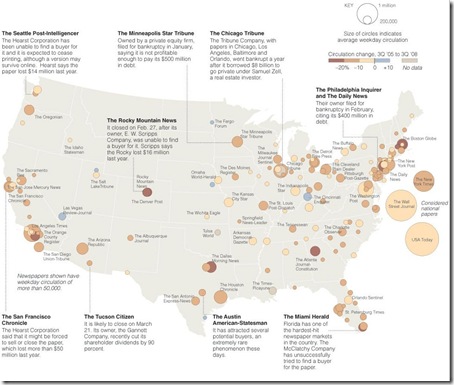
You’ll have to click and see the enlarged version to read the text, but the brown and beige circles show declining circulation numbers for US newspapers; blue circles show increases (there are very few blue dots). The US is a country of brown and beige dots. The fact that neither Shirky nor anyone else knows what should come next is an important tension. For those currently making a living working for newspapers who are laying off staff, this is a really immediate tension and, to be honest, I’m glad I’m not in those shoes. For society more broadly, the question of where we get our news, and whether we’re willing to pay anything for it – either personally or through an organisation we support, or even through government funding – is something we do need to consider. I have to say, I’m feeling more protective than ever of the Australian Broadcasting Corporation and SBS and have no qualms whatsoever about some fraction of my taxes supporting both. And sitting at a point of convergence of the best traditional journalism and web 2.0 platforms have to offer, I’m glad that people like Margaret Simons are finding new ways to keep the fourth estate alive and well. (And to be fair, there is still a lot of quality journalism out there “¦ it just too often gets buried behind the bleeding leads.)
For Perth folks, the paucity of our current choice in newspapers has been obvious for a long time; we only have one and it has spent almost all credibility it ever had. A new editor is on board now, but it’ll take a lot before The West holds any serious sway or has most people read it for anything other than the TV Guide and Saturday classifieds. In a well timed move, Perth’s citizen journalism advocate, Brownen Clune, has just relaunched her own web presence, hitting the ground running a provocative post entitled ‘The Emperor’s New Media’ which argues that many journalists lack credibility, and the profession overall is in disrepute, leaving little wonder why so many folks don’t want to pay to read it anymore:
Can we be so quick to blame the business models of newspapers (selling advertisements) when people won’t miss the service (news) they are providing? For years journalists have been regarded alongside used-car salesmen as the least trustworthy profession and every journalist has certainly experienced the polite disdain from strangers when you tell them what you do.
There is something very wrong with the media and the quality of journalism has a lot to do with it. “News” has become so devalued that people are not willing to pay for it.
Bronwen’s post has attracted some spirited comments from Fairfax journo Nick Miller (continuing an older debate, really) who does remind us that Perth certainly hasn’t really developed much of an alternative model as yet (and Bronwen’s PerthNorg, which is valuable, relies a great deal on filtered content created by the mainstream newspapers). But to return to Shirky’s point, we need more experiments, like PerthNorg, which are willing to try and find new ways to connect journalists of various types with audiences.
In terms of the quality of journalism out there, there’s definitely appetite for more transparent reporting and for reporting that returns more clearly to the notion of the fourth estate; keeping the average citizen informed is, after all, the aim. If nothing else, the fact that Jon Stewart and The Daily Show (a comedy show!) managed to get so many tongues wagging in the US recently when they went after CNBC’s ethics, and then Jim Cramer in particular when he took issue with Stewart’s criticism, shows that there is real desire for a more robust sense of the fourth estate (even if many people don’t recognise the term any more). As The Washington Post put it:
Jon Stewart has amassed a passionate following over the years as a sharp-edged satirist, the man who punctures the balloons of the powerful with a caustic candor that reporters cannot muster. As public furor over the economic meltdown rises, the Comedy Central star has turned not just his humor but also his full-throated outrage against financial journalists who he says aided and abetted the likes of Bear Stearns, AIG and Citigroup — especially those who work for the nation’s top business news channel. Stewart morphed into a populist avenging angel this week, demanding to know why CNBC and its most manic personality, Jim Cramer, failed to warn the public about the risky Wall Street conduct that triggered the financial crisis.
Okay, ‘avenging angel’ might be a bit over-the-top, but Stewart has, in my opinion, re-energised the question of journalistic ethics and, if nothing else, we can see responses like Fix CNBC http://fixcnbc.com/; while the sentiment is noble, perhaps, like, Fix the Newspapers, we need to hope for more?

Tama Leaver dot Net by Tama Leaver is licensed under a Creative Commons Attribution-NonCommercial-ShareAlike 4.0 International License.