Home » 2016 (Page 2)
Yearly Archives: 2016
Social, Casual and Mobile Games Book Published!
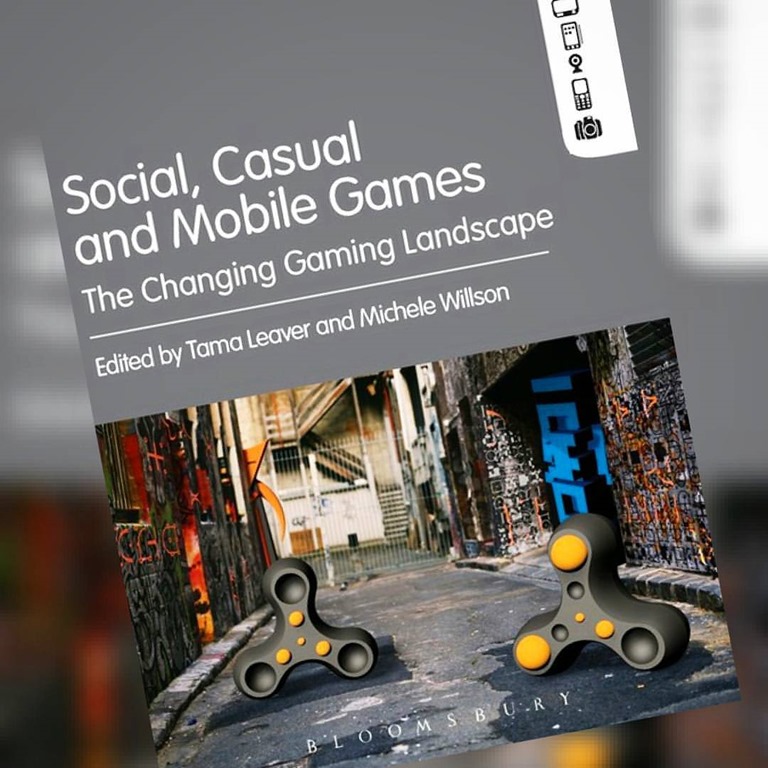 Michele Willson and I are delighted to announce that our collection Social, Casual and Mobile Games: The Changing Gaming Landscape has been released by Bloomsbury Academic.
Here’s a quick blurb and the contents and contributors:
Social, casual and mobile games, played on devices such as smartphones, tablets, or PCs and accessed through online social networks, have become extremely popular, and are changing the ways in which games are designed, understood, and played. These games have sparked a revolution as more people from a broader demographic than ever play games, shifting the stereotype of gaming away from that of hardcore, dedicated play to that of activities that fit into everyday life.
Social, Casual and Mobile Games explores the rapidly changing gaming landscape and discusses the ludic, methodological, theoretical, economic, social and cultural challenges that these changes invoke. With chapters discussing locative games, the new freemium economic model, and gamer demographics, as well as close studies of specific games (including Candy Crush Saga, Angry Birds, and Ingress), this collection offers an insight into the changing nature of games and the impact that mobile media is having upon individuals and societies around the world.
Contents
1. Social networks, casual games and mobile devices: the shifting contexts of gamers and gaming / Tama Leaver and Michele Willson
Part I: The (New?) Gaming Landscape
2. Who are the casual gamers? Gender tropes and tokenism in game culture / Lina Eklund
3. Between aliens, hackers and birds: non-casual mobile games and casual game design / Brendan Keogh
4. Casual gaming: the changing role of the designer / Laureline Chiapello
5. Discussions with developers: F2Play and the changing landscape of games business development / Tom Phillips
Part II: Reasons to Play
6. The sociality of asynchronous gameplay: social network games, dead-time and family bonding / Kelly Boudreau and Mia Consalvo
7. Digital affection games: cultural lens and critical reflection / Lindsay Grace
8. Mobile games and ambient play / Larissa Hjorth and Ingrid Richardson
9. Affect and social value in freemium games / Fanny Ramirez
Part III: Locative Play
10. Riding in cars with strangers: a cross-cultural comparison of privacy and safety in Ingress / Stacy Blasiola, Miao Feng and Adrienne Massanari
11. Playful places: uncovering hidden heritage with Ingress / Erin Stark
12. Rewriting neighbourhoods: Zombies, Run! and the runner as rhetor / Jamie Henthorn
13. The de-gamification of Foursquare? / Rowan Wilken
Part IV: New Markets
14. Social games and game-based revenue models / Mark Balnaves and Gary Madden
15. Angry Birds as a social network market / Tama Leaver
16. From premium to freemium: the political economy of the app / David Nieborg
Part V. Cheating, Gambling and Addiction
17. Social casino apps and digital media practices: New paradigms of consumption / Cesar Albarran-Torres
18. Cheating in Candy Crush Saga / Marcus Carter and Staffan Bjork
Afterword
19. Reflections on the casual games market in a post-Gamergate world / Adrienne Shaw and Shira Chess
Michele and I would like to publicly thank all of our wonderful contributors, the folks at Bloomsbury, and Troy Innocent for the rather nifty cover image. For the book’s launch Bloomsbury are offering 40% off the normal price, which makes the eBook version actually affordable for humans, not just libraries! Details here: http://www.bloomsbury.com/us/social-casual-and-mobile-games-9781501310584/
The front material and first chapter can be read online here (PDF).
Finally, here are the very generous cover jacket reviews:
“This book is an exciting rogue’s gallery of authors, games and topics at the forefront of modern gaming. The inclusion of issues discussing not only recent developments in design, playfulness and the definition of who plays games, but also attending to the darker aspects of contemporary gaming cultures such as the transition to Freemiun, cheating and GamerGate is an important step in examining new pathways into games and gaming culture. Social, Casual and Mobile Games: The Changing Gaming Landscapedemonstrates through an impressive series of chapters how this genre of games needs to be taken seriously as a cultural marker of today’s players and the games they engage with.”
– Esther MacCallum-Stewart, Research Fellow, Digital Cultures Research Centre, University of the West of England, UK“Social, Casual and Mobile Games captures a wide array of scholarship from all corners of Game Studies. The authors explore, from a variety of empirical and theoretical perspectives, a rich tableau of games and players that often disappear from dominant narratives about what makes a game or a game player.”
– Casey O’Donnell, Associate Professor of Media and Information, Michigan State University, USA, and author of Developer’s Dilemma“This terrific and timely book is an invaluable guide to the profound ways in which gaming – in all its casual, mobile, and social glory – will never be the same again. Critical research for the rest of the (gaming) world has finally arrived.”
– Gerard Goggin, Professor of Media and Communications, The University of Sydney, Australia
Workshops past & coming soon…
So 2016 seems to be all about the workshops and Summer School so far!
Just finished:
- On 1 February, my first day back from leave, I presented “Developing a Scholarly Web Presence and Using Social Media for Research Networking” at the Perth Research Bazaar (ResBaz) held at Murdoch University (slides available here). The talk was vey well received, with some great questions. Also, kudos to the organizers for the ease of parking!
- Last week I had the great pleasure in facilitating several workshops with my collaborator Tim Highfield, updating our “Instagrammatics: Analysing Visual Social Media Workshop” (slides here) for the 2016 CCI Summer School on Digital Methods hosted by the fabulous folks at the QUT Digital Media Research Centre. This was a fabulous event, with participants from across the world, all exploring the nuances of Digital Media methods and research. Tim and I learnt just as much from our participants as we brought to the table, which makes events like this so very rewarding. And there may have been one or two moments of levity, too!

Coming Up:
- On March 8th I’ll be giving a talk Introducing TrISMA – Tracking Infrastructure for Social Media Analytics with Alkim Ozaygen. This will be held in the new Internet of Everything Innovation Centre at Curtin and is hosted by the Curtin Institute for Computation (CIC).
- On March 30th, I’ll be facilitating a workshop at ECU Mouth Lawley (and livestreamed elsewhere, I believe) on “Promoting Your Research Online and Social Media Awareness“. This is tailored for ECU’s postgradaute students, but is open for anyone else to attend.
- Finally, for now, on May 2 I’ll be the first presenter at the Socialising Your Research – Postgrad and ECR Workshop @ UWA (flyer below). This event is open at anyone interested in WA, but RSVPs are needed (see the flyer for details).
Curtin TrISMA Seminar
On 8 March, I’ll be presenting an overview of TrISMA – Tracking Infrastructure for Social Media Analysis for interested researchers at Curtin. Details in the embedded flyer …
Born Digital? Presence, Privacy, and Intimate Surveillance
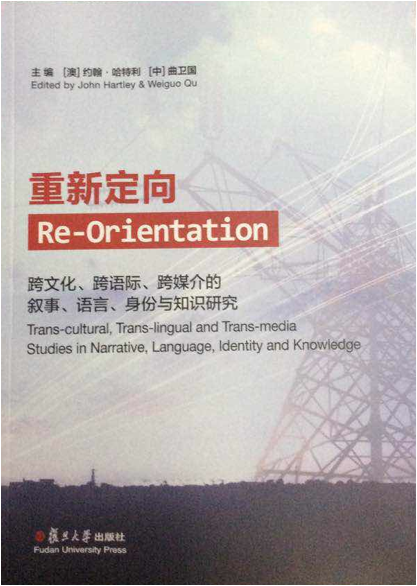 I’m pleased to note that my chapter ‘Born Digital? Presence, Privacy, and Intimate Surveillance‘ is out now in the Re-Orientation: Trans-lingual, Trans-cultural, Trans-media. Studies in narrative, language, identity, and knowledge collection edited by John Hartley and Weiguo Qu for Fudan University Press. The collection is the outcome of the fantastic Culture+8: New Times, New Zones symposium in 2014 which explored cultural synergies between different countries and locations in the +8 timezone which include Perth where we hosted the event, and, of course, China.
My chapter is a key part of my Ends of Identity project; here I start to think about ‘intimate surveillance’ which is where parents and loved ones digitally document and survey their offspring, from sharing ultrasound photos to tracking newborn feeding and eating patterns. Intimate surveillance is a deliberately contradictory term: something done with the best of intentions but with possibly quite problematic outcomes. Here’s the full abstract:
The moment of birth was once the instant where parents and others first saw their child in the world, but with the advent of various imaging technologies, most notably the ultrasound, the first photos often precede birth (Lupton, 2013). In the past several decades, the question is no longer just when the first images are produced, but who should see them, via which, if any, communication platforms? Should sonograms (the ultrasound photos) be used to announce the impending arrival of a new person in the world? Moreover, while that question is ostensibly quite benign, it does usher in an era where parents and loved ones are, for the first years of life, the ones deciding what, if any, social media presence young people have before they’re in a position to start contributing to those decisions.
This chapter addresses this comparatively new online terrain, postulating the provocative term intimate surveillance, which deliberately turns surveillance on its head, begging the question whether sharing affectionately, and with the best of intentions, can or should be understood as a form of surveillance. Firstly, this chapter will examine the idea of co-creating online identities, touching on some of the standard ways of thinking about identity online, and then starting to look at how these approaches do and do not explicitly address the creation of identity for others, especially parents creating online identities for their kids. I will then review some ideas about surveillance and counter-surveillance with a view to situating these creative parental acts in terms of the kids and others being created. Finally, this chapter will explore several examples of parental monitoring, capturing and sharing of data and media about their children, using various mobile apps, contextualising these activities not with a moral finger-waving, but by surfacing specific questions and literacies which parents may need to develop in order to use these tools mindfully, and ensure decisions made about their children’s’ online presences are purposeful decisions.
The chapter can be read here.

Tama Leaver dot Net by Tama Leaver is licensed under a Creative Commons Attribution-NonCommercial-ShareAlike 4.0 International License.