Digital Culture Links: December 13th 2010
Links for December 7th 2010 through December 13th 2010:
- The state, the press and a hyperdemocracy [Unleashed (Australian Broadcasting Corporation)] – Mark Pesce provokes a much larger debate about Wikileaks … is it really ‘the press’? “WikiLeaks is the press, but not the press as we have known it. This is the press of the 21st century, the press that comes after we’re all connected. Suddenly, all of the friendliest computers have become the deadliest weapons, and we are fenced in, encircled by threats – which are also opportunities. This threat is two-sided, Janus-faced. The state finds its ability to maintain the smooth functioning of power short-circuited by the exposure of its secrets. That is a fundamental, existential threat. In the same moment, the press recognises that its ability to act has been constrained at every point: servers get shut down, domain names fail to resolve, bank accounts freeze. These are the new selection pressures on both sides, a sudden quickening of culture’s two-step.”
- The Atlantic Turns a Profit, With an Eye on the Web [NYTimes.com] – The Atlantic turns a profit by thinking digitally, and employing bloggers: “How did a 153-year-old magazine “” one that first published the “Battle Hymn of the Republic” and gave voice to the abolitionist and transcendentalist movements “” reinvent itself for the 21st century? By pretending it was a Silicon Valley start-up that needed to kill itself to survive. The Atlantic, the intellectual’s monthly that always seemed more comfortable as an academic exercise than a business, is on track to turn a tidy profit of $1.8 million this year. That would be the first time in at least a decade that it had not lost money. Getting there took a cultural transfusion, a dose of counterintuition and a lot of digital advertising revenue. “We imagined ourselves as a venture-capital-backed start-up in Silicon Valley whose mission was to attack and disrupt The Atlantic,” […] “In essence, we brainstormed the question, ‘What would we do if the goal was to aggressively cannibalize ourselves?'””
- Angry Birds, Flocking to Cellphones Everywhere [NYTimes.com] – “It sounds like a tough sell: a game that involves catapulting birds at elaborate fortresses constructed by evil pigs. But Angry Birds, a hit game by Rovio, a small Finnish company, is one of the unlikeliest pop-culture crazes of the year “” and perhaps the first to make the leap from cellphone screens to the mainstream. Angry Birds, in which the birds seek revenge on the egg-stealing pigs, is meant to be easily played in the checkout line and during other short windows of downtime “” but some players have trouble stopping. Rovio says people around the world rack up 200 million minutes of game play each day. (Put another way, that is 16 human-years of bird-throwing every hour.) The game has inspired parodies, homages and fervent testimonials. Homemade Angry Birds costumes were big hits on Halloween. Conan O’Brien demonstrated the game in a YouTube video promoting his new show, and a sketch from an Israeli TV show about a birds-and-pigs peace treaty was popular online ….”
- Assange And WikiLeaks Have Parallels With Spycatcher [SMH] – Malcolm Turnbull on Wikileaks: “Governments and politicians should be careful not to make a martyr of Assange and fools of themselves. Julia Gillard’s claim that Assange had broken Australian laws, when it is clear he has not, demonstrates how out of her depth she is. One may well ask whether her denunciations would be so shrill if the documents had been handed to a powerful newspaper group – if the contents were being dribbled out by The Australian, would she be accusing Rupert Murdoch of high crimes and misdemeanours? Assange is an Australian citizen. No matter how much the government disapproves of his actions, it should make it clear that he is entitled to return to Australia if he wishes and to receive consular assistance if the charges of sexual assault proceed in Sweden.”
- Wikileaks and the Long Haul [Clay Shirky] – Some thoughts from Clay Shiry regarding Wikileaks which are well worth reading: “Over the long haul, we will need new checks and balances for newly increased transparency “” Wikileaks shouldn’t be able to operate as a law unto itself anymore than the US should be able to. In the short haul, though, Wikileaks is our Amsterdam. Whatever restrictions we eventually end up enacting, we need to keep Wikileaks alive today, while we work through the process democracies always go through to react to change. If it’s OK for a democracy to just decide to run someone off the internet for doing something they wouldn’t prosecute a newspaper for doing, the idea of an internet that further democratizes the public sphere will have taken a mortal blow.”
The Anti-Social Network
I’ve got a new column up over at Flow called ‘The Anti-Social Network’ about The Social Network film and how Zuckerberg is treated as a metaphor for all Facebook users. Here’s the introduction:
A film about writing a piece of software and two lawsuits about who really owns that software doesn’t sound like blockbuster material, but that’s exactly the premise behind The Social Network (2010) penned by Aaron Sorkin, of West Wing fame, and directed by David Fincher, best known for Fight Club (1999). Despite the seemingly dry premise, powered by Sorkin’s amazing dialogue and Fincher’s eye for pacing and casting, the film has done remarkably well, largely embraced by critics, and for a film in which nothing blows up and no one gets shot at, it has taken an impressive $175 million (U.S.) at the global box office thus far. Of course, the real story is about Mark Zuckerberg, Facebook’s creator and co-founder, and how more than half a billion people have voluntarily used the software he wrote to share their personal details and lives, in the process making Zuckerberg a billionaire many times over. It’s fair to say that the portrayal of Zuckerberg is far from sympathetic, but what’s a little more disturbing is how the depiction of Zuckerberg’s social awkwardness and moral ambiguity seems designed to paint all Facebook users with the same generational brush.
If you’d like to read the rest, it’s here.
The Australian Vs Julie Posetti (over a tweet!)
So, today’s big news is that Chris Mitchell, the editor-in-chief of The Australian, is going to sue journalism academic Julie Posetti for defamation over a twitter tweet in which she quoted a former The Australian journalist, Asa Walhquist, speaking at the Journalism Education Association Australia conference, as saying Mitchell had increasingly told her what to write with regard to environmental stories. Here’s the tweet in question:
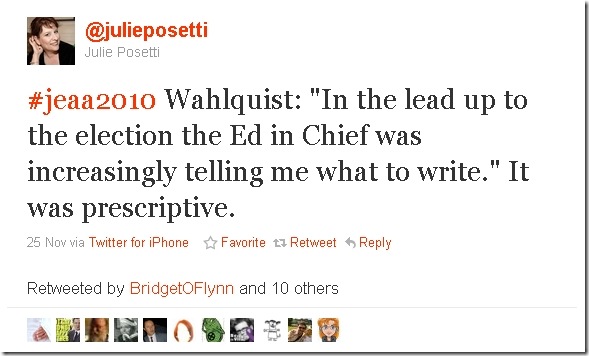
Walhquist has reportedly denied that the Posetti quote is accurate, but it mustn’t be that hard to check with a conference full of journalists – surely someone was recording the conversation? Julie Posetti is a prolific twitter user and a journalism academic at the University of Canberra and I suspect she’d know a lot better than to misquote someone, even in a tweet. For the record, here’s a screenshot of the tweets surrounding the one that offended Mitchell:
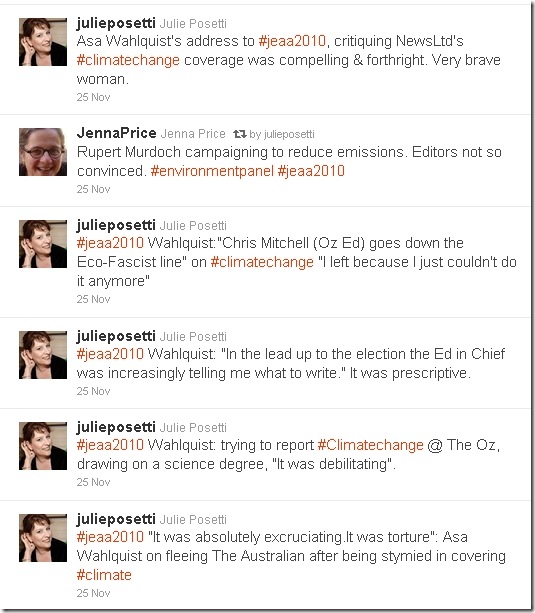
Beyond the question of whether defamation has actually occured, the big story here is the recognition implicitly made by Chris Mitchell that commentary on Twitter is now a big deal!
Update: Andrew Dodd’s report covering the same talk in Crikey tells the same story and thus supports Posetti’s position.
Update 2 (Monday, 29 Nov 2010): An ABC story reports that audio recorded at the conference demonstrates that Posetti accurately quoted Walhquist in the contentious tweet! (You can follow developments via the #twitdef hashtag on Twitter. You can hear an mp3 recording here (on the ABC website).)
Update 3 (Tuesday, 30 Nov 2010): Jonathon Holmes has posted ‘140 characters of legal nightmare’ on The Drum at it’s well worth reading as it highlights some of the legal complications that come from Twitter, real-time ‘reporting’ and the challenges of context and the way contexts shift.
Digital Culture Links: November 24th 2010
Links for November 19th 2010 through November 24th 2010:
- Long Live the Web: A Call for Continued Open Standards and Neutrality [Scientific American] – Inventor of the World Wide Web, Tim Berners-Lee, in a passionate defense of the open web (and a few pointed jabs at Facebook): “The Web is now more critical to free speech than any other medium. It brings principles established in the U.S. Constitution, the British Magna Carta and other important documents into the network age: freedom from being snooped on, filtered, censored and disconnected. […] If we want to track what government is doing, see what companies are doing, understand the true state of the planet, find a cure for Alzheimer’s disease, not to mention easily share our photos with our friends, we the public, the scientific community and the press must make sure the Web’s principles remain intact””not just to preserve what we have gained but to benefit from the great advances that are still to come.”
- Everything is a Remix – Part 1 [Vimeo] – Kirby Ferguson’s great video about remix, focusing on musical culture and the long history of remix as a core creative process (long before the web).
- The Attention-Span Myth [NYTimes.com] – A great read: “Whether the Web is making us smarter or dumber, isn’t there something just unconvincing about the idea that an occult “span” in the brain makes certain cultural objects more compelling than others? So a kid loves the drums but can hardly get through a chapter of “The Sun Also Rises”; and another aces algebra tests but can’t even understand how Call of Duty is played. The actions of these children may dismay or please adults, but anyone who has ever been bored by one practice and absorbed by another can explain the kids’ choices more persuasively than does the dominant model, which ignores the content of activities in favor of a wonky span thought vaguely to be in the brain. So how did we find ourselves with this unhappy attention-span conceit, and with the companion idea that a big attention span is humankind’s best moral and aesthetic asset? […] Instead, the problem with the attention-span discourse is that it’s founded on the phantom idea of an attention span.”
- New Facebook Messaging Continues to Block Some Links [Epicenter | Wired.com] – Facebook’s “not email” email system will block certain links. Definitely not email. “Facebook’s “modern messaging system” may make it convenient to seamlessly move between instant messaging and a Facebook.com e-mail account, but not if you are sharing a link to a file sharing site. Facebook began blocking BitTorrent link-sharing on Facebook walls and news feeds last spring, and also started blocking private messages between users that included a link to torrents on the Pirate Bay. Facebook says that content censorship policy isn’t changing, even as its new Facebook Messages service gives users e-mail accounts and encourages them to communicate even more through Facebook. “We have systems in place to prevent abuse on Facebook and prevent spam which we’ll continue to deploy with the new Messages,” a Facebook spokeswoman said in a written statement. “We don’t share specifics on those systems.””
- Facebook credits go on sale in UK [guardian.co.uk] – This is Facebook’s answer to the app store; watch the money flow! “Online currency, with which Facebook users can purchase pixel-based virtual farm animals or pay to attend virtual events, might seem small beer. But now the online goods economy may be about to boom in the UK, as Tesco and the games retailer Game start selling Facebook credits in more than 1,000 high street stores. The UK’s 33 million Facebook users will be able to buy so-called “Facebook credits” in the non-pixellated world. The gift cards, costing £10 or £20, will only be redeemable on Facebook, where users can spend the converted currency on any number of nonexistent objects. The virtual goods economy, where money is spent on items that only exist on the internet, is expected to exceed £550m for social gaming such as Zynga’s Farmville by the end of this year, according to a recent Inside Virtual Goods report.”

Tama Leaver dot Net by Tama Leaver is licensed under a Creative Commons Attribution-NonCommercial-ShareAlike 4.0 International License.