Home » australia (Page 22)
Category Archives: australia
Digital Culture Links: October 14th 2009
Links for October 12th 2009 through October 14th 2009:
- MySpace Loses Market Share As Facebook, Twitter Gain [SMH] – “MySpace has lost more than half of its market share in the past year even though Australians have doubled the amount of time they spend on social networking sites in that period. New figures released by Nielsen this week revealed that Australians spent 1.6 million hours on social media sites in June this year, up from 800,000 hours a year earlier. The two major beneficiaries of the social media rush have been Facebook and Twitter, which, according to Nielsen, now have 8 million and 1.5 million unique Australian users, respectively. Conversely, MySpace has been hemorrhaging users in the past year, with its monthly Australian unique visitors reaching 2.381 million in August, Nielsen said. Separately, traffic monitoring company Experian Hitwise said the site’s Australian market share dropped by 54 per cent in the year to October 10.” (So … notMySpace?)
- Ajay Rochester threatens to sue Woman’s Day magazine [The Australian] – TV host Ajay Rochester has used microblogging site Twitter to threaten to sue ACP Magazines’ Woman’s Day over a story claiming she was planning “a raft of cosmetic procedures”. In a series of “tweets”, the first of which was posted at about 2am today Sydney time, LA-based Rochester writes: “Shame on you Woman’s Day! Photo’s are 7 months old and u didn’t have permisson to use! Shame Shame Shame!” Rochester also took aim at a Woman’s Day reporter, saying: “Phil Koch – better get a lawyer son, better get a reaaaal good one! You had every op to do this with respect, integrity and honesty.” However, this tweet was later deleted. […] “Thank You Twitter for giving people like us the op to shout back at the injustices the media think they can just take with our lives.” [she tweeted.] “Had many things said about me in the last year – mostly untrue twisted by people intent on hurting me. But this is THE WORST. No respect!”
- Australian social media use doubles [Media Hunter] – “The amount of time spent on social media sites has nearly doubled from around 800,000 hours per month in August 2008 to 1.6 million hours per month in June 2009. Online measurement company Nielsen has found time spent on social media sites was just behind entertainment, which had just over 1.6 million hours per month. The number of Australians accessing social media sites has continued to grow in the past year, with Facebook’s unique audience surpassing eight million for the first time in August 2009. Twitter was up 979% to 1.5 million in August 2009.”
- 4,000,000,000 [Flickr Blog] – Flickr just passed the 4 billion photos mark … that’s a lot!
- No Video for Twitter and No Twitter for Miley [New TeeVee] – “Elsewhere in the intersection of Twitter and video, teen queen Miley Cyrus posted a rap on YouTube about why she shut down her Twitter account. “The reasons are simple, I started Tweeting ’bout pimples; I stopped living for moments, and started living for people.” OK, so I’ll agree it’s ridiculous to consider this a news story, but I have to admire Cyrus’ chops; she executes a fantastically low-fi explanatory music video complete with back-up dancers in shower stalls. With YouTube partner ads on some 1,750,000 views over the weekend…” (Her rationale for leaving Twitter seems an entirely reasonable one and quite quotable when trying to capture some people’s concerns about Twitter as banal.)
VegeSmite? Some quick thoughts on #vegefail & #nestlefamily
Twitter hastags are quickly becoming the popular shorthand to express corporate disasters with social media. Two cases in point recently: #vegefail, the dramatic, vitriolic and 100% negative response to Kraft naming a new Vegemite and Cheese product ‘iSnack 2.0’ after opening to public suggestions, and #nestlefamily in which the many, many questionable practices for Nestle regarding infant formula, and other things, resurfaced as the company courted influential ‘mummybloggers’ (a shorthand which, I gather, should really be ‘parent bloggers’ since some dads blog in this fashion, too).
First, Kraft: while having a national competition to name the new Vegemite product actually seemed a great way to harness Aussie love for all things Vegemite, especially when you receive more than 50,000 suggestions, letting Kraft simply pick a winner from all those suggestions was not such a good plan, especially when they picked ‘iSnack 2.0’ (which might be a good name for Steve Jobs’ new toaster, but not for an Australia food icon). Since the announcement last Saturday, there has been complaints, loud, angry, and funny (see one person’s response Downfall meme style! and the satirical iSnack 2.0 Twitter stream) but at the same time, the love for Vegemite was the most thing most central in these responses. All the complaints may have looked like a massive marketing fail (hence #vegefail) yet Kraft have announced today (a mere 6 days later) that they’re going back to the drawing boards and getting another new name:
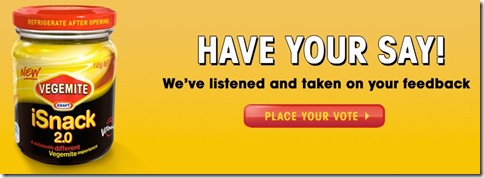
In the end, though, I tend to agree that the iSnack 2.0 reaction was far from a PR disaster – whether planned from the beginning, or a clever reaction to overwhelming customer sentiment, in going back to their consumers and letting them vote once again (albeit from six safe and crappy names) Kraft both reminded most Australians how much they care about Vegemite and got more publicity for a new product than you could possibly generate with a traditional advertising campaign. (And despite the cynicism, yes, I’ve voted.)
By contrast, the recent #nestlefamily controversy erupted when Nestle attempted to court influential ‘mummybloggers’ in the US by inviting 20 or so of them to a paid retreat where Nestle could show off their latest products and get authentic mummyblogger feedback. However, Nestle seemed to give no thought at all to what openly courting social media attention might actually mean. On hearing about the planned event, and noting that some of the attendees were people she respected, PhD in Parenting wrote a long post entitled ‘An open letter to the attendees of the Nestle Family blogger event’ which reminded a lot of people about the many issues with Nestle as a company, including their long history of unethical behaviour, especially in relation to infant products, most notably, of course, being pushing infant formula in Africa. Needless to say, before the event even started, a massive debate began on Twitter between supporters and detractors of Nestle; the oddest thing, though, was the deafening silence from Nestle. For most of the debate, they remained silent and let people rage on blogs and Twitter. In leaving others to defend Nestle, some of the most angry defenders have clearly done more harm than good. I don’t have time to go too far into the details, but I recommend reading the summary by Crunchy Domestic Goddess which gives an even-handed overview of the guts of the debate in terms of the way social media has been used.
Then, in a last ditch effort, Nestle have officially joined Twitter to try and manage the #nestlefamily debates, but they still don’t understand that this is a conversation, not a PR engine. At the end of the day, this tweet seems to sum up perfectly why Nestle just don’t get social media:
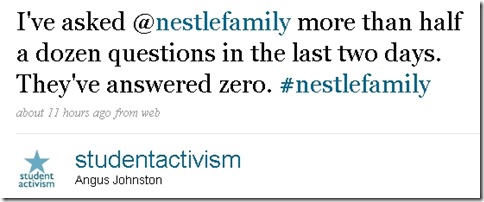
Of course, now that questions are being asked loudly, if Nestle doesn’t answer them, others will.
The difference between Nestle and Kraft is simple: at the end of the day, Kraft listened and that was their salvation. Nestle could learn from their corporate cousin.
Digital Culture Links: October 1st 2009
Links for September 28th 2009 through October 1st 2009:
- Google Wave Overview [YouTube] – A nice and short (8 minute) explanation of Google Wave: it’s a hosted conversation, encouraging collaboration!
- MPs warned to avoid hasty blogs [BBC NEWS | UK | UK Politics] – The next generation of [UK] Labour MPs have been warned to be careful about what they write on blogs and websites like Twitter, Facebook and YouTube – as comments made in haste remain on the internet forever. At a packed fringe meeting hosted by Google at the Labour conference, activists, prospective and current MPs were told of the benefits of social networking sites – where politicians can get their message out without civil servants and special advisers getting in the way. Labour’s newly crowned “Twitter tsar”, MP Kerry McCarthy, made a bid to win over the sceptics by saying it did not have to be a burden […] But in a word of warning Adewale Oshineye, a Google engineer, advised prospective MPs to bear in mind they were publishing something that could be dug out years later. “When you are saying something amusing as a prospective parliamentary candidate, in four or five years’ time when you are a cabinet minister and someone digs that up…–
- Online advertising ‘overtakes TV’ [BBC NEWS | Business] – “Online advertising spending in the UK has overtaken television expenditure for the first time, a report has said. Outlay grew 4.6% to £1.752bn between January and July, according to the study by the Internet Advertising Bureau and PricewaterhouseCoopers. The recession saw overall advertising slide by 16% in the period, according to the study. E-mail campaigns, classified adverts, display ads and search marketing are all classed as online advertising. The body representing UK commercial television broadcasters said that the comparison was unfair.” (Unfair … or harder to pitch against?)
- Aussies call an end to just phoning on mobiles [The Age] – “Using mobiles for just calls and texting is a thing of the past, as a third of Australians now check emails on their handsets and more than 70 per cent access mobile entertainment and information services. In spite of the global financial crisis, the use of mobile phone services has continued to grow in the past year as more Australians buy internet-enabled smartphones, the 2009 Australian Mobile Phone Lifestyle Index reveals. Released today by the Australian Interactive Media Industry Association, the exhaustive survey of 3710 respondents found 36% used email on their mobiles in the past 12 months, and, of those, almost half used email daily – a growth rate of 80 per cent over the previous year. In last year’s survey, just 7 per cent of respondents accessed social networking sites from their handsets, but this figure has jumped this year to 32 per cent, with half of those accessing the sites daily.”
- Sarah Brown becomes Britain’s highest-profile Twitter user [Politics | guardian.co.uk] – “Sarah Brown [wife of UK PM] has overtaken Stephen Fry as Britain’s highest profile Twitter user, it emerged today. “SarahBrown10” has gained more than 775,000 followers since joining the social networking service in March, outstripping Fry’s 768,000. The number of fans keeping up with Brown’s tweets amounts to almost five times the entire Labour party membership. The prime minister’s wife steers clear of political controversy in her messages, instead giving followers glimpses into her day-to-day life and publicising her favourite charities. … Since joining Twitter, Brown has sent out 1,162 messages, each limited to 140 characters. Ross Furlong, an online public relations expert, said Brown’s tweets could help Labour despite the fact that she does not use them for campaigning purposes. “Although the content is deliberately not party political, she is effectively pressing voter flesh online, as she did in person at the Glenrothes byelection to great effect,” Furlong said .”
Digital Culture Links: September 21st 2009
Links for September 18th 2009 through September 21st 2009:
- RIP Facebook Beacon [Mashable] – “Facebook launched its ad platform “Beacon” in Nov 2007, hoping to revolutionize advertising by posting updates to your Facebook profile when you interacted with its partner sites. This week Facebook said that it has settled a class-action lawsuit against the product, agreed to shut it down completely, and will establish a $9.5 million “settlement fund” to fund initiatives related to online privacy. … Facebook Beacon was a system that posted your activity on third-party websites – Blockbuster, Gamefly, Overstock.com and more – back to your Facebook profile. Privacy advocates rallied against it, however, arguing that data was being sent without the users’ explicit permission. The situation worsened after a report claimed that Beacon was collecting data from partner sites regardless of whether users were Facebook members …” (Beacon remains one of those most teachable examples of Facebook’s privacy woes, but I’m delighted with the idea of money being spent privacy initiatives.)
- Nigeria ‘offended’ by sci-fi film [BBC NEWS | Africa] – “Nigeria’s government is asking cinemas to stop showing a science fiction film, District Nine, that it says denigrates the country’s image. Information Minister Dora Akunyili told the BBC’s Network Africa programme that she had asked the makers of the film, Sony, for an apology. She says the film portrays Nigerians as cannibals, criminals and prostitutes. An actor from the film said that it was not just Nigerians who were portrayed as villains. … But Mr Khumbanyiwa said Nigerians in the cast did not seem worried by the portrayal of their country. He suggested that the film, which depicts people wanting to eat aliens to gain the superhuman powers, should not be taken too literally. “It’s a story, you know,” he said. “It’s not like Nigerians do eat aliens. Aliens don’t even exist in the first place.– (Well said, Mr Khumbanyiwa, well said.)
- Welcome to the (anonymous) rabbit hole [Unleashed] – Mark Pesce’s playful take on the largely unsuccessful attempts by Anonymous to take down the ACMA and Australian Prime Minster’s websites on 09/09/09/
- VICTORY: FCC to Mandate Net Neutrality for the Web [Mashable] – “The Federal Communications Commission has been in the middle of it, as it has outlined loose net neutrality guidelines in the past. But according to The Wall Street Journal, the FCC is about to propose definitive rules that could have major repercussions for the entire web. The new rules, expected to be announced Monday by Julius Genachowski, the FCC Chairman, will outline requirements for ISPs to treat all traffic on the Internet equally. This means that Comcast can’t decide that Google gets less bandwidth and Microsoft/Bing (Bing) gets more for any reason (i.e. one pays for preferential treatment). It’s also expected that the net neutrality rules will apply to wireless services, meaning they would be in effect for Internet data via your phone and 3G networks. The impact of this cannot be understated, especially as iPhones and other smart phones make the mobile web a major part of our lives.” (Excellent!)
- Google slams Murdoch plan to charge for online news [The Age] – “Publishers of general news would find it hard to charge for their content online because too much free content is available, the chief executive of Google said. Speaking to a group of British broadcasting executives via video link, Eric Schmidt said he could, however, imagine niche providers of content such as business news succeeding in this area. Schmidt was responding to an announcement by News Corp CEO Rupert Murdoch that he could start charging for content online. “In general these models have not worked for general public consumption because there are enough free sources that the marginal value of paying is not justified based on the incremental value of quantity,” he said. “So my guess is for niche and specialist markets … it will be possible to do it but I think it is unlikely that you will be able to do it for all news.–
- Meme Analysis: Kanye Interrupts, the Internet (and Obama) Listens [NewTeeVee] – Everything you ever wanted to know about the Kayne West interrrupts Taylor Swift meme …

Tama Leaver dot Net by Tama Leaver is licensed under a Creative Commons Attribution-NonCommercial-ShareAlike 4.0 International License.