Home » australia (Page 30)
Category Archives: australia
Annotated Links of Interest: November 9th 2008
Links of interest for November 7th 2008 through November 9th 2008:
- Huffington: ‘Obama Not Elected Without Internet’ [InternetNews Realtime IT News] – “Obama campaign-related videos garnered 14.5 million hours of viewing on YouTube, according to Democratic political consultant Joe Trippi. He estimates that amount of time would have cost $47 million to buy on TV … “And to buy that time, you’re interrupting people watching football games and soap operas,” said Trippi. On the Web, “this is stuff people wanted to watch.” Just as the power of television, via televised debates, was credited with helping John Kennedy win the presidency over Richard Nixon in 1960, the panelists agreed with moderator John Heilemann that in 2008 the Web had at least as significant a role.”
- PLATFORM: Journal of Media and Communication – “Welcome to PLATFORM: Journal of Media and Communication, a biannual open-access online postgraduate publication. Founded by the Media and Communications Program, School of Culture and Communication, University of Melbourne, PLATFORM has just been launched in November 2008. This new postgraduate journal, PLATFORM, is refereed by an international board of established and emerging scholars working across diverse paradigms in Media and Communication. It is planned to develop it as an international journal.”
- Gwen and baby Zuma [Gwen Stefani : News] – I really hadn’t imagined Gwen Stefani to be a champion of copyright reform and the Creative Commons, but the termsunder which she released the first picture of herself and her baby are positively forward-thinking: “[(c) Mrs. Me, Inc., 2008.] This photo is licensed under aCreative Commons BY-NC-ND license. In addition to the permissions granted to the public under this license, this photograph may also be used in its original and unaltered form for commercial purposes by publishers in connection with the distribution of news or human interest stories, such as magazines, blogs, and newspapers. All other rights, including without limitation use of this photo in whole or in part or in connection with commercial posters, calendars, and other commercial products and services, are reserved exclusively by the copyright holder.” (The Obama campaign have been posting CC licensed photos since 2007, too!)
- Google Street View turned into artwork [The Age] – “Two American artists have made swooning for Google’s all-seeing eye an art form, creating what they term the first artistic intervention in Google Street View. After witnessing the immense online interest in quirky sightings on Google Maps, Robin Hewlett and Ben Kinsley approached Google with the idea of creating a series of staged tableaux along a street in Pittsburgh. The scenes, which were shot on May 3 this year and feature Pittsburgh’s Northside residents hamming it up along a nondescript lane called Sampsonia Way, went live on Google Maps this week.” Check out the result: http://www.streetwithaview.com/
Australia’s Twitterati SAY NO to Internet Censorship
As part of a protest against the proposed Australian Internet censorship filter, many Australia Twitter users have changed their avatars to pictures with their mouths gagged or crossed out. Rene Lemerle has created this very Australian collage collating many of these protest avatars:
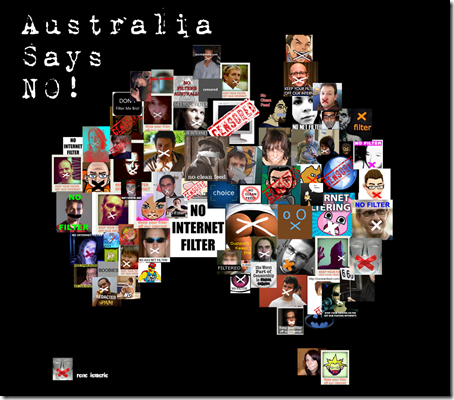
Can you spot me in there? 🙂 Make sure you’re doing your bit to stop the insanity of the “clean feed“!
Annotated Links of Interest: October 29th 2008
Links of interest for October 29th 2008:
- New chapter for Google Book Search [Official Google Blog] – Google Book Search settles the lawsuit, makes a whole lot of things more accessible (especially if you’re a library or a university) and generally makes books searchable! 🙂 (Read Siva Vaidhyanathan’s excellent summary and initial reponse to the settlement.)
- Warfare game throws down gauntlet to Iran [The Age] – “A Sydney-based Jewish businessman bankrolling a shoot-’em-up warfare game pitting Israeli troops against Iranians says the aim is to “throw out a challenge to Iran” after its President vowed to wipe Israel off the map.
But Kevin Bermeister, world renowned for being sued by the music industry in a multimillion-dollar lawsuit over the Kazaa file-sharing program, said his intention was also to take the war between Jews and Muslims out of the real world and into cyber space. The online multiplayer game, Rising Eagle – Gaza, was officially released as a free download less than a week ago. It earns revenue through advertising billboards peppered throughout the game environment. The game, which contrary to its setting does not include any Palestinian fighters, is an update to earlier versions of the game set in Paris and China. It pits the Iranian Revolutionary Guard against Israel’s elite Golani Brigade in a first-person shooter setting.” - A history lesson in video games [BBC NEWS | Technology] – “The UK’s first official national video game archive has been launched in a bid to preserve the history of gaming. The archive has been set up in partnership between Nottingham Trent University and the National Media Museum in Bradford in the north of England. The gaming industry is now worth an estimated £22bn globally and steps are needed in order to record its development. The archive will be housed at the National Media Museum in Bradford and will include consoles, cartridges and advertising campaigns. “We are going to be archiving video games but it’s not just about the games themselves, it’s also about gaming culture,” said James Newman, from Nottingham Trent University’s Centre for Contemporary Play, a research group dedicated to video games.”
- Editor furious over Bishop plagiarism explanation [ABC News (Australian Broadcasting Corporation)] – “A plagiarism row between deputy Liberal leader Julie Bishop and the editor of a book on the party, Peter Van Onselen, has flared again. Ms Bishop’s chief of staff has taken responsibility for plagiarising a speech by a New Zealand businessman when he wrote a chapter for the book, called Liberals and Power; The Road Ahead, on Ms Bishop’s behalf. Now Mr Van Onselen says he is angry with Ms Bishop for saying that the footnote crediting the businessman was forgotten. “It’s not just a matter of them having forgotten to send through footnotes,” he said.
“Even once they belatedly sent those footnotes through they didn’t cover the plagiarism. “Footnoting doesn’t cover the fact that there weren’t quotation marks around exact lifting of words without attribution that came from this New Zealand businessman’s speech.– (It seems no one’s buying the Bishop defense!)
Interactive Australia 2009 Report
 The Interactive Entertainment Association of Australia have released their third annual survey of the state of videogames and videogamers in Australia, Interactive Australia 2009. From the key findings (PDF):
“¢ 88% of homes have a device for playing computer or video games.
“¢ 68% of Australians play computer or video games.
“¢ 46% of gamers are female.
“¢ The average age of an Australian gamer is 30 years.
“¢ 84% of Australians aged 16-25 compared with those 50+ play computer and video games.
“¢ The average adult gamer has been playing for 11 years.
“¢ Half of all gamers play daily or every other day, a quarter play once a week.
“¢ The average game play session is one hour.
So, in line with international trends, the majority of Australians play videogames, there is close to a gender balance, and far from being exclusively for children, the average age for a videogame player is well into legal adulthood at 30 years old. Moreover, most adults see videogame play as something that should be supervised:
“¢ 70% of parents in game households play computer and video games, 80% of these parents play them with their children.
“¢ 78% of parents say an adult is present when games are purchased for their children,
“¢ 92% of parents say they are aware of the games played in their homes.
“¢ 75% of all computer and video games classified in Australia are G or PG (Classification Board).
Also not necessarily surprising is that most adults in Australia presume that there is an R18+ rating for videogames (there isn’t):
“¢ 63% of adults do not know that Australia has no R18+ for computer and video games.
“¢ 91% of adults (including gamers and non-gamers) say Australia should have an R18+ classification for games.
“¢ 17% of adults in game households admit to having pirated games in their collections with nearly 10% of all games in Australian homes being illegal copies.
If that 91% figure isn’t clear evidence that the ratings system for videogames in Australia desperately needs and overhaul to, at the very least, include and R18+ videogame category, I don’t know what is! More to the point, if that last figure about game piracy isn’t directly related to the censored, or entirely banned, videogames intended for adults being downloaded in their original form, then I’ll eat my digital hat!
The final finding that stood out for me was:
“¢ 75% of gamers say interactivity in games makes them more educational than other media, 89% of non-gamers say interactivity makes games more violent than other media.
Despite there being no conclusive evidence as to what impact the interactivity of games ‘really’ has, it’s noteworthy that most players presume games can be both educational and can cause more violent thoughts than other media (presumably viewed as more passive). You can view the full Interactive Australia 2009 report online as a PDF.
Annotated Links of Interest: October 28th 2008
Links of interest for October 28th 2008:
- Putting Privacy Settings in the Context of Use (in Facebook and elsewhere) [apophenia] – danah boyd’s sensible and timely reminder about Facebook’s ridiculously complicated and confusing privacy settings: “Facebook’s privacy settings are the most flexible and the most confusing privacy settings in the industry. Over and over again, I interview teens (and adults) who think that they’ve set their privacy settings to do one thing and are shocked (and sometimes horrified) to learn that their privacy settings do something else. Furthermore, because of things like tagged photos, people are often unaware of the visibility of content that they did not directly contribute. People continue to get themselves into trouble because they lack the control that they think they have.” [Via Jill] (These, incidentally, are among the reasons why you won’t see any pictures of my son on Facebook! Flickr, where I retain copyright and can actually use meaningful privacy settings, is far preferable!)
- Google considers local centre [Australian IT] – “Google has quietly dispatched a team of experts from the US on a fact-finding mission to decide whether it should establish a data centre in Australia. In the past few weeks the team of about five Google US employees had been involved in high-level discussions with local data centre providers, sources said. The meetings are believed to have been led by Simon Tusha, who labels himself as “Google’s duke of data centres”. A Google-run data centre would be positive for the company’s operations in Australia as it sought to increase its penetration of the large education sector.”
- Microsoft to battle in the clouds [BBC NEWS | Technology] – “Microsoft has unveiled a cloud computing service, in which data and applications will not be stored on individuals’ computers. The new platform, dubbed Windows Azure, was announced at Microsoft’s Professional Developers Conference in Los Angeles. The platform was described by Microsoft’s chief software architect Ray Ozzie as “Windows for the cloud”. … The move sees Microsoft taking on established players like Google and Amazon in the rapidly growing business of online software. The aim is to allow developers to build new applications which will live on the internet, rather than on their own computers.” [Check out Windows Azure; but Dave Winer’s not impressed.]
Annotated Links of Interest: October 27th 2008
Links of interest for October 27th 2008:
- Telecommunications Today Report 6: Internet Activity and Content [ACMA, 22 October 2008] – A detailed look at Internet use in Australia (September 2008): “Age is a determining factor in the activities consumers choose to perform online. Email is the most common application across all age groups. Streaming videos and banking online feature in the top five activities of all age groups, and participating in auctions features in the top 10. Internet users aged between 16 and 24 years are the most likely group to use the internet for entertainment, while those aged between 25 and 34 also recorded a high level of use of social and entertainment applications. A high proportion of users over the age of 45 use the internet to submit forms or information to government websites; this activity is recorded in the top 10 of all three age group segment …” [View the full PDF.]
- Net filters may block porn and gambling sites [The Age] – “Family First Senator Steve Fielding wants hardcore pornography and fetish material blocked under the Government’s plans to filter the internet, sparking renewed fears the censorship could be expanded well beyond “illegal material”. The Opposition said it would most likely block any attempts to introduce the controversial mandatory ISP filtering policy, so the Government would need the support of Senator Fielding as well as the Greens and Senator Nick Xenophon to pass the legislation. Industry sources said Senator Fielding’s sentiments validated ISPs’ concerns that the categories of blocked content could be broadened significantly at the whim of the Government, which is under pressure to appease vocal minorities.”
- Bishop apologises after second plagiarism incident [ABC News (Australian Broadcasting Corporation)] – “Deputy Opposition Leader [and former education minister!!] Julie Bishop has been forced to apologise after being embroiled in a second plagiarism row. A spokeswoman for Ms Bishop says the Opposition treasury spokeswoman submitted a chapter for a book about the future of the Liberal Party, that was actually written by her chief of staff, Murray Hansen. In the essay, Mr Hansen used material contained in a speech made by New Zealand businessman Roger Kerr several years ago. Mr Hansen says he forgot to provide footnotes to the publisher.” (I wonder how many of our students will be ‘forgetting to include the footnotes’ and calling it the Bishop defense, this semester? *sigh*)

Tama Leaver dot Net by Tama Leaver is licensed under a Creative Commons Attribution-NonCommercial-ShareAlike 4.0 International License.