Home » privacy (Page 3)
Category Archives: privacy
Visualising Locative Media with Foursquare’s Time Machine
I’m currently working on a chapter for the forthcoming Locative Media edited collection; the piece I’m co-writing with Clare Lloyd examines some of the pedagogical strategies that have arisen to better inform users about the data that they generate whilst using locative media in various forms (from explicit check-ins with Foursquare to less obvious locative metadata on photographs, tweets and so forth). We’ve been looking at several tools and services like PleaseRobMe.com, I Can Stalk U and Creepy which visualise the often hidden layer locative media layers of mobile devices and services.
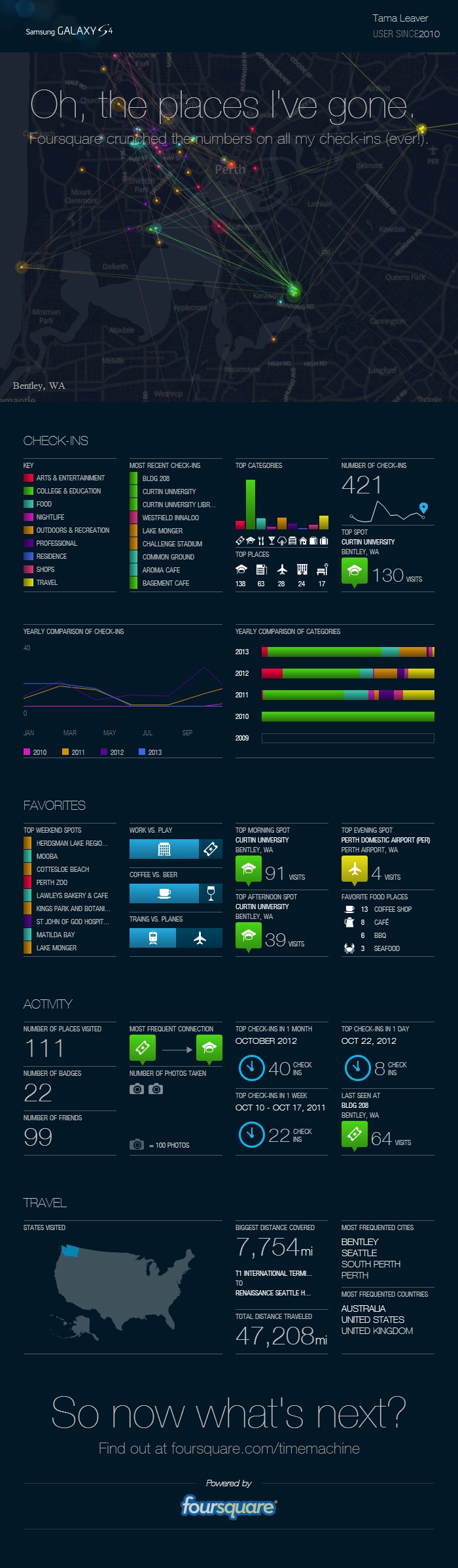
Given this context, I was fascinated to see Foursquare’s release of their ‘Time Machine’ (deployed as a promotion for Samsung’s S4) which creates an animation and eventual infographic visualising the a user’s entire Foursquare check-in history. Since I’m very conscious of where I do and don’t use Foursquare, I was fascinated to see what sort of picture of my movements this builds. The grouping of check-ins in Perth (where I live) and the places I’ve travelled to for conferences (which is the main time I use Foursquare) was very smooth, and made my own digitised journey through the world look like a personalised network diagram. The eventual infographic produced is fairly banal, but does crunch your own Foursquare numbers. I’ve embedded mine below.
While Foursquare users are probably amongst the most aware locative media users and generators of locative data, it’s still fascinating to see what a rich and robust picture these individual points of data look like when aggregated. In line with the writing I’m doing, I can’t help wonder how people would respond to a similar sort of visualisation based on their smartphone photos or Facebook posts or some other service which is less explicit or transparent in the way locative metadata is produced and stored.
Digital Culture Links: May 21st
Links through to May 21st:
- Sensis Yellow Social Media Report 2013 [PDF] – The new Sensis Yellow Social Media Report is out (based on a survey of 937 Australians in March and April 2013), showing widespread social media use, with growth in mobile and second screen uses:
* 95% of AUstralian social media users use Facebook
* The typical Australian spends 7 hrs/wk on Facebook
* 67% of Australians access social sites on a smartphone
* 42% of Australians use social media while watching TV - A better, brighter Flickr [Flickr Blog] – Yahoo have majorly redesigned Flickr, giving new free (ad-supported) accounts 1Tb of storage, which is an awful lot of photos. The Android app is now almost identitcal to the iOS app, but the new aesthetics of the web-based version are a big change, looking more and more like every other photo-sharing service around today. Quite a few long-term Flickr users (of which I am one) have voiced a range of concerns about the design changes. Also, what this redesign means for people who’ve already paid for Pro accounts is deeply unclear on the main Flickr pages. (The Twitter account seems to suggest nothing changes.)
- Yahoo! to Acquire Tumblr / Yahoo [Yahoo News Centre] – Yahoo buys Tumblr for $1.1 billion and, in their words, “promises not to screw it up”. A clever buy for Yahoo, but it’ll be hard to integrate the rebellious/youth Tumblr userbase into the Yahoo brand.
- Introducing Photos of You [Instagram Blog] – Just in case you momentarily forgot that Facebook owns Instagram, the photo-sharing service has just added the ability to tag photos (remarkably similar to Facebook’s tagging function). Looks like Instagram needs a better map of your personal networks before they can harness it commercially.
- Follow the audience… [YouTube Blog] – May 2013 and YouTube users “are watching more than 6 billion hours of video each month on YouTube; almost an hour a month for every person on Earth and 50 percent more this year than last.”
The Social Media Contradiction: Data Mining and Digital Death
I’ve got a new article in the most recent issue of the M/C Journal entitled ‘The Social Media Contradiction: Data Mining and Digital Death’. Here’s the abstract:
Many social media tools and services are free to use. This fact often leads users to the mistaken presumption that the associated data generated whilst utilising these tools and services is without value. Users often focus on the social and presumed ephemeral nature of communication – imagining something that happens but then has no further record or value, akin to a telephone call – while corporations behind these tools tend to focus on the media side, the lasting value of these traces which can be combined, mined and analysed for new insight and revenue generation. This paper seeks to explore this social media contradiction in two ways. Firstly, a cursory examination of Google and Facebook will demonstrate how data mining and analysis are core practices for these corporate giants, central to their functioning, development and expansion. Yet the public rhetoric of these companies is not about the exchange of personal information for services, but rather the more utopian notions of organising the world’s information, or bringing everyone together through sharing.
The second section of this paper examines some of the core ramifications of death in terms of social media, asking what happens when a user suddenly exists only as recorded media fragments, at least in digital terms. Death, at first glance, renders users (or post-users) without agency or, implicitly, value to companies which data-mine ongoing social practices. Yet the emergence of digital legacy management highlights the value of the data generated using social media, a value which persists even after death. The question of a digital estate thus illustrates the cumulative value of social media as media, even on an individual level. The ways Facebook and Google approach digital death are examined, demonstrating policies which enshrine the agency and rights of living users, but become far less coherent posthumously. Finally, along with digital legacy management, I will examine the potential for posthumous digital legacies which may, in some macabre ways, actually reanimate some aspects of a deceased user’s presence, such as the Lives On service which touts the slogan “when your heart stops beating, you’ll keep tweeting”. Cumulatively, mapping digital legacy management by large online corporations, and the affordances of more focussed services dealing with digital death, illustrates the value of data generated by social media users, and the continued importance of the data even beyond the grave.
Read the rest at the M/C Journal (open access).
Incidentally, yes, one of the points in this article is already out of date as last month Google quietly launched their Inactive Account Manager. While far from perfect, this Inactive Account manager gives Google users more control over what happens to their Google stored assets after they pass away (well, actually, after they don’t log in for a specified period of time). It is, however, far from perfect.
Digital Culture Links: April 25th
Links through to April 22nd (catching up!):
- Siri secrets stored for up to 2 years [WA Today] – “Siri isn’t just a pretty voice with the answers. It’s also been recording and keeping all the questions users ask. Exactly what the voice assistant does with the data isn’t clear, but Apple confirmed that it keeps users’ questions for up to two years. Siri, which needs to be connected to the internet to function, sends all of its users’ queries to Apple. Apple revealed the information after
Wired posted an article raising the question and highlighting the fact that the privacy statement for Siri wasn’t very clear about how long that information is kept or what would be done with it.” - Now playing: Twitter #music [Twitter Blog] – Not content to be TV’s second screen, Twitter wants to be the locus of conversations about music, too: “Today, we’re releasing Twitter #music, a new service that will change the way people find music, based on Twitter. It uses Twitter activity, including Tweets and engagement, to detect and surface the most popular tracks and emerging artists. It also brings artists’ music-related Twitter activity front and center: go to their profiles to see which music artists they follow and listen to songs by those artists. And, of course, you can tweet songs right from the app. The songs on Twitter #music currently come from three sources: iTunes, Spotify or Rdio. By default, you will hear previews from iTunes when exploring music in the app. Subscribers to Rdio and Spotify can log in to their accounts to enjoy full tracks that are available in those respective catalogs.
- Android To Reach 1 Billion This Year | Google, Eric Schmidt, Mobiles [The Age] – “Google executive chairman Eric Schmidt predicts there will be more than 1 billion Android smartphones in use by the end of the year.”
- Soda Fountains, Speeding, and Password Sharing [The Chutry Experiment] – Fascinating post about the phenomenon of Netflix and HBO Go password sharing in the US. When a NY Times journalist admitted to this (seemingly mainstream) practice, it provoked a wide-ranging discussion about the ethics and legality of many people pooling resources to buy a single account. Is this theft? Is it illegal (apparently so)? And, of course, Game of Thrones take a centre seat!
- “Welcome to the New Prohibition” [Andy Baio on Vimeo] – Insightful talk from Andy Baio about the devolution of copyright into an enforcement tool and revenue extraction device rather than protecting or further the production of artistic material in any meaningful way. For background to this video see Baio’s posts “No Copyright Intended” and “Kind of Screwed”.
- Instagram Today: 100 Million People [Instagram Blog] – Instagram crosses the 100 million (monthly) user mark.
RIOT gear: your online trail just got way more visible
By Tama Leaver, Curtin University
The recent publication of a leaked video demonstrating American security firm Raytheon’s social media mining tool RIOT (Rapid Information Overlay Technology) has rightly incensed individuals and online privacy groups.
In a nutshell, RIOT – already shared with US government and industry as part of a joint research and development effort in 2010 – uses social media traces to profile people’s activities, map their contacts, and predict their future activities.
Yet the most surprising thing isn’t how RIOT works, but that the information it mines is what we’ve each already shared publicly.
Getting to know you
In the above video, RIOT analyses social media accounts – specifically Facebook, Twitter, Gowalla and Foursquare – and profiles an individual.
In just a few seconds, RIOT manages to extract photographs as well are the times and exact location of frequently visited places. This information is then sorted and graphed, making it relatively easy to predict likely times and locations of future activity.
RIOT can also map an individual’s network of personal and professional connections. In the demonstration video, a Raytheon employee is surveyed, and the software shows who his friends are, where he’s been and, most ominously, predicts that the most likely time and place to find him is at a specific gym at 6am on a Monday morning.
Privacy concerns
The RIOT software quite rightly raises concerns about the way online information is being treated.
Since privacy rules and regulations around social media are still in their infancy, it’s hard to tell if any legal boundaries have been crossed. This is especially unclear since it appears, from the video at least, that RIOT only scrutinises information already publicly visible on the web.

The usefulness of some social media tools for mapping a person’s activity are abundantly clear. Foursquare, for example, basically produces a database of the times and places someone elects to “check-in” to specific locations.
Checking-in allows other Foursquare users to interact with that individual, but the record is basically a map of someone’s activities. Foursquare can be a great service, allowing social networking, discounts from businesses, and various location-based activities, but it also leaves a huge data trail.
Foursquare, though, has a (relatively) small user base (around 30 million) compared to Facebook (more than one billion) – although Facebook, as we know, also allows users to check-in by specifying a location in updates and posts. But the richest source of information we tend to share publicly, but not even think about, is our photographs.
Picture this
Every modern smartphone, whether an iPhone, Windows or Android device, by default saves certain information every time you take a photograph. This information about the photograph is saved using something called the Exchangeable image file format, or “exif” data.
Exif data typically includes camera settings, such as how long the camera lens was open and whether the flash fired, but on smartphones also includes the exact geographic location (latitude and longitude) and time that each photograph is taken.
Thus, all of those photographs of celebrations, birthdays, and our kids at the beach all include a digital record of where and when each and every event occurred.

Given that so many of us share photographs online using Facebook or Twitter or Instagram or Flickr, it’s not surprising that RIOT might be able to build a picture of where we’ve been and use that to guess where we might be in the future.
Yet we don’t have to leave this trail. Most smartphones have the ability to turn geographic location information off so that it’s not recorded when we take photographs.
Most of us never think to turn these options off because we don’t think about our social media persisting, but it does. Our social media fragments – our photos and posts – have no expiry date so it’s worth taking a moment when we set up a new phone or account and tweak the settings to only share what you really want to share.
If RIOT demonstrates anything, it’s the fact that information shared publicly online will likely be read, shared, copied, stored and analysed in ways we didn’t immediately think about.
If we take the time to adjust our privacy settings and sharing options, we can exercise some control over the sort of profile RIOT, or any future tool, might build about us.
Tama Leaver receives funding from the Australian Research Council.

This article was originally published at The Conversation. Read the original article.

Tama Leaver dot Net by Tama Leaver is licensed under a Creative Commons Attribution-NonCommercial-ShareAlike 4.0 International License.