Home » privacy (Page 8)
Category Archives: privacy
Digital Culture Links: July 12th 2011
Links for July 5th 2011 through July 12th 2011:
- China’s first ‘virtual property’ insurance launched for online gaming sector [Global Times] – “A Chinese insurance company has unveiled a new type of “virtual property” insurance that might be the first of its kind in the world. The new service, tailored for online game players, was jointly launched by Sunshine Insurance Group Corporation and online game operator and manufacturer Gamebar. The two companies agreed to create the virtual property insurance amid an increasing number of disputes between online game operators and their customers, often related to the loss or theft of players’ “virtual property” such as “land” and “currency.” Over 300 million people engage in online gaming in China, and these players sometimes become involved in arguments with game operators due to the loss of property.” [Via]
- First lesson of viral video: No monkey business [Online Video News] – “Apes with assault rifles are just a bad idea: That’s the lesson 20th Century Fox wanted to convey with a viral video it published on YouTube last week. The video shows a group of soldiers from an unidentified African country having some fun with a chimpanzee. Then one of the soldiers hands the ape an AK-47, and the animal takes aim at the soldiers. The clip is a viral video ad for the upcoming Rise of the Planet of the Apes movie, complete with a semi-authentic and amateurish look and some subtle branding that identifies it as content of the “20th Century Fox Research Library.” And so far it has been a success, if you only measure view counts: The video has attracted more than 4.5 million views since being published last Wednesday. But a look at the YouTube comment section tells a different story: A substantial number of commenters take the opportunity to drop the n-word, compare black people to monkeys or publish other kinds of racial slurs.”
- Fifty Million [Matt Mullenweg] – On July 11, 2001, Worpress “passed over 50,000,000 websites, blogs, portfolios, stores, pet projects, and of course cat websites powered by WordPress.” That’s a lot! 🙂
- Smartphone Adoption and Usage – 11 July 2011 [Pew Research Center’s Internet & American Life Project] – “In its first standalone measure of smartphone ownership, the Pew Internet Project finds that one third of American adults – 35% – own smartphones. The Project’s May survey found that 83% of US adults have a cell phone of some kind, and that 42% of them own a smartphone. That translates into 35% of all adults. […] Some 87% of smartphone owners access the internet or email on their handheld, including two-thirds (68%) who do so on a typical day. When asked what device they normally use to access the internet, 25% of smartphone owners say that they mostly go online using their phone, rather than with a computer.” [Full Report PDF]
- Apple App Store: 15 Billion Downloads & Counting [Mashable] – “Apple’s App Store has generated 15 billion downloads since its launch in July 2008, Apple has announced. The App Store now offers more than 425,000 apps, 100,000 of which are created specifically for Apple’s tablet, the iPad. Apple has paid developers more than $2.5 billion to date. Given Apple’s 30/70 revenue split with app developers, that means Apple itself has netted more than $1 billion directly from app sales. In January 2010, the App Store surpassed 3 billion downloads, and in January 2011, Apple announced that the App Store surpassed 10 billion downloads. It took Apple’s App Store only six months to jump from 10 billion to 15 billion downloads.”
- Zynga Launches PrivacyVille, a Gamified Version of Its Privacy Policies [Inside Social Games] – Gamification of Zynga’s privacy policy! “As Zynga edges closer to its initial public offering, the social game developer seems concerned with educating the masses both on social game revenue models and on the actual fine print of social game privacy policies. Today, the company announces PrivacyVille, an interactive walkthrough of its privacy policies that rewards participants with zPoints to spend in gift network RewardVille. The experience can be clicked through in about two minutes, with each structure on the CityVille-like map representing a different component of Zynga’s privacy policy. The tutorial text seems to stress to readers that Zynga will collect players’ information from Facebook and from mobile devices and share it with third-party service providers, the legal system in the case of a court ordered disclosure, and with other players in cases where a player’s icon displays a link back to their Facebook account.”
- Natalie Tran: Down Under’s Top YouTuber Considers Her Next Move [Forbes] – Quick profile of Natalie Tran, the person behind Australia’s most subscribed to YouTube channel (communitychannel): “Around the world, young adults like Natalie Tran are facing a key moment in their lives: they’ve been graduated from university and are examining the success and failures of their academic years to decide which direction to take their careers. It’s just that most of those students have not built an international fan-base at this point. Tran, 23, has. The Sydney, Australia resident recently received her Digital Media degree from the University of New South Wales. I hope she got at least one high mark for this fact: Tran is Australia’s most-subscribed-to YouTuber. Over the past five years, her “communitychannel” has amassed nearly 1 million subscribers and her videos have garnered nearly 400 million upload views. Reasons: Smart, funny, quirky, beautiful. Why complicate matters?”
- Google Realtime goes dark after Twitter agreement expires [VentureBeat] – “Google has taken its powerful Realtime search product offline after a 2009 agreement to display up-to-the-minute Twitter results expired. The shutdown of Realtime comes just as Google is in the process of rolling out Google+, its new social networking initiative that competes with Twitter. Google said it planned to relaunch Realtime search after retooling it and adding in Google+ results. “Since October of 2009, we have had an agreement with Twitter to include their updates in our search results through a special feed, and that agreement expired on July 2,” Google told Search Engine Land. “While we will not have access to this special feed from Twitter, information on Twitter that’s publicly available to our crawlers will still be searchable and discoverable on Google. Our vision is to have google.com/realtime include Google+ information along with other realtime data from a variety of sources.””
Digital Culture Links: June 24th 2011
Links for June 7th 2011 through June 24th 2011:
- Harry Potter and the amazing exploding book industry [GigaOM] – “Despite the obvious demand, Harry Potter author J.K. Rowling has adamantly refused to offer electronic versions of her phenomenally popular series for young adults “” until now. As part of Thursday’s launch of an interactive website called Pottermore, the billionaire writer also announced that e-book versions of the novels will be available directly through the site for all major platforms. In one fell swoop, Rowling has cut both her publishers and booksellers such as Amazon out of the picture. Not everyone has that kind of power, of course, but Rowling’s move shows how the playing field in publishing continues to be disrupted. The author said the Pottermore site will offer extra content that she has written about the characters in the books … There will also be a social network of sorts built into the site that allows readers to connect with each other, play games and share their thoughts about the novels and their characters.”
- Google to be formally investigated over potential abuse of web dominance [guardian.co.uk] – “US regulators are poised to launch a formal investigation into whether Google has abused its dominance on the web, according to reports. The Federal Trade Commission (FTC) is days away from serving subpoenas on the internet giant in what could be the biggest investigation yet of the search company’s business, according to The Wall Street Journal. Both Google and the FTC declined to comment. A wide-ranging investigation into Google has been discussed for months. Google has faced several antitrust probes in recent years, and is already the subject of a similar investigation in Europe. In the US inquiries have so far largely been limited to reviews of the company’s mergers and acquisitions. The inquiry will examine the heart of Google’s search-advertising business, and the source of most of Google’s revenue. Google accounts for around two-thirds of internet searches in the US …”
- Kind of Screwed [Waxy.org] – The really sad story of how Andy Baio ended up paying over $US30,000 for a pixel-art cover on an homage album because a photographer (and his lawyers) don’t believe it’s fair use: “Last year, I was threatened with a lawsuit over the pixel art album cover for Kind of Bloop. Despite my firm belief that I was legally in the right, I settled out of court to cut my losses. This ordeal was very nerve-wracking for me and my family, and I’ve had trouble writing about it publicly until now.”
- The Social Network’s Aaron Sorkin quits Facebook [guardian.co.uk] – “Aaron Sorkin, 50, was speaking at the Cannes Lions International Festival of Creativity at a session alongside David Simon, creator of The Wire and Treme. His admission came as part of a discussion of the downsides of sites such as Twitter. Sorkin described himself as “this side of being a Luddite”, and said he had been on Facebook while he making the film, but had since given up his account. “I have a lot of opinions on social media that make me sound like a grumpy old man sitting on the porch yelling at kids,” he said. Sorkin’s scepticism of social media was shared by the film’s star, Jesse Eisenberg, who joined Facebook under a false name while in production but left soon afterwards, unnerved by the experience. “[I] was sent a message from Facebook suggesting people I should befriend,” Eisenberg said last October. “One of them was a girl my sister was friends with in high school. I don’t know how they found her, no idea. I signed off right then.–
- “Teen Sexting and Its Impact on the Tech Industry” – Provocative talk well worth reading: “Most of you have probably read the panic-laden stories about teens who got caught sexting. You may even have read the salacious stories about teachers who sext with students. And, unless you’ve been on a remote island this month, you’ve probably heard countless jokes about Anthony Weiner’s recent sexting scandal. While most Americans had never heard of the term “sexting” a few years ago, it’s hot news these days. And while you might have read these stories in the press, you might not realize how relevant they are to you. More than any other teen phenomenon, more than Justin Bieber or cute cats, teen sexting is something that you need to deal with. And you need to deal with it ASAP, both because it’s the right thing to do and because you face serious legal liabilities if you don’t. When first coined by Australian press only a few short years ago …” (boyd, danah. 2011 Read Write Web 2WAY conference.New York, NY, June 13)
- Facebook Changes Privacy Settings to Enable Facial Recognition [NYTimes.com] – “Facebook is pushing the privacy line once again, according to a new report from a security and antivirus company. According to the report, from Sophos, Facebook recently began changing its users’ privacy settings to automatically turn on a facial recognition feature that detects a user’s face in an image. Once the person’s face is detected, the Web site then encourages Facebook friends to tag them. Facebook introduced this feature last year for its North American users; it is now rolling it out globally. Facebook also doesn’t give users the option to avoid being tagged in a photo; instead, people who don’t want their name attached to an image must untag themselves after the fact. In response to a reporter’s inquiry, posted on a Facebook blog, the company said, “We should have been more clear with people during the roll-out process when this became available to them.””
- Apple’s new iOS5 features – really that new? [Ausdroid] – A quick comparison of Apple’s new iOS 5 mobile and the current offering from Android. Good points on both sides, but no clear “winner”.
iCloud: Winners & Losers

Today Apple made some big announcements about their desktop operating system OS X Lion and their mobile iOS 5, and most importantly the service which will more intimately bind these two: iCloud. Globally, news services will continue their iFetish and splash reports everywhere, so I’ll leave you to catch the full details elsewhere. However, the iCloud is interesting for all sorts of reasons, not least of all because Apple, Google and Amazon are all dancing around the same territory, so I thought I’d take a minute and consider who (apart from Apple, of course) are the obvious winners and losers in the wake of the iCloud announcements.
The Big Winners:
- The Big Music Companies. Here’s Apple’s description of iMatch service, part of the iCloud:
iTunes determines which songs in your collection are available in the iTunes Store. Any music with a match is automatically added to your iCloud library for you to listen to anytime, on any device. Since there are more than 18 million songs in the iTunes Store, most of your music is probably already in iCloud. All you have to upload is what iTunes can’t match. Which is much faster than starting from scratch. And all the music iTunes matches plays back at 256-Kbps iTunes Plus quality “” even if your original copy was of lower quality.
Those songs that iTunes can’t match may very well be unauthorised downloads, but once you’ve paid $25 to use iTunes in the cloud, you’ve got access to it on any Apple device. And where is that money going? Estimates suggest the bulk is going to the music labels, with Apple keeping their customary 30% (which might just pay for the service, but this item by itself is probably going to be making a loss, especially for people who have huge music libraries). As Mashable note, Apple Has Just Monetized Pirated Content. The music labels are once again getting paid for ‘pirated’ music – a big win for them!
- Twitter: iOS 5 integrates Twitter into almost everything, making Apple the Twitter OS of choice (and implicitly waving goodbye to Apple’s failed music social network, Ping). As the official Twitter blog celebrates: “Building Twitter into iOS 5 truly creates the easiest way to share everything that’s happening in your world. Take a picture, tap “Tweet”. Tweeting has never been simpler.”
- And, of course, “The Cloud”: while the cloud and cloud computing are nebulous terms, Sony’s recent PlayStation Network hacks have really dampened the reputation of web-based storage and services, especially in terms of security. Now that Apple have stuck and ‘i’ in front of the cloud, Steve Jobs’ “it just works” magic will no doubt ensure the cloud stays cool and secure (even their brushed metal iCloud logo emphasises strength and security).
The Big Losers:
- PC manufacturers and Microsoft: iOS 5, and the cloud-based services, will all be available on Apple devices (iPhones, iPads ,touchscreen iPods) without needing to connect to a PC. These devices can now be activated on their own terms, working using cloud services, and for many people may do away with the need for a PC altogether. A big plus for Apple hardware sales, but a really clear slap in the face to standard PC manufacturers. I wonder, though, if this will force PC makers to form more robust alliances with Google (or maybe Amazon) to keep a competitive edge? Perhaps PC manufacturers will suddenly be falling over themselves to create Chromebooks. None of this will help Microsoft, because these conversations don’t involve anyone needing to run Windows anymore!
- Amazon/Google: Apple is almost certainly running iMatch and the iTunes in the cloud services as a loss-leader (ie making little or no profit), using these services to drive hardware sales. Google and Amazon have both been trying to carve out the same cloud-based music sharing (and other services) but don’t have the core hardware sales business to offset the cost of keeping the music labels on side. It’s hard to see how they’ll compete without having to at least match Apple’s costs and security imperatives.
- Point’n’click camera manufacturers: a smaller change in iOS 5, but a big one of you rely on your iPhone for photography, is that you can go straight to the iPhone camera from the locked phone in one click. This makes photography a lot easier, and avoids the clicks through the navigation screens. This does seems a small change, but for many folks the only reason to carry a point’n’click camera and an iPhone was that the camera could get to the point of actually taking a shot faster – it really doesn’t look like that’ll be the case soon.
One to watch: I’m really curious how Apple’s End User License Agreements will shape the iCloud. If users are really going to rely on Apple to make mp3s available via the cloud, regardless of whether there is any evidence of a legal purchase or otherwise, Apple will own an vast and important database of what people actually possess. While the big music labels are implicitly supporting the iCloud and iMatch service for now, what happens if the relationship sours? How will Apple react to lawsuits demanding individually identifiable information, especially, say, for music which is leaked or not legally available in one country or another? Even the date of access would be enough to show unauthorized file-sharing in action and do we really trust Apple to be a custodian of that information? (For those interested in this issue, you should really read Jonathan Zittrain’s The Future of the Internet and How to Stop It.)
Digital Culture Links: April 28th 2011
Links for April 13th 2011 through April 28th 2011:
- Copyright – 25 April 2011 [Rocketboom] – This 5 minute Rocketboom episode focuses on copyright in the US, looks at what Fair Dealing can and can’t do (especially with regarding to sampling) with reference to the Mickey Mouse protection act (Copyright Term Extension) of 1998.
- YouTube founders’ Delicious new venture [The Age] – Delicious lives on, and may yet prosper! “Yahoo! has sold Delicious to YouTube founders Chad Hurley and Steve Chen, who promised to continue and grow the popular social bookmarking site. Financial details of the transaction were not disclosed. Hurley and Chen, who sold YouTube to Google for $US1.65 billion in 2006, said they planned to integrate Delicious with their new San Mateo, California-based internet company AVOS. “We’re excited to work with this fantastic community and take Delicious to the next level,” AVOS chief executive Hurley said in a statement. “We see a tremendous opportunity to simplify the way users save and share content they discover anywhere on the web,” Hurley said. The YouTube co-founders said they would seek to use Delicious to “develop innovative features to help solve the problem of information overload.–
- No Tweets Allowed at the Royal Wedding [Mashable] – “Any 140-character loving guests attending the April 29 wedding of Prince William and Catherine (Kate) Middleton will be sorely disappointed, as signal-blocking technology will be installed at Westminster Abbey to nix cellphone use. According to Yahoo, the idea was suggested by members of the royal family and confirmed by police and security. They hope nixing phones and tweeting will cut down on news photos and videos featuring cellphone-toting guests, distracting ringtones and info about the wedding getting out ahead of the ceremony.”
- YouTube star TomSka ‘makes thousands’ every month [BBC – Newsbeat] – “… 20-year-old student Tom Ridgewell, [is] one of a new generation of YouTube stars making thousands of pounds through the site every month. “I like to think I work in comedy,” he says. “I just try to make funny videos really – ones that make me laugh.” He’s written, produced and directed dozens of short films, sketches and cartoons. But get onto his channel and it’s the numbers that really stand out: 55 million views and 220,000 subscribers – numbers he’s been able to translate into money. “They put adverts around your videos and you get a cut of that,” Tom explains. He wouldn’t give away specific numbers but told Newsbeat he earns between £3,500 and £7,000 each month. The student makes his money through YouTube’s partner programme.”
- Many under-13s ‘using Facebook’ [BBC News] – “Almost half of British children aged 9 to 12 are using social networking sites, despite minimum age limits, a report claims. One in five has a Facebook page, even though rules say they must be 13, according to EUKidsOnline. The report’s authors suggest that removing such requirements would make it easier to monitor online behaviour. However, children’s charity Kidscape criticised the idea and warned it would lead to more cyber bullying. The research, carried out by the London School of Economics for the European Commission, was based on a survey of 25,000 young people – aged between nine and 16 – from across Europe. It asked if they maintained a social networking profile. In the UK, 43% of 9 to 12-year-olds answered yes, along with 88% of 13 to 16-year-olds.” [EU Kids Online Social Networking, Age and Privacy Report PDF]
- E-Book Sales Surpass Print: Is This a Win or a Loss for the Publishing Industry? [RW Web] – eBooks surpass print in US sales: “When the Association of American Publishers (AAP) released its sales figures for the month of February [2011], the headlines were easy to compose: e-books have surpassed print in all trade categories. E-books have become the format-of-choice, these figures suggest. In January, the AAP said that e-book sales were up 116% year-over-year, and for the month of February that growth accelerated even further. February 2011 sales were up 202.3% from the same time last year. “
- iPhone 4 About To Be Flickr’s Top Camera. Point & Shoots? Pretty Much The Opposite. [TechCrunch] – The iPhone 4 is now the second most popular camera being used by Flickr photo sharers, well on the way to becoming the most popular. In comparison, point’n’click cameras are declining in use. This article also laments Flickr’s failure to create a mobile app, especially since it’s very clear that a large percent of vernacular photography will be done on mobile devices.
- White House unveils cyber ID proposal [SMH] – “The White House has unveiled a plan [for] the creation of a single, secure online credential. “By making online transactions more trustworthy and better protecting privacy, we will prevent costly crime, we will give businesses and consumers new confidence, and we will foster growth and untold innovation,” President Barack Obama said in a statement. “That’s why this initiative is so important for our economy,” Obama said. The National Strategy for Trusted Identities in Cyberspace (NSTIC) proposes the creation of secure and reliable online credentials that would be available to consumers who want to use them. It would be private-sector driven and participation would be voluntary. The “identity ecosystem” would involve the use of a single credential – unique software on a smartphone, a smart card or a token that generates a one-time digital password, for example, – and would eliminate the need to remember multiple passwords.”
- YouTube Live: The makeover continues – youtube, web, media streaming, internet [PC World Australia] – “Another sign that Google is positioning YouTube to compete with broadcast and cable TV, as well as other video-streaming services like Hulu and Netflix: YouTube Live, a new branch of the hugely popular video-sharing service, debuted on Friday. As its name suggests, YouTube Live provides live-streaming events rather than the recorded videos found on the regular YouTube site. “With over 2 billion views a day, it’s easy to think about YouTube as a place to watch videos recorded in the past. But you’ve told us you want more — and that includes events taking place right now,” Google managers Joshua Siegel and Christopher Hamilton wrote in a Friday post on The Official YouTube Blog.”
- Cisco plans to shut its Flip camcorder business [The Age] – This is extremely disappointing news (and appears quite silly in business terms, too!): “Cisco Systems, one of the titans of the technology industry, said it is killing the Flip Video, the most popular video camera in the US, just two years after it bought the startup that created it. It appears to be a case of a big company proving a poor custodian of a small one, even one that makes a hit product. Cisco never meaningfully integrated the Flip Video into its main business of making computer networking gear. Flip Video users are now lamenting the demise of a camera that broke new ground. It was inexpensive, pocketable and very easy to use, from shooting to editing and online sharing. These features have been copied by many other manufacturers, but the Flip Video still outsells them.”
Creepy: Educational Tool or Privacy Nightmare?
Like Please Rob Me and I Can Stalk U before it, Creepy is an application which lives up to its name. It’s a recently-released basic desktop application (Windows or Linux) which scrapes Twitter and a bunch of image sharing services, including Flickr, TwitPic and yFrog, and builds a diary and map of someone’s movements and the times these were logged. Now, Creepy only accesses data which is public, data which is shared online but, like Please Rob Me or I Can Stalk U, it presents this data is a way which isn’t conventionally available. More to the point, when confronted with a map of your day-to-day activity, plotted on the basis of social media activity, it can be quite confronting. The tool is described thus on the website:
creepy is an application that allows you to gather geolocation related information about users from social networking platforms and image hosting services. The information is presented in a map inside the application where all the retrieved data is shown accompanied with relevant information (i.e. what was posted from that specific location) to provide context to the presentation.
Additionally, the FAQ adds this detail and rationale:
1) Dude, this app is disturbing , what were you thinking ?
Well, I don’t think that the fact that your geolocation information can be gathered and aggregated is disturbing. The fact that you were publishing it in the first place , is , on the other hand. Just to be clear, the intention behind creating creepy was not to help stalkers or promote/endorse stalking. It was to show exactly how easy it is to aggregate geolocation information and make you think twice next time you opt-in for geolocation features in twitter, or hitting “allow” in the “this application wants to use your current location” dialog on your iphone.
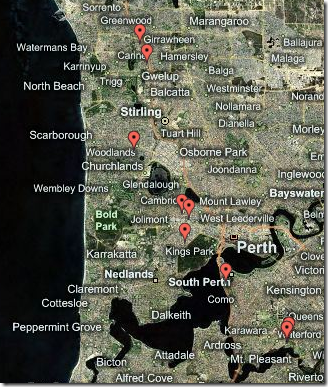
So Creepy does explicitly claim to be an educational tool in the ‘here, look what you’ve already done, now change your habits’ kind of way. Running Creepy just based on my own Twitter information produced a rudimentary map of my logged activity in Perth (clearly Creepy is following data from FourSquare and Flickr images which I posted with my Twitter account):
However, when I zoom in a long way, for example onto my workplace, there’s certainly a quite explicit level of geographic information:
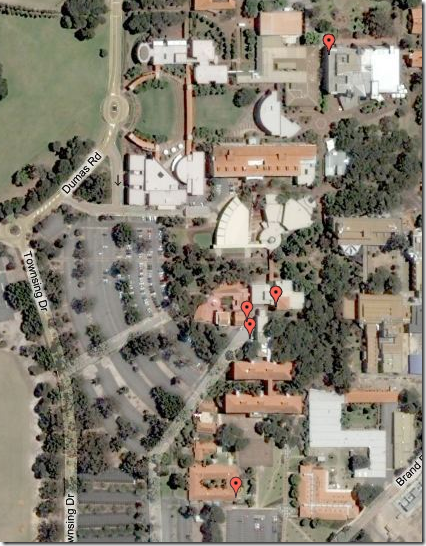
Now, I’m well aware of the data trail my Twitter, FourSquare and Flickr photos generate and acknowledge that if someone wanted to they could aggregate that information and build a reasonable picture of my activity. The point, though, is that many people aren’t that aware of the data trails they are leaving and that’s what Creepy purports to fix: it’s a very visible, confronting and explicit visualized map of the data trail you’re leaving. It’s not a technical privacy violation, but it might feel like an invasion of sorts. If it does feel that way, perhaps it’s time to think a little more about how, when and where you share information about yourself on social media and what data is actually embedded in your photos.
Digital Culture Links: March 1st 2011
Links for March 1st 2011:
- Should an employer ever require your social media passwords as an employment condition? [eGov AU] – “At least one state agency in the US, Maryland Division of Correction, recently started requiring employees to provide their personal Facebook password and allow their employer to scrutinise their account as a condition of continued employment. Apparently this request wasn’t illegal – although it breaches Facebook’s usage policy (which could mean the employee loses their account). The rationale given by the employer was that they needed to review the contents of the account as part of the employment contract. A video of one staff member asked to provide his personal Facebook password is below. […] A number of law enforcement agencies have also apparently begun requesting this information as part of their recruitment process, as reported by USANow in the article, Police recruits screened for digital dirt on Facebook, etc. […] Should employers be allowed to request your passwords?” My answer: absolutely not!
- Your view from the #Oscars stage [Twitter Media] – “The 83rd Annual Academy Awards captured the country’s attention on Sunday night, but ABC’s cameras didn’t provide the only view. This year’s show was a new kind of 360-degree event, with:
* a camera-snapping, live-tweeting host;
* an official hashtag on air; and
* a big, sustained second-screen conversation on Twitter.
First: whatever you thought of his hosting, there’s no question that James Franco broke new ground with his tweeting. […] And all together, that represents a brand-new kind of event experience: one where viewers get to experience it from every vantage point, from even the stage itself. And the experience went both ways, because Franco got to hear what the viewers at home were saying, too; his account was mentioned 63,737 times during the show. Second: an official #oscars hashtag appeared on air twice””once near the beginning of the telecast and again near the end: Now, we know that when a hashtag shows up on TV, it causes a surge of Tweets.” - Auto-Tune the News Rocks the Oscars: Online Video News [NewTeeVee] – “I’m probably not the only one who was ready to fall asleep halfway through the show during last night’s Oscars telecast, but then it happened: Anne Hathaway and James Franco joked slightly awkwardly about this being “the year of the movie musical,” only to wake up the audience with an awesome auto-tune mash-up, featuring Harry Potter pals Ron Weasley and Hermione Granger, Woody from the Toy Story franchise, Justin Timberlake playing Sean Parker and Twilight’s Edward, Jacob and Bella. […] The video wasn’t just a tribute to the YouTube auto-tune mash-up phenomenon, though; it was actually produced by none other than the Gregory Brothers, best known for Auto-Tune the News and their Songify This videos. Asked about the collaboration, Evan Gregory told me via email: “The producers of the broadcast reached out to us and asked us to do a piece. Then we collaborated with them over a period of several weeks to pull it together.””
- 5 Reasons Why Your Online Presence Will Replace Your Resume in 10 years [Dan Schawbel – Personal Branding – Forbes] – While I don’t agree with all of these points, it is a useful indicator of how central web presence will be in terms of employment now and even more so in the future:
“5 reasons why your online presence will replace your resume:
1. Social networking use is skyrocketing while email is plummeting
2. You can’t find jobs traditionally anymore
3. People are managing their careers as entrepreneurs
4. The traditional resume is now virtual and easy to build
5. Job seeker passion has become the deciding factor in employment” - Gmail back soon for everyone [Official Gmail Blog] – Apparently it was “0.02%” of gmail accounts that were temporarily deleted – still tens of thousands of accounts. Google sound confident all data will be back, soon, but that’s an awfully big scare, especially given how stable and reliable Gmail has appeared in the past compared to other cloud email services (yes, Hotmail, I’m looking at you!).
- Many Gmail Users Can’t Find Their Messages [Google OS] – Woah: Google has (accidentally?) deleted “0.08%” of all gmail accounts. That must be hundreds or thousands of accounts! While I love Gmail, it’s this sort of accident that reminds us all how precarious data in the cloud can be. Google are in the process of restoring these accounts, but even a few days with none of your email or email account would cause real challenges for most people! (Actually the BBC note that this might mean up to 150,000 Gmail accounts!!)
- iiNet again slays Hollywood in landmark piracy case [The Age] – “The giants of the film industry have lost their appeal in a lawsuit against [Australian] ISP iiNet in a landmark judgment handed down in the Federal Court today. The appeal dismissed today had the potential to impact internet users and the internet industry profoundly as it sets a legal precedent surrounding how much ISPs are required to do to prevent customers from downloading movies and other content illegally. The film studios had sued iiNet arguing that, by not acting to prevent illegal file sharing on its network, it was essentially “authorising” the activity. “I have concluded that the appeal should be dismissed,” Justice Arthur Robert Emmett said in court this afternoon…”
- Filmed on a phone, spy movie takes out junior Tropfest award [WA Today] – Tropfest under-15 winner shot the whole film on an iPhone: “Simeon Bain cites the 2010 blockbuster Inception as the motivation for his own film, for which he won the Tropfest film festival’s Trop Jr prize this year. Like Inception, Simeon’s film, Imagine, follows the story of a skilled spy, but that is where the similarities end. Simeon’s film was much cheaper, costing $70 to make over three days, and being shot entirely with a mobile phone. ”I was between cameras,” Simeon, from Gisborne, said. ”I was on the verge of getting a new one, and my old camera just wasn’t good enough, so I decided to use my iPhone instead. Filming with a phone has its benefits, because it requires very little set up and it’s highly portable.””
- What is ‘The Streisand Effect’? [YouTube] – Quirky little video which actually explains the Streisand Effect very clear (short version: attempts to censor information online often lead to that information becoming a lot more popular and viewed!).
- Facebook Privacy: 10 Settings Every User Needs to Know [Mashable] – Useful list of privacy settings every Facebook user should be aware of.
- How Angry Birds really took off: 200m minutes a day spent playing it [SMH] – Fluffy article on the development of Angry Birds, but it does highlight the importance of the Apple App Store as a reliable single portal for developers: “Rovio needed a solution and the iPhone provided one. After the phone’s launch in 2007, Rovio realised that their industry was about to change completely. For the first time, users from all over the world would be able to download games from the same place: Apple’s online App Store. So a manufacturer only had to produce one version of a game, reducing costs dramatically.”

Tama Leaver dot Net by Tama Leaver is licensed under a Creative Commons Attribution-NonCommercial-ShareAlike 4.0 International License.