Home » web2.0 (Page 23)
Category Archives: web2.0
Podcamp Perth Wrapup

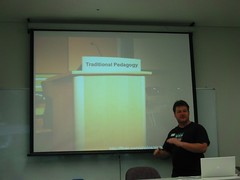
Last weekend was Australia’s first Podcamp, right here in Perth. It was pretty good with an engaging mix of tech, talk and interesting folks. I don’t have time to hunt down all the many, many blogposts and photos from Podcamp, but Simone van Hattem links to most of them in her blog, or else you can check Technorati or Flickr. I was intending to add audio to my presentation slides, but the audio didn’t quite eventuate. However, Stewart Greenhill did an excellent job capturing video of many of the Podcamp sessions, and so if anyone wants to hear the session on Podcasting in Education which was led by Sue Waters and I, here you go:
(Yes, I do use a lot of gestures!)
For those who prefer a static image, here’s one picture of me attempting a ‘Presentation 2.0’ style of slides mainly because I wanted to try something a bit different (but also to keep my co-presenter Sue happy):
I also rather like this photo, of white and black Macs at play:
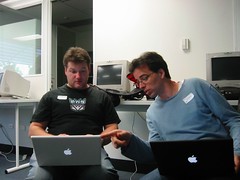
(Photos by CW.)
PS Yes, it’s October 31st, but, no, most Australian don’t celebrate Halloween. However, if we did, I’d definitely give the most candy to anyone who knocked on my door who was geeky enough to be wearing this.
Tale of Mighty Rudd Ascension
As the description tells us, “Short propaganda philosophy tells tale of mighty Rudd ascension” …
Without a doubt, one of the best political satires, and mashups, of the 2007 Federal Election campaign thus far. And, yes, for those who watch The 7.30 Report, I am getting YouTube pointers from Michael Brissenden these days. After all, he’s a keen YouTube watcher himself now; as last night’s report said:
The 2007 election will be remembered as the YouTube campaign – the first time the internet became a real force. Both sides are exploiting cyber space relentlessly but as we have seen already, the net is not always such a comfortable place for politicians.
Bring on the political discomfort! 🙂
Update: NineMSN staff writers seem to like this clip, too.
e-Lection.au
No Australian can have missed the news that we’ll be voting in a Federal Election on November 24. The advertising onslaught has begun and, unlike past campaigns, this one’s taking online campaigning seriously, with the current Liberal government apparently spending upward of $5 million on their web-based advertising. In the lead up to the official election campaign we’ve seen Labor make considerable inroads with both MySpace and Facebook. Indeed, Team Rudd have been so clever with Facebook that Kevin not only has his maximum-allowed 5000 friends, but there is also an “I want to be Kevin Rudd’s Facebook Friend, Too!” Facebook group which has over 10,000 members and uses Facebook’s structural limitation as a popularity mechanism! Given their knowledge of web campaigning, it’s hardly a surprise that the Kevin07 web campaign is so clearly modeled on the high-profile runners for the 2008 US elections.
Things have really kicked into overdrive for both main political parties – and the others – with Google’s 2007 Australian Federal Election page which has lots of usefully aggregated material as well as a dedicated YouTube channel for each of the political parties. While the potential social affordances of these tools aren’t necessarily being explored that well by the major parties, at least the web is being taken seriously as a battleground for the minds and hearts of the Australian public. In that direction, it’s great to see Australia’s national broadcaster – the ABC – getting in on the act with their Poll Vault, which collates reporting from their various sources.
Also important for this election – and really, this is the first Australian election in which it’s been a major player – is the influx of citizen journalism and participatory cultural portals centred on the election. For example the ambitious YouDecide07 attempts to bring citizen journalists across the country together tightly focusing on the election seat-by-seat. This project is run through QUT‘s Centre for Creative Industries and Innovation with Jason Wilson doing a lot of the hard yards in running the website itself, with the help of media-savvy folk like Barry Saunders. Also of note is the Election 07 Norg from the people who bring you PerthNorg. This user-voted website with at least partially user-generated content (and mainstream media reports ranked via a Digg-style voting system) is just getting started but looks quite promising. It’ll probably retain a WA flavour given it’s run here, but there’s nothing stopping sharing between this Norg and the many other mainstream and user-generated election 07 sources. Similarly the team at New Matilda have launched a focused groupblog called Polliegraph while the always political Lavartus Prodeo have kicked into election overdrive.
Of course, there are still many individual bloggers offering insightful – or sometimes just vicious – commentary but you’ve probably got your own favourites so I shan’t run through the major individual bloggers. I will, however, end by mention two newer folks well worth reading: Peter Black from Law at QUT is blogging at his dedicated sub-site Australian Politics 2.0 while Elliott Bledsoe from Creative Commons Australia and Vibewire (who have their own youth-orientated political bloggers) , among other things, has upped his what it feels like for a boi into full election mode. And if you’re already over the campaign promises and just want the election-related comedy clips, Elliot’s also focused on building an Election on YouTube stream. In that spirit, as elections always bring out the most amusing video clips, I’ll finish with a satire from the self-anointed Axis of Awesome, called their Rudd Vs Howard rap…
Dove’s Onslaught
Last year as part of Dove’s ‘Real Beauty’ campaign they produced the important and memorable Evolution video which graphically illustrated the many, many steps between a photograph being taken and the image based on that photograph ending up on a billboard or fashion magazine cover. This year Dove have, in my opinion, produced another fine clip which looks at the tirade of body images and messages young girls and women encounter through various media in their everyday life. It’s called Onslaught:
Incidentally, while I know these viral videos are something of a marketer’s dream, I don’t think that distracts from the message one little bit.
Reflections on the Australian Blogging Conference and Blogging in Education
 As readers of this blog will know, I spent Friday at the Australian Blogging Conference at QUT’s Creative Industries Precinct in Brisbane. It was a fabulous, stimulating and intellectually rich conference and a great end to Tama’s-month-o-conferencing. I was the facilitator for the ‘Blogging and Education’ session so thought, in the spirit of the conference, I’d better get my notes up here:
Blogs and Education
The session ran for two hours, with a good balance between K-12 educators and those of us from the Higher Ed sector. After a brief (well, brief for me) introduction, the session was loosely structured around three main questions…
Why blog in education?
The Pros
* Allowing students to connect with community, family and an intellectual arena beyond the boundaries of the classroom.
* While most educational institutions have some sort of Learning Management System (such as Blackboard), the architecture of these systems tends to be inward-focusing, getting students thinking that everything they need is inside the walls of the black box. Blogging, by contrast, is outwardly-focused and keeps students focused on the broader (potential) public or audience they may be writing for. Thus, if we’re teaching life-long skills, blogs are often better platforms, due to their openness, than other closed systems.
* Blogs can meaningfully extend the educational experience, giving students a space to engage, write and communicate beyond the tutorial room. The uptake of this opportunity will often be uneven, but it’s often the less confident students who flourish in blogged communication.
* in certain contexts, blogs can become ‘student property’ once a particular unit of course is over, thus allowing students to continue to build and use their blogs (this clearly differs depending on the context and aim of an educational blog, and on the age of the participants).
* Blogging as an ethos is about sharing knowledge, building ties and acknowledging the input of others – all key characteristics of good pedagogy!
The Cons
* Having purchased the (usually quite expensive) Learning Management System, the majority of schools and universities invest most of the training, support and infrastructure costs to maintain the hardware and use of this system. Blogging is thus often done using peripheral tools which educators must teach themselves to use rather than getting central support.
* Many institutions desire to contain and control everything that students are producing, both in terms of protecting student privacy and in terms of protecting institutional intellectual property or even just keeping work away from outside scrutiny. While this can be overcome, it’s often IT and central policies which have to be convinced and converted to make the use of blogs (and other web 2.0 tools) feasible.
* At times education in Australia is still focused on the idea of a digital divide – where the aim is to get every student access to a computer – whereas the meaningful discussion needs, really, to shift to the idea of the participation gap – where the focus needs to be on ensuring all students are familiar with network and digital literacies, thus being able the meaningfully utilise social software and other tools, which is a lot more than just having occasional access to the internet.
* The mythos of the digital natives tends to scare many educators because it suggests that many younger people (dubbed digital natives as they’ve never know a world without the internet) will always have more familiarity than their teachers (who are dubbed digital immigrants since the web appeared at some point during their lifetime) and thus teachers are worried about not being knowledgeable in these areas.
Examples and reflections?
K-12 Examples
* Year one ‘Little Gems’ blog – Amanda Rablin demonstrated this outstanding blog by year one students (!) which not only broadened their classroom experience, but also showed a level of reflexivity well beyond the primary school level!
* PodKids Australia – From a year 4/5 class in a WA country town who have used podcasting (and their blog) to communicate with their parents and the wider world in a sensible, thoughtful and safe manner.
Higher Ed Examples
* Self.Net Tutorial (Monday 2pm) blog – An example of a blog used to expand the engagement of students in the tutorial process, and extend their potential interaction beyond the confines of the classroom.
* iGeneration Honours Unit blogs – A full university unit where the entire curriculum is online (collaboratively constructed by the unit coordinator and the students) as well as all of the students work – which include critical evaluations of blogs and podcasts as the major assessment item – and the week-by-week tutorials in the course.
* Communication Studies 1101 link blog – the least exciting of all the examples, but nevertheless useful, this blog is simply a series of links to useful material for students in a first-year Communication Studies course at UWA.
(All three Higher Ed examples use Creative Commons licenses to make legally explicit the intention that students’ content can be build-upon by others, on the condition of citation. I was particularly pleased to see both Elliott Bledscoe and Jessica Coates from Creative Commons Australia in this session!)
Missing from these examples was the best use of blogging as per blogging as a participatory cultural form which is a course-length blog maintained across the three to five years of a degree. One good example I’ve found now that the session is over is Sarah Demicoli’s Looking Up? blog; notably Sarah is a student in Adrian Miles’ Labsome Honours cohort.
Should academics blog?
This question ended up being divided into two parts: should K-12 teachers blog, and should academics (and doctoral students) blog? The first question proved far more complicated in that there is an expectation that teachers in the K-12 environment will share less of their personal lives with the world. The accountability that comes with being a teacher – especially from parental expectations – means it’s something of a challenge to share too much of a teacher’s life publicly, less it be seen and critiqued by parents or students. Likewise, the important line between teachers and students was one of those areas where teachers need to be especially careful when using social networks like Facebook or MySpace because ‘friending’ students might inadvertently be read as entering into a social dynamic with students which is generally something of a taboo. Some folks felt this was particularly complicated since some teachers using social networks might be less familiar with the social norms of the platforms and accidentally cross a line – or be perceived to cross a line – by accident. Sadly, excessive accountability seems to be one of the major reasons that teachers would be hesitant to blog – or at least only blog on a narrow band of topics. That said, there was still a sense that teachers would blog if they found the right reason or topic, but that the boundaries as to what other personal information would find its way online would be a very solid boundary indeed!
On the ‘should academics blog?’ front, things were decidedly more optimistic. There was a strong sense that academic blogs were a rich source of information, insight and commentary and that these were often far more accessible than other forms of academic writing. I asked a particularly loaded question – should academics feel obliged to blog since in publicly funded institutions the onus is to share our thoughts, research and ideas with the public, not just a our peers via peer viewed gatekeeping – and a few people were enthused by this idea, although there were a few comments about the need to have peer review before academic ideas escape into the world. The confusion surrounding danah boyd’s MySpace/Facebook class paper, and her subsequent reflections on the process, proved a useful example. That said, the biggest boundary to academic blogging seemed to be the amount of time it might take, but most people in the session thought it was time well spent!
I should add that these notes are re-constituted from rather poorly recorded keywords during the session, so further reflections, comments and notes on this session are most definitely welcome!
The Rest of the Conference
I don’t have terribly detailed notes from the other sessions I attended (which might be a blessing since caught the red-eye from Perth the night before the conference was thus a little less than coherent in the morning sessions), but thankfully being a blogged event, there are plenty of posts about the conference worth reading. Reflections well worth reading include those from Senator Andrew Bartlett, Australia’s most web-savvy politician. Derek Barry has posted three detailed reports on the Morning Panel discussion, The Politics of Blogging session and the panel on Citizen Journalism. Mark Bahnisch, one of the Politics of Blogging facilitators, has also posted on the ‘state of political blogging’ specifically for that session. Robyn Rebollo has notes from the conference which include reflections on the Legal Issues and Blogs session. Nick Hodge was one of the facilitators for the Business Blogging session and has posted both his notes and powerpoint slides. Likewise, Joanne Jacobs has some useful notes from The Future of Blogging closing session, and Kate Davis’ notes from the parallel ‘Building a Better Blog’ session are useful, too. Conference notes and reports keep emerging, so watch the blogoz tag on Technorati for more.
I should say, as well, that I was fortunate enough to catch up with a whole bunch of folk I’ve known through blogging, social networks, shared research interests and so on, but never actually met in the flesh before. It was great chatting with Brian Fitzgerald, Jessica Coates and Rachel Cobcroft, as well as Elliot Bledscoe who I met a few weeks earlier, all of whom are part of the Creative Commons Australia team, which Brian leads. Given their enthusiasm and energy, I’m sure CC Australia has a lot going on in the future, and with any luck I’ll be involved with some of the CC and Education things as they emerge. I also chatted to Melissa Gregg, Jean Burgess and Axel Bruns, all of whom are blogosphere friends who its nice to see annually (or thereabouts) at conferences. Quite unexpectedly, I ran into Sarah Xu who I’ve met through local fannish events, but I hadn’t realised she’d landed in sunny BrisVegas to write her doctorate, which is creatively exploring the important question: “how can cyberfeminist practice and Web 2.0 applications be used to recode gendered representations of women on the Internet?” Sounds like a thesis worth watching!
Finally, a huge congratulations to Peter Black who put the conference together and assembled a fascinating group of people to participate in some really meaningful exchanges! Time to start planning for next year …
Update: Peta Hopkins also has some notes from the Blogging in Education session, including a several things I’d forgotten we’d talked about (including ebublogs.org).
Blogging Burma

Like the Asian Tsunami (December 29, 2004),the The London Bombings (July 2005) and Hurricane Katrina’s Aftermath (September 2005), information about the current demonstrations and atrocities happening in Burma are flowing through user-generated channels as much (indeed, often more so than) through the traditional mainstream media. There is a great deal of activity both in blogs and throughout the broader sphere of citizen media, but some noteworthy places to look are:-
[X] The 2007 Burmese anti-government protests Wikipedia entry – Wikipedia is at its most useful during moments of crisis which have many sets of eyes watching. The collective intelligence of Wikipedia contributors continues to develop one of the best resources on the Burma protests.
[X] YouTube has a number of clips like this one which simply show the enormous scope of the protests [Via]. A very good source is the videostream from news6776 which collates a great deal of footage (both mainstream media-produced and from citizen journalists)
[X] The Support the Monks’ protest in Burma Facebook Group – To be honest, I’ve never really thought Facebook would provide a terribly useful platform for political activism as the ‘groups’ often seem a peripheral part of Facebook’s design. However, I happily stand corrected as the exponential growth of the Support the Monks’ protest in Burma Facebook Group has been amazing – over 170,000 members when I checked this morning – and the links, advice and descriptions of how members can actively support the Burmese demonstrations in that group seems quite robust to me, not just a tokenistic gesture. Indeed, I’d go so far as to say this Facebook group has probably done more to promote the ‘ Day of International Action for a Free Burma – Free Aung San Suu Kyi & Support the Monks in Burma’ on October 6th than any other single outlet online or offline.
[X] The SmartMobs blog notes that cameraphones and other mobile devices are one of the main tools allowing information and media to get out of Burma, but the government has moved from shutting down Internet Cafes to blocking the entire internet in order to try and stop knowledge about the situation in Burma being available internationally. Taking the massive step of blocking the entire internet speaks volumes to how widely the impact of citizen reportage is from inside Burma is disseminating to international viewers and readers.
[X] For a traditional media rundown of the impact of citizen media, see ‘Bloggers in Burma keep world informed during military crackdown’ in the San Francisco Chronicle and Dan Gillmor’s response at the Centre for Citizen Media where he points out, quite rightly, that there’s a lot more than just blogging going on!
[X] Finally, you should visit Free Burma (dot Org) which is a portal for international information on how to support the protestors and get involved in their struggle.

[Photo by Hugo*’s from protestors supporting the Burmese democratic protests, in front of the Myanmar embassy in Paris, with a portrait of Aung San Suu Kyi.]

Tama Leaver dot Net by Tama Leaver is licensed under a Creative Commons Attribution-NonCommercial-ShareAlike 4.0 International License.