Home » 2012 (Page 5)
Yearly Archives: 2012
Digital Culture Links: April 11th
Links for April 11th:
- Hillary Clinton Responds to Her Meme … With a Meme [The Atlantic] – Hillary Clinton responds to the Texts from Hillary Tumblr/meme by penning her own version and meeting with the two guys who started the Tumblr. Hilarity ensues, and Clinton’s online credibility goes up about 5000%. The pundits are impressed, too.
- Selling You on Facebook [WSJ.com] – Useful article from the Wall Street Journal looking at how Facebook and Facebook apps utilise user’s data: “This appetite for personal data reflects a fundamental truth about Facebook and, by extension, the Internet economy as a whole: Facebook provides a free service that users pay for, in effect, by providing details about their lives, friendships, interests and activities. Facebook, in turn, uses that trove of information to attract advertisers, app makers and other business opportunities.”
- Angry Birds animated TV series to premiere in Autumn 2012 [Technology | guardian.co.uk] – “Rovio Mobile is launching a series of 52 shortform animations for its Angry Birds in Autumn, but has ruled out a movie until after 2014. “We’re going to roll out a weekly animation series later this year of shortform content,” said Rovio’s head of animation Nick Dorra, speaking at the MIPTV conference in Cannes. The series will consist of 52 episodes lasting between two-and-a-half and three minutes each. “We’re going to roll it out on all possible devices,” said Dorra. “We’re looking at building a video app for that, and we’re also looking at partnerships and so on… We want to be on all screens.” Those partnerships include a deal with Samsung announced in January 2012 that involves an app for the company’s range of Smart TV internet-connected televisions.”
- Twitter UK boss says social TV happens whether broadcasters like it or not [Technology | guardian.co.uk] – “Twitter’s UK general manager Tony Wang expects broadcasters to start using the microblogging service in more “artful” ways beyond showing hashtags and account handles on-air. “Broadcasters are not the ones to choose whether to have social TV. It happens whether they like it or not. But they have a choice about how to harness that social TV energy,” he told the MIPCube conference in Cannes. Wang cited stats showing that 80% of under-25s are using a second screen to communicate with friends while watching TV, while 72% of them are using Twitter, Facebook and other mobile apps to comment on the shows they watch. He added that Twitter sees three distinct strategies from broadcasters when it comes to social TV: some are doing nothing, others are doing something, and a few are doing “artful” things on-air. “It’s the past, present and future of social TV.–
Digital Culture Links: March 30th
Links for March 26th through March 30th:
- The Dark Knight Rises Trailer 2: IN LEGO [YouTube] – Beautifully put together Lego version of the new Dark Knight trailer. “LEGO Dark Knight Rises Movie Trailer By ParanickFilmz. http://paranickfilmz.co.nr/ Thanks to Adviceversas for the mouth animation and JediMasterSoda for the CGI. Movie (2012) HD.”
- CBS Blocks Use of Unused ‘Star Trek’ Script by Spinrad [NYTimes.com] – “For “Star Trek” fans it was like finding a lost Shakespeare play “” only to have it snatched away by the playwright’s heirs.Last fall an unused script for the cult 1960s television show turned up after being forgotten for years. Its author, the science-fiction writer Norman Spinrad, announced that it would become an episode of a popular Web series, “Star Trek New Voyages: Phase II,” which features amateur actors in the classic roles of Capt. James T. Kirk, Mr. Spock and other crew members of the starship Enterprise. But then another player stepped in: CBS, which said it owned the script and blocked a planned Web production of it. Trekkies were appalled. “These executives should be phasered on heavy stun,” said Harmon Fields of Manhattan, who called himself “a ‘Star Trek’ fan of galactic proportions.” … By all indications CBS is within its rights. In the entertainment industry the paid writer of a teleplay generally cedes the rights to the material, even if it remains unproduced.”
- Shitter: Social Media has never been so disposable – Online service that prints a twitter feed onto toilet paper. I suppose such a thing was inevitable.
- Pay TV piracy hits News [AFR] – A detailed investigative report accuses NewsCorp of actively promoting and facilitating the piracy of competitors pay TV network content: ” A secret unit within Rupert Murdoch’s News Corporation promoted a wave of high-tech piracy in Australia that damaged Austar, Optus and Foxtel at a time when News was moving to take control of the Australian pay TV industry.” These are hugely important accusations both in terms of NewsCorp but also in terms of how piracy is framed and understood.
- What book publishers should learn from Harry Potter “” Tech News and Analysis – Useful post detailing the DRM-free release of the Harry Potter ebooks and audio books for sale on J K Rowling’s Pottermore website. The lesson here is that DRM really isn’t necessary, and you’re more likely to reach a wider audience without it. Admittedly Rowling has unprecedented clout in managing her own books in electronic form, and has already made so much money off these books there’s no real risk involved, but the strategy is an important one nevertheless.
- Angry Birds Space gets 10m downloads in three days [BBC] – The latest version of the Angry Birds game notched up 10 million download in its first three days of release, says its developer Rovio. Angry Birds Space only came out on 22 March, but in a tweet on Monday Rovio announced the game’s swift success. … The new Angry Birds instalment features 60 initial levels and six new characters and has what Rovio calls a “unique twist in a variable gravity environment”. As well as Google Android and Apple iOS devices, last week also saw the game released simultaneously on PC and Mac. Nasa was also involved in promoting the game, posting a video showing an astronaut on the International Space Station explaining the laws of physics using Angry Bird characters.
The space agency called it “an exciting way to get people engaged with Nasa’s missions of exploration and discover”. - Google ordered to suspend autocomplete function over cyber-harassment [The Japan Times Online] – “The Tokyo District Court approved a petition demanding that Google Inc. suspend its autocomplete search feature for Internet browsers after a man alleged that it breached his privacy and got him fired, his lawyer said Sunday. Google is refusing to suspend the feature, saying that its headquarters in the United States will not be regulated by Japanese law and that the case does not warrant deleting the autocomplete suggestions related to the petition under its in-house privacy policy, lawyer Hiroyuki Tomita said. The case, which was adjudicated on March 19, is believed to be the first to order the suspension of the Web search feature, which attempts to instantly anticipate and list the words or phrases a person will type into a browser’s search box, Tomita said. [..] The man discovered that when people type his name into Google’s search engine, words suggesting criminal acts, which he is unfamiliar with, appear.”
- Facebook Asserts Trademark on Word ‘Book’ in New User Agreement [Threat Level | Wired.com] – “Facebook is trying to expand its trademark rights over the word “book” by adding the claim to a newly revised version of its “Statement of Rights and Responsibilities,” the agreement all users implicitly consent to by using or accessing Facebook.”
Digital Culture Links: March 16th through March 22nd
Links for March 16th through March 22nd:
- The Hunger Games Game [CollegeHumor Video] – A parody video from College Humor, turning The Hunger Games into a tween-girl fantasy boardgame focusing on the love-triangle, to great comic effect. On some level, though, this is also a pretty decent critique of the way a film which and certain elements of the fandom around it miss the core critique of authority and a media culture, reducing it to a vapid romance tale.
- Dragon Tattoo Has Unique DVD Design – Sony’s DVD release of The Girl with the Dragon Tattoo has confused some people because it’s designed to look like a ripped copy and, sporting letters which look like they’re written in felt-tip pen on a DVD-R. Confusing messages you’re sending there, Sony!
- Twitter turns six [Twitter Blog] – On the sixth anniversary of Twitter’s launch, the service has reached 140 million users, with 340 million tweets made daily. That said, since most active users seem to tweet a lot more than 3 times a day, a significant proportion of users don’t actually seem to tweet much.
- Game sales surpassed video in UK, says report [BBC News] – “Sales of computer games in the UK have surpassed those of videos for the first time, new figures suggest. The Electronic Retailers Association (ERA) said sales of £1.93bn in 2011 made the gaming industry the country’s biggest entertainment sector. By contrast, sales of DVDs and other video formats totalled £1.80bn, while music pulled in £1.07bn.”
- Will The Real Mitt Romney Please Stand Up (feat. Eminem) – YouTube – Clever political mashup video in search of the ‘real’ Mitt Romney featuring Romney and Obama in the style of Eninem’s Slim Shady.
- Rob Reid: The $8 billion iPod | Video on TED.com – Fantastic TED parody explanation of the logic behind copyright lawsuits and litigation: copyright maths. From TED: “Comic author Rob Reid unveils Copyright Math (TM), a remarkable new field of study based on actual numbers from entertainment industry lawyers and lobbyists. Rob Reid is a humor author and the founder of the company that created the music subscription service Rhapsody”
Artificial Culture (my first book!)
While I set up a page for my new book, and told Twitter and Facebook a while ago, I realised I never actually blogged about my book finally coming out! So, without any ado at all, here’s the announcement:
Artificial Culture: Identity, Technology, and Bodies (Routledge, 2012)
Tama Leaver, Curtin University
Amazon http://amzn.to/wRe4PN
Routledge: http://bit.ly/mivLzx
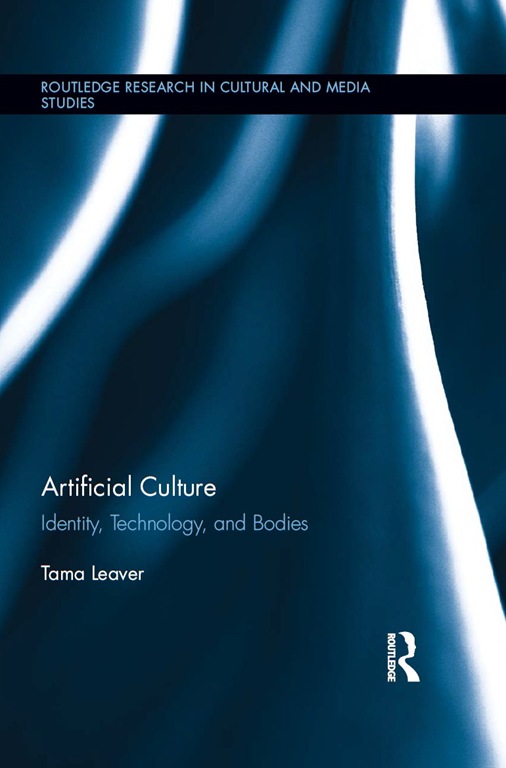 Artificial Culture is an examination of the articulation, construction, and representation of "the artificial" in contemporary popular cultural texts, with a focus on science fiction films and novels, but also addressing digital culture more broadly including analysis of Wikileaks, the Visible Human Project and the emergence of synthespians. The book argues that today we live in an artificial culture due to the deep and inextricable relationships between people and technology, with human bodies as a key marker of these symbiotic connections. While the artificial is often imagined as outside of the natural order and thus also beyond the realm of humanity, paradoxically, artificial concepts are simultaneously produced and constructed by human ideas and labor. The artificial can thus act as a boundary point against which it is possible in some respects to measure what it might mean to be human. More importantly, the artificial often blurs the boundary between humans, technology and the environment at large in often purposefully unsettling ways.
The core texts analysed in the book are: 2001 A Space Odyssey; the four Terminator films; Greg Egan’s novels Permutation City and Diaspora; The Visible Human Project; William Gibson’s bridge trilogy (Virtual Light, Idoru, and All Tomorrow’s Parties); Wikileaks; The Matrix films and franchise; WETA’s digital effects in the Lord of the Rings films, with a particular focus on the synthespian Gollum; the Spider-Man trilogy; Wall-E; and Avatar.
Contents:
Part1: Artificial Intelligence
1. Early Artificial Intelligence Films: ‘When are you going to let me out of this box?
2. "I am a machine!": Artificial Intelligences in Contemporary Cinema
Part 2: Artificial Life
3. From Digital Genesis to the Artificial Other
4. Diasporic Subjectivities: Not Quite ‘Beyond the Infinite’
Part 3: Artificial Space
5. The Fortification of Place in the Digital Age
6. Resistance is Spatial
7. The Infinite Plasticity of the Digital?
Part 4: Artificial Culture
8. Matrices of Embodiment
9. The Symbiosis of Special Effects
Part 5: Artificial Culture
10. Before the Mourning
11. Artificial Mourning: Spider-Man, Special Effects and September 11
For slightly more information (and colour versions of the images used in the book) please visit https://tamaleaver.net/artificial-culture/ . My apologies that the book on the expensive side; if you have access to a university library, perhaps recommend they purchase it in the first instance.
Digital Culture Links: March 14th
Links for March 11th through March 14th:
- A Sign of the Times: Encyclopaedia Britannica to End Its Print Run [The Atlantic] – “After nearly two-and-a-half centuries in print, the publishers of the Encyclopaedia Britannica are expected to announce tomorrow that they are stopping their presses … As Wikipedia emerged over the past decade, the question has always been, but how does it compare to the Encyclopaedia Britannica? (Answer: mostly favorably, with bonus points for breadth and accessibility.) … Recent years have seen a sharp decline: The 1990 edition sold 120,000 editions in the United States — the most ever — but the 2010 edition sold just 8,000. Four thousand copies are still in a warehouse, waiting for owners. Today, the printed encyclopedia accounts for less than one percent of the company’s revenues. Britannica, as a whole, is not moribund, though: a half a million people pay $70 each year for complete access online.”
- Apple Reveals New “All-Time Top Apps” Following 25 Billion Downloads [Mac Stories] – Following the downloading of the 25 billionth app from the App Store, Apple have release top-downloads of all time charts for iPhone and iPad, breaking them down into free and paid lists. Angry Birds features prominently on all lists!
- The Story of Keep Calm and Carry On [YouTube] – Well-made little video which tells the history of the now iconic and meme-ready ‘Keep Calm and Carry On’ poster which was originally designed and produced in England during the Second World War.
- A Show with Ze Frank by Ze Frank [Kickstarter] – Ze Frank (of ‘The Show with Ze Frank’) uses Kickstarter to ask fans to contribute to a new version of The Show, aiming to raise $50,000 to do The Show for a year. Instead, he raised $146,752, with over 3,900 backers (with one parting with $4000 … that’s a LOT of love for The Show)!
Digital Culture Links: March 8th
Links for March 4th through March 8th:
- Animated GIFs: The Birth of a Medium [Off Book | PBS – YouTube] – Nifty little video looking at the history of the GIF (Graphics Interchange Format) image, from the 1987 creation (pre-web) through tothe Under Construction GIFs the were prevalent on the early web, the disappearance of GIFS, and their resurgence as an art-form (cinemagraphs) and a memey means of expression (Tumblr!).
- Tweet a Link, Save a Link [Delicious Blog] – Delicious adds a native Twitter connector, with which you can save tweets, links in tweets, and filter by a specific hashtag.
- Coles Twitter campaign goes down, down gurgler [WA Today] – “A social media experiment has backfired for Coles, exposing the supermarket to a flood of negative comments on Twitter. The supermarket is the latest company to have a social media marketing exercise go terribly wrong, following blunders from Qantas and Coca-Cola. The official Coles account last night urged followers to complete the sentence “in my house it’s a crime not to buy…..” But the PR exercise quickly fizzled as Twitter users inundated the supermarket’s account with negative comments. User @Pollytics wrote, “Food from markets while Coles exploits mental illness via pokies.” Other users raised concerns about the supermarket not giving farmers a fair price for their produce. @TaraMacca wrote, “In my house, its a crime not to buy LOCALLY- and I don’t mean from a @coles supermarket.” “In my house it’s a crime not to buy…BREAD AND MILK AT PRICES THAT ALLOW PRIMARY PRODUCERS TO SURVIVE,” said @downesy.”
- Apple passes 25bn iPhone and iPad app downloads milestone [Technology | guardian.co.uk] – “Apple’s App Store has passed 25 billion downloads, with Disney’s iOS game Where’s My Water? Free nudging it past the milestone. Apple had been running a counter on its website and store, so the 25bn mark was actually reached over the weekend. The company has now revealed which app was the 25 billionth, as well as the name of the downloader: Chunli Fu in Qingdao, China. Late chief executive Steve Jobs would surely have approved of both. He was Disney’s largest shareholder in his later years, after it acquired his Pixar Animation Studios. Meanwhile, China has been an important growth market for Apple in the last year, as the iPhone went on sale there. […] As a comparison, Google recently announced that its Android Market store is generating 1bn monthly app downloads.”
- Lego blondes [thinking with my fingers] – Torill Mortensen looks at the differences between normal Lego figure (minifigs) and the new ‘for girls’ Lego. The fact that ‘girl’ lego figures are incompatible with the ‘normal’ accessories and parts is telling. 🙁
- Kevin Allocca: Why videos go viral [TED – YouTube] – Seven minute TED talk by Kevin Allocca explaining why he (on behalf of YouTube) thinks videos ‘go viral’.

Tama Leaver dot Net by Tama Leaver is licensed under a Creative Commons Attribution-NonCommercial-ShareAlike 4.0 International License.