Home » australia (Page 38)
Category Archives: australia
Links for April 1st 2008
Interesting links for March 31st 2008 through April 1st 2008:
- Police take a tip from YouTube [Australian IT] – “Call it BlueTube. Citizen-supplied video evidence of crimes appears set to take off with police forces around Australia.”
- Embracing the torrent of online video [BBC NEWS | Technology] – Very positive piece from Michael Geist on the Canadian Broadcasting Corporation’s decision to make one of their shows available for free, without DRM, via peer to peer Bittorrent networks.
- Decline Of US Newspapers Accelerating [Tech Crunch] – “Figures released by the Newspaper Association of America show that the decline of newspapers is more rapid than previously thought, with total print advertising revenue in 2007 plunging 9.4% to $42 billion compared to 2006…”
Sculpture by the Sea – Cottesloe 2008
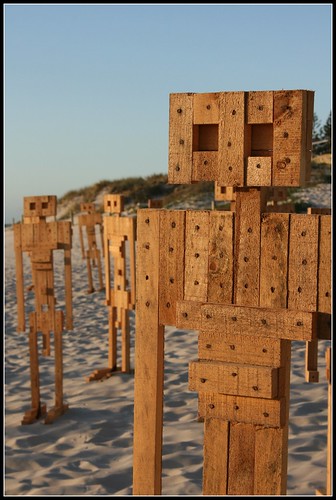
Last night Emily and I enjoyed the 2008 installations for Sculpture by the Sea which is in its final few days this year. For those of you unfamiliar, this wonderful annual effort sees one of Perth’s best beaches suddenly populated with all manner of installation art and sculptures for a couple of weeks – it’s always a great event which really does mix art and beach culture in a really engaging way. While I didn’t take that many pictures list year (unlike 2007 where I went a little nuts!), you can find a few more photos of this years sculptures on Flickr.
Anyone in Perth who hasn’t made it down to Cottesloe yet, tomorrow (18 March) is the last official day, so get your skates on!
R18+ Category for Video Games In Australia (The Saga Continues)
Australia has once again got an R18+ category for videogames on the discussion table. However, as Asher Moses reports in The Age:
In the gaming community at least, South Australian Attorney-General Michael Atkinson has become the Darth Vader of politics with his opposition to R18+ ratings for games. But Mr Atkinson insists his forceful opposition is to protect children from “harmful material”. Australia is the only developed country without an R18+ classification for games, meaning any titles that do not meet the MA15+ standard – such as those with excessive violence or sexual content – are simply banned from sale by the Classification Board.
Any changes to the censorship regime must be agreed on by the Commonwealth and all state and territory attorneys-general. For the first time since November 2005, the issue will be discussed later this month at the Standing Committee of Attorneys-General, but Atkinson has confirmed he will maintain his long-running opposition to the idea. […] In a speech in South Australia’s State Parliament yesterday, during which Atkinson was forced to return to his seat after being cut off by interjections, he acknowledged blocking the R18+ rating would deny adults choice. But he said this was necessary as the alternative would allow children easy access to “potentially harmful material”. “Games may pose a far greater problem than other media – particularly films – because their interactive nature could exacerbate their impact,” he said. “The risk of interactivity on players of computer games with highly violent content is increased aggressive behaviour.”
I’ve long been a proponent for the R18+ rating for video games in Australia and now that it’s in sight once again, I’m really troubled that one man – Michael Atkinson – could stand in the way. Let me just reiterate why the R18+ category is important:
- The majority of video game players in Australia are adults and thus deserve the right to decide for themselves what games they’ll play.
- Banning video games increases their notoriety, making them more appealing to kids and teenagers, meaning that they are far more likely to download them illegally or purchase them in or from another country.
- Part of the argument against the R18+ category seems to be a presumption that Australia’s current ratings system for film, tv, etc., isn’t effective. If the ratings system is broken, focus on fixing that, not blanket bans on whole sections of a medium!
- There is no substantial evidence that violent video games cause violent behaviour. (There are small-scale studies which see some increase in violent thoughts (not actions: thoughts), but there are an equal number of studies that show no correlation. A lot more research and study here would help! Personally, I’m reminded that at the beginning of the twentieth century books were being banned for corrupting the moral fibre of society; in the 1950s and 60s rock music had similar charges levelled against it!
- Interactive doesn’t equal addictive, nor does it dull the critical senses of players. If someone can’t distinguish between games and everyday life, the there’s a lot more to worry about than the games.
While The Age and other reports are supposedly trying to be neutral in their reporting, I suspect from the last few lines of Moses’ report on the issue, his sympathies are with those arguing for the R18+ category, too:
Research conducted by Bond University in Queensland for the IEAA found that the average age of Australian gamers is 28 and over 50 per cent of gamers are over 18.
Another survey of 1601 Australian households, conducted by the university in 2005, found 88 per cent of Australians supported an R18+ classification for games.
“From what I’m hearing the majority don’t seem to be opposing the R18+ [rating for games], so i’d be interested in what constituency he (Atkinson) is fighting this cause for,” [Ron] Curry [CEO of the games industry body, the Interactive Entertainment Association of Australia (IEAA)] said.
Logan Booker, editor of the gaming blog Kotaku Australia, said that ultimately parents, and not the government, should be the ones take responsibility for restricting what games their kids play.
“The UK, Europe and the US seem to handle an R18+ rating just fine, isn’t Australia mature enough to cope as well?”
UWA Science Fiction/Fantasy Discussion Group
For any interested Perth folk, a SF/F discussion group re-emerges:
After a long hiatus, the UWA science fiction/fantasy discussion group is restarting in 2008. Meetings will be held on the last Tuesday of each month in Arts G.05, and undergraduate students, postgraduate students, staff and anyone else interested are welcome to attend.
We have two speakers presenting papers in the next two weeks, but are looking for volunteers to fill the rest of the year. Please contact Karen Hall if you would like to give a paper.
26 February (Next Tuesday)
Gotham Central
Presented by David Medlen
A short lived award winning comic set in the world of superheroes but not about superheroes. What does this short lived title tell us about the genre in the 21st Century? A summary of the comic is available at http://en.wikipedia.org/wiki/Gotham_Central, and source material will be available in the Scholars Centre at UWA’s Reid Library.4 March
“Against heritage: Invented identities in science fiction film”
Presented by Dr Sky Marsen, Victoria University of Wellington
Pre-reading material for this talk is available from Karen Hall.
Australia’s Peer-to-Peer TV Underbelly

While Australians have long been noted as some of the most voracious downloaders of television, using bittorrent-based peer-to-peer sources has generally been focused on accessing UK and US shows which don’t screen in Australia until some time (from weeks to years) after the original airdates. However, the recent case of the Australian production Underbelly is a little bit different.
Underbelly dramatises the infamous events in Melbourne, Victoria between 1995 and 2004 which encompassed a gangland war and a series of murders. However, at least one criminal trial from these events is still underway, and so just prior to the screening of the first episode of Underbelly, a court injunction prevented the Nine Network from screening the tv series in Melbourne, on the grounds it could prejudice any potential Victorian jury. So, on February 13, every other Australian state except Victoria could view the show, while Victorians could not. Also, as it’s pretty much impossible to limit websites on a state-by-state basis, the ban also prevents promotional material, trailers and episodes of Underbelly being hosted online. Thus, the official website currently sports a great many “This functionality is not available due to current legal restrictions” (screenshot) signs and not that much else.
Yet in the era of bittorent and peer-to-peer networks, that’s far from the end of the story. As soon as the ban was issued, media reports appeared highlighting the fact that Underbelly was sure to be available as a download in Victoria within hours of its screening in every other state. As the Herald Sun reported:
… the explosion of video on the internet, through websites and through file sharing, may allow Victorians to see the drama within hours of its broadcast interstate. A scan of one site today revealed several copies of the promotional clips from the series on the website, despite their removal from Nine’s site. “This is a great problem on the internet,” University of NSW Cyberspace Law and Policy Centre executive director David Vaile said. “Legal jurisdiction is typically limited by geography, and by its nature the internet doesn’t place much regard to geography.”
Mr Vaile believed the judge may have taken into consideration the possibility that copies of the drama would appear on the internet, but that it would have limited impact on potential jurors. “(The judge) may well have decided that something that is not the official publisher’s website will not have the same sort of impact,” he said. However watching illegal versions of the underworld drama will not be without risk. Mr Vaile said people caught uploading clips from Underbelly could face copyright and contempt of court charges.
Subsequent reports noted that it took less than half an hour for Underbelly to hit bittorrent networks and a quick search on isohunt this morning revealed more than a dozen active bittorrent sources for the first two episodes of Underbelly still available almost a week later. Vaile’s comments do note a new potential avenue for prosecuting uploaders in this case, namely contempt of court, but as Alex Malik notes, it seems unlikely that option will be pursued:
While it is probably illegal for viewers to upload Underbelly to these [peer-to-peer] services, it is unlikely that the Nine Network and other rights owners will undertake any enforcement activity to stop them. They may be too busy enjoying the viral marketing buzz associated with internet TV show access. Or they may be thinking about DVD sales down the road. In short, this ban by the Supreme Court may result in Underbelly being one of the internet events of the year. And of course once the TV show hits the internet, it’s fame can then become international fame.
Strangely enough, the only mainstream article which suggests that Australian filesharers are in any way worried about potential court action is on the NineMSN website (co-owned by Microsoft and the Nine Network), while most other reports simply note that a lot of Victorians were accessing peer-to-peer networks in the past week!
Underbelly has certainly focused the spotlight on the wide use of peer-to-peer networks in Australia. The hype and attention that the banned show has received may very well work in the producers’ favour in the long run, ensuring that the people who do see the show in Victoria keep the buzz alive, even if the ban does last the entire 13 episodes. Such buzz should make any DVD sales which are eventually allowed a huge success.
Overall, though, the attempt to ban any sort of digital media on a state by state basis in Australia is clearly impossible, and the attempt to restrict this series in Australia may very well have led a number of Victorians to avail themselves of bittorrent files for the first time. It seems unlikely that once Pandora’s peer-to-peer networks are opened that Victorians will simply put this newfound resource back in the box.
Update (26 March 08): Despite an appeal by Channel 9, the ban on Underbelly screening in Victoria has been upheld. In at least once Victorian town, though, unusual weather conditions have allowed Victorians to watch an episode that was being broadcast in Tasmania!
Sorry
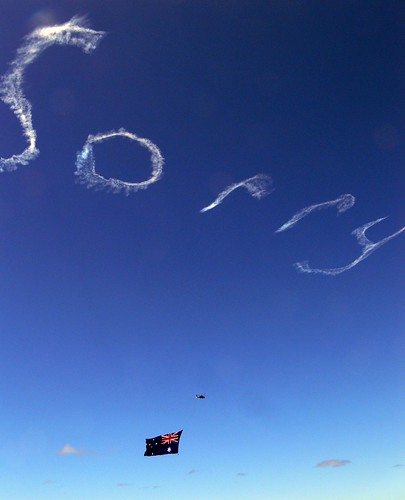
Saying sorry to the Stolen Generations isn’t the solution, but it is the beginning of a solution. Like Jean, I choose to be optimistic that this apology is an important and substantial step in the right direction for all Australians.
Update: Kevin Rudd has said sorry on behalf of all Australians, which is long overdue and most welcome. You can read the apology or watch it here.
[Photo by Spud Murphy]

Tama Leaver dot Net by Tama Leaver is licensed under a Creative Commons Attribution-NonCommercial-ShareAlike 4.0 International License.