Home » australia (Page 39)
Category Archives: australia
Australia’s Internet Censorship Regime
The first big concern for 2008 is that the newly-elected Rudd Labor Government in Australia has introduced laws requiring across-the-board filtering of the internet by ISPs. While the plan may have some good intentions behind it, if implemented in the way currently envisaged it will almost certainly make the internet in Australia slower, make internet services more expensive and likely infringe on privacy and civil liberties of Australian net users (seriously, a PIN number of equivalent to log on to the internet – why not have just been honest and kept the Australian ID card?!).
Not good.
For an overview of the changes, see Bookbuster; and for a good wrap-up of the increasingly negative media response, check out Peter Black’s solid overview here. Facebook users might want to join the Australian ISP filtering plan is stupid! or People against mandatory internet filters in Australia groups.
Update: As you might expect, the most sensible response thus far from an Australia politician to Labor’s internet censorship plan has been from Senator Andrew Bartlett:
As with every aspect of the measure, until the full details are known its impossible to judge. However, comments like Conroy’s make it much harder to be confident that the government is doing anything other than populist pandering, putting up a feel-good measure which will have no practical impact but create the illusion of doing something effective.
(My italics.)
From YouTube to UniTube?
It would appear that the University of New South Wales (UNSW) has the dubious honours of being the first Australian university to have their own YouTube channel. In the past couple of months, there have been a number of reports of US universities setting up on YouTube. For example, this article from News.com on UC Berkeley’s channel:
YouTube is now an important teaching tool at UC Berkeley.
The school announced on Wednesday that it has begun posting entire course lectures on the Web’s No.1 video-sharing site.
Berkeley officials claimed in a statement that the university is the first to make full course lectures available on YouTube. The school said that over 300 hours of videotaped courses will be available at youtube.com/ucberkeley.
Berkeley said it will continue to expand the offering. The topics of study found on YouTube included chemistry, physics, biology and even a lecture on search-engine technology given in 2005 by Google cofounder Sergey Brin.
“UC Berkeley on YouTube will provide a public window into university life, academics, events and athletics, which will build on our rich tradition of open educational content for the larger community,” said Christina Maslach, UC Berkeley’s vice provost for undergraduate education in a statement.
Similarly excited press has greeted other US universities, this article on the University of Southern California’s channel (Via). However, the I think educational administrator and web 2.0 aficionado Greg Whitby notes probably wins the most excited prize for his take on the UNSW channel (Via):
While it’s a great marketing strategy, it recognises where today’s students are. Although the channel will broadcast some lecturers in an attempt to reach potential students, it captures the ubquitous nature and popularity of Web 2.0.
This is the democratisation of knowledge – no longer contained within lecture theatres or classrooms but shared. Learning becomes accessible, anywhere, anytime. Transportable, transparent, relevant and exciting.
The University of NSW is to be applauded but we still lag behind. iTunes has developed a store dedicated to education called University. It’s ‘the campus that never sleeps’ – allowing universities across the US to upload audio/video lectures, interviews, debates, presentations for students – any age, anywhere. And it’s free. It’s astounding and exciting to think that a cohort of students and teachers from a school western Sydney can watch a biology lecture from MIT.
The challenge for us is to open our K-12 classrooms to a new audience – to share knowledge as professionals and to showcase quality learning and teaching as we move from isolated classrooms to a connected global learning environment.
Readers of any of my blogs will know I’m also an advocate for integrating certain web 2.0 tools into learning and teaching. However, these announcements seem oddly familiar to me – it’s just like the press that came out as pretty much every university in the world embraced podcasting one after another, each pushing out press releases about embracing the future. However, what didn’t happen half as readily was the pedagogical discussion about how podcasting should or could be used in education. Nor, I have to say, are we seeing much interrogation of the use of online video via YouTube or other services. Let me be clear: there is certainly value in using YouTube in particular ways in education. However, as I argued about podcasting in the past, it’s probably more important to focus on working out new ways to engage students (such as having them create content for podcasting or to post on YouTube) rather than primarily just replicating the top-down structures of lecture delivery. (I don’t have a problem with recorded lectures, I should add, I just don’t think that’s all we should worry about.)
It’s also worth keeping in mind that YouTube is a two-way street as demonstrated by clips of teachers at their worst appearing on YouTube.
Podcamp Perth Wrapup

Last weekend was Australia’s first Podcamp, right here in Perth. It was pretty good with an engaging mix of tech, talk and interesting folks. I don’t have time to hunt down all the many, many blogposts and photos from Podcamp, but Simone van Hattem links to most of them in her blog, or else you can check Technorati or Flickr. I was intending to add audio to my presentation slides, but the audio didn’t quite eventuate. However, Stewart Greenhill did an excellent job capturing video of many of the Podcamp sessions, and so if anyone wants to hear the session on Podcasting in Education which was led by Sue Waters and I, here you go:
(Yes, I do use a lot of gestures!)
For those who prefer a static image, here’s one picture of me attempting a ‘Presentation 2.0’ style of slides mainly because I wanted to try something a bit different (but also to keep my co-presenter Sue happy):
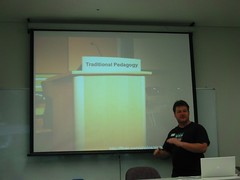
I also rather like this photo, of white and black Macs at play:
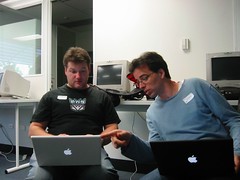
(Photos by CW.)
PS Yes, it’s October 31st, but, no, most Australian don’t celebrate Halloween. However, if we did, I’d definitely give the most candy to anyone who knocked on my door who was geeky enough to be wearing this.
Podcamp Perth
So, as I’m sure you remember, Australia’s first Podcamp happens today in Perth. It’s a free event and is held at Central TAFE in East Perth, so if you’re just remembering now, please still feel free to come along! Sue Waters and I are facilitating a session on Podcasting in/as Education at some point during the day (we sort the actual schedule out first thing in the morning). Here and the few slides I’ll be using:
 | View | Upload your own
There aren’t that many slides, as the whole point of an unconference is that everyone participates, so the sessions should be a lot more like a conversation that just presentations. My understanding is that the short presentation bits are really to help focus the conversation, not dominate it.
To check in on the blogging and podcasting during the day, and afterwards, watch the tag “podcampperth07“.
Tale of Mighty Rudd Ascension
As the description tells us, “Short propaganda philosophy tells tale of mighty Rudd ascension” …
Without a doubt, one of the best political satires, and mashups, of the 2007 Federal Election campaign thus far. And, yes, for those who watch The 7.30 Report, I am getting YouTube pointers from Michael Brissenden these days. After all, he’s a keen YouTube watcher himself now; as last night’s report said:
The 2007 election will be remembered as the YouTube campaign – the first time the internet became a real force. Both sides are exploiting cyber space relentlessly but as we have seen already, the net is not always such a comfortable place for politicians.
Bring on the political discomfort! 🙂
Update: NineMSN staff writers seem to like this clip, too.
Australia Bans ‘Soldier of Fortune: Pay Back’ Videogame

As Asher Moses reports in The Age, Australia’s censors have banned yet another videogame:
Australia’s draconian classification regime for video games has taken yet another scalp, with local retailers banned from selling the upcoming shooter title Soldier of Fortune: Pay Back. The highly anticipated game, which was to be released on PC, Xbox 360 and Playstation 3, was refused classification by the Classification Board for being too violent. Aside from Singapore, which is reviewing its classification system, Australia is understood to be the only country in the western world that does not have an R18+ rating for games. As a result, games that do not meet the MA15+ standard – such as those with excessive violence or sexual content – are simply banned from sale. This is despite recent figures from the Interactive Entertainment Association of Australia (IEAA) showing the average Australian gamer is 28, and over 50 per cent of gamers are over the age of 18.
While Solider of Fortune: Pay Back certain sounds very violent, the decision by the Office of Film and Literature Classification (OFLC) should, of course, have placed this game in an R18+ category, if only Australia had such a rating for games. Instead, games like this are refused classification altogether, implicitly suggesting that videogames are meant for kids (by having no adult game category) despite, as Moses notes above, the average age for gamers being well over 18 in Australia! Really, it’s time for the OFLC (and the Governors General at State and Federal levels, who’d need to push such a plan) to take note of the actual demographics of game players in Australia, and update the ratings system accordingly.
Of course, as comments on The Age‘s Screen Play Blog suggest, officially banning this game will likely result in it being downloaded illegally or simply purchased overseas – and legally – in pretty much any other English-speaking country.

Tama Leaver dot Net by Tama Leaver is licensed under a Creative Commons Attribution-NonCommercial-ShareAlike 4.0 International License.