Home » australia (Page 43)
Category Archives: australia
Facebook and Australian Politics?
Over the past month I’ve suddenly seen Facebook grow from an oddity to something on which the majority of my university-based friends appear. Since I spent some of yesterday pondering the oddities of US politics and digital culture, I thought I’d spend a little of today looking at Australian politics. For those of you not in the know, Australia has what amounts to a two-party political system, divided between Liberal (close to Republican/Tory parties) and Labor (close to the Democrat/UK Labor parties); the Liberal party is led by John Howard, who is our current Prime Minister, while the Labor party, after many years of leadership ambiguity, is led by Kevin Rudd.
Unlike the US (and a lesser extent the UK), mainstream press and politics in Australia really hasn’t embraced either the blogosphere or social networking as a means of promotion or gaining support (and Australian politicians can’t and don’t fund-raise in the explicit way US politicians do). That said, younger voters are clearly looking for some sort of connection with the political sphere, even if its not done through the same rhetoric of civil participation that comes through the US education and advocacy systems. So, that said, is either Australia’s Prime Minster or his Labor rival on Facebook? The answer, initially, appears yes to both, although after some scrutiny, the answer changes to yes for Rudd and no for John Howard – there are, in fact, three Howards, but all are fake.
Of the three Howards, two are obvious fakes, while one is more subtle, but still not authentic. Since this is a fun moment to think about digital literacy, I’ve taken screenshots of the three Howard profiles and circled in red the most obvious indicators that these aren’t authentic pages.
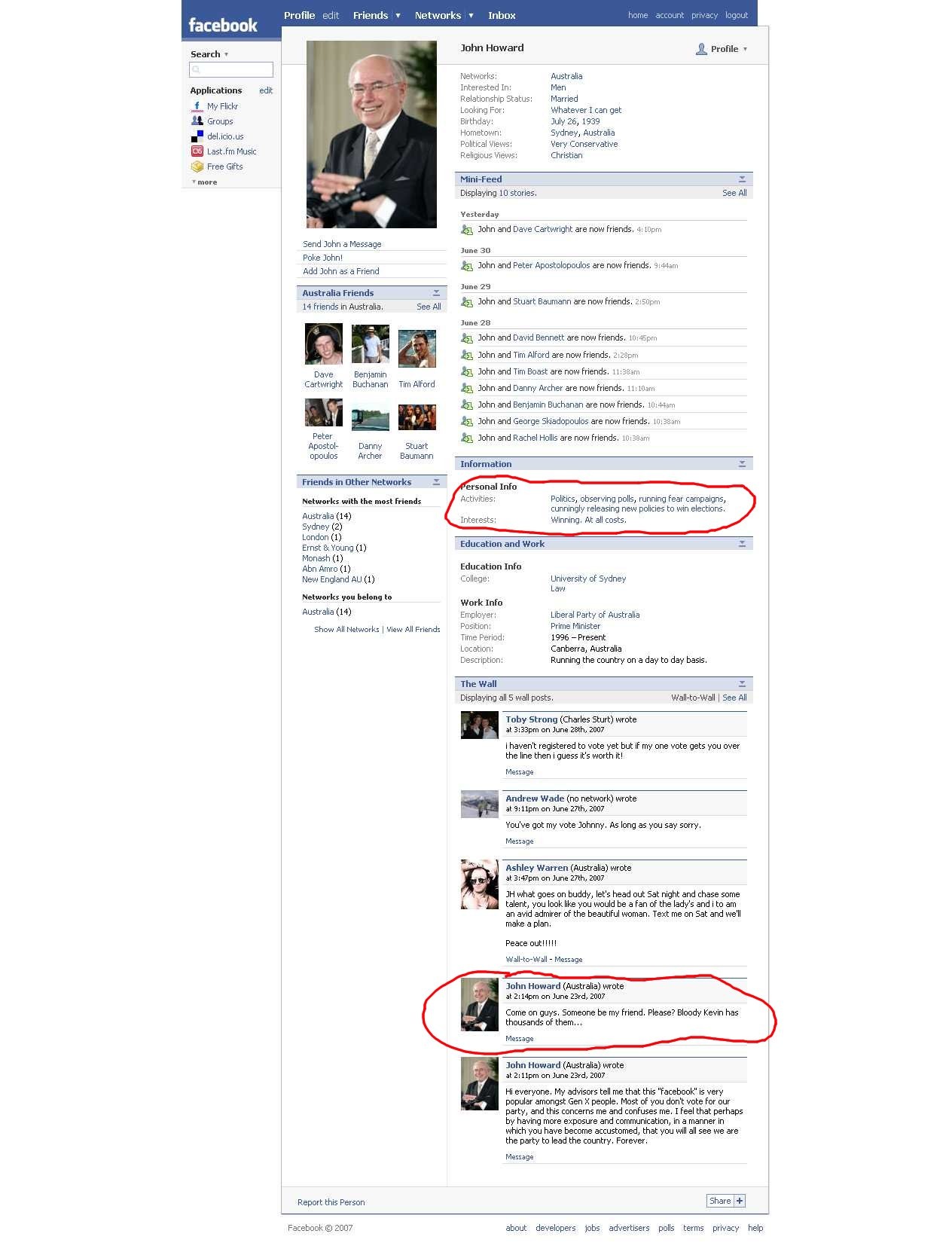
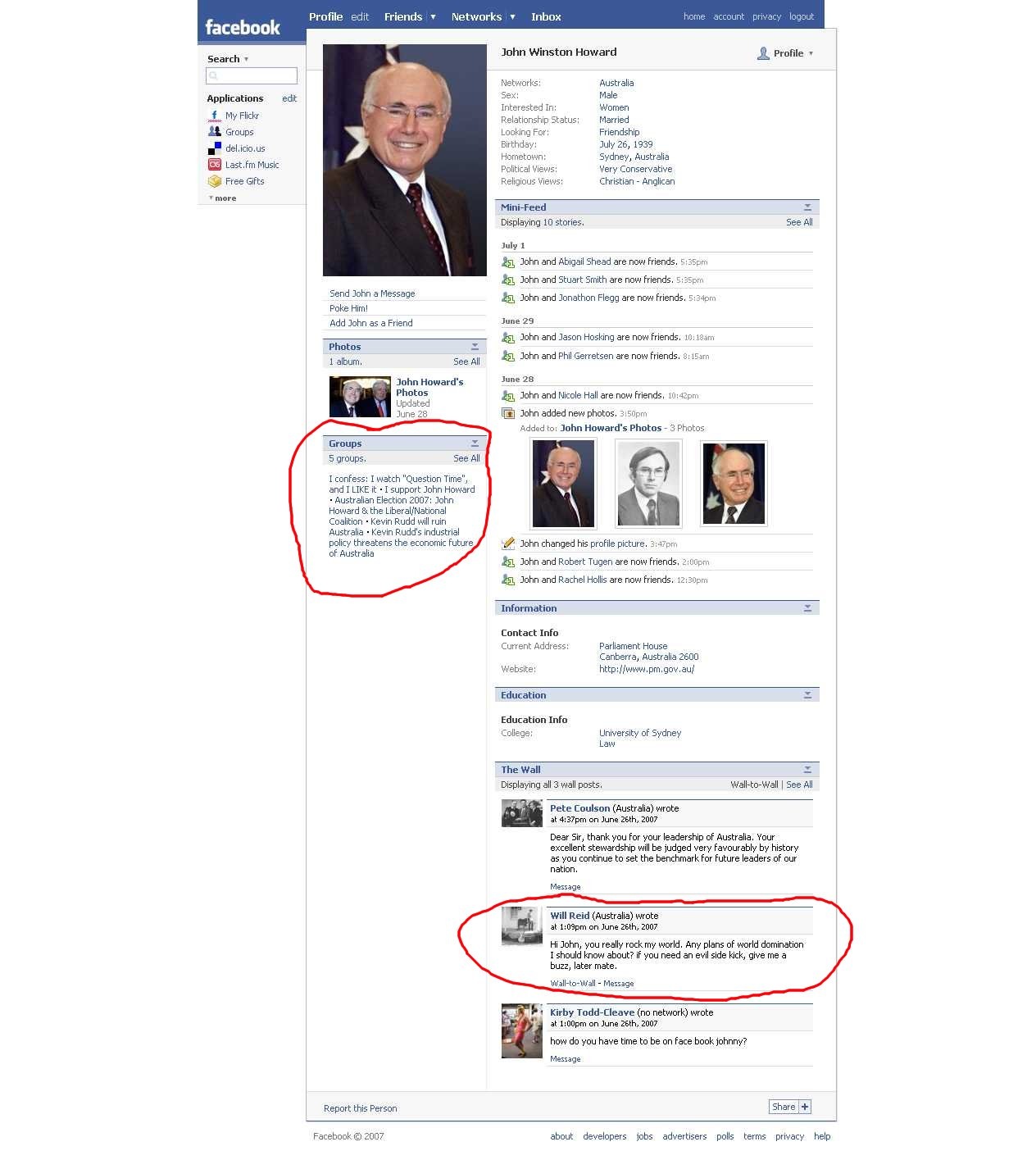
and John Howard #3 …
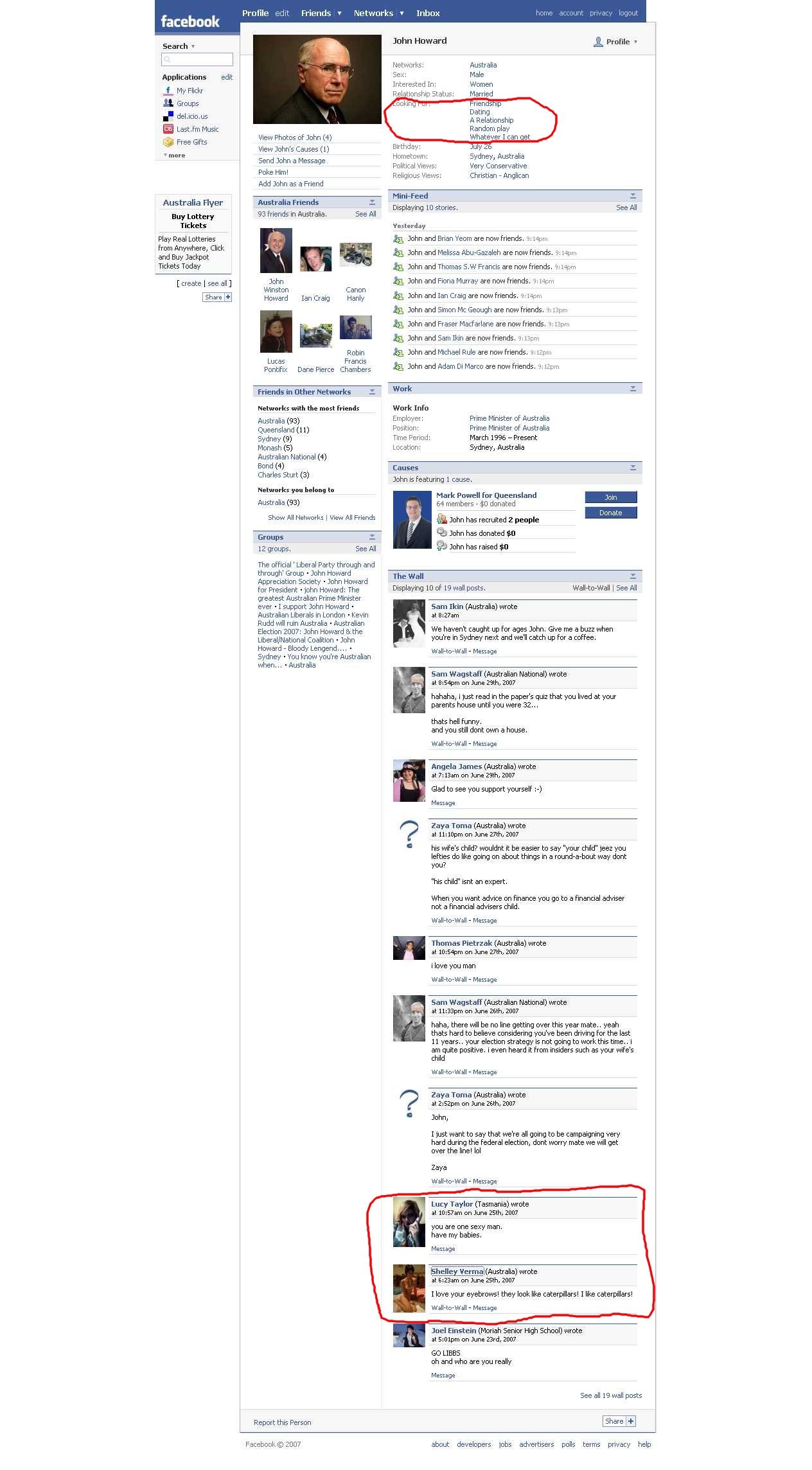
In contrast, Kevin Rudd’s Facebook page is rather dull, but clearly authentic. (I’ve just made a friend request, so if there’s anything exciting in friends-only land, I’ll write a little more.) It is worth noting that comments which cast John Howard as a sexual or ‘hot’ figure are unambiguously meant to be satirical, in contrast to the clips from the US mentioned yesterday which, while playful, aren’t necessarily ironic (although they might be, especially Hott4Hill).
When Subiaco Oval Attacks!
The second half of 2007 hit with something of a bang today. The combination of extreme winds and the proximity of our place to Subiaco Oval suddenly led to the rather loud, dramatic and quite dangerous appearance of the massive advertising signs from Subi Oval hitting out (glass) back door and coming to rest in our back yard:
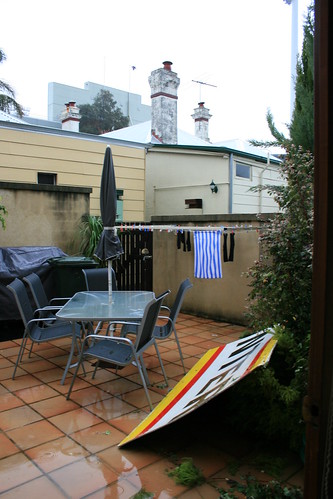
While fascinating on some level, these huge signs had to travel over the top of the oval (they’re supposedly fixed to the stands) and fly probably 50 metres in the air before spinning down into our place. It’s incredibly lucky that it was pouring with rain, too, because it anyone was outside, being hit by one of these could have caused some very serious injuries.
When the winds settled a little, Emily headed out the front door and discovered a whole lot more of these hoardings lying on our road and in the drive-way, so now we have four massive advertising banners on centimetre-think cardboard sitting soggily in our little backyard:

We now have part of an SGIO sign, a National Australian bank advertisement and something that has NTER in its lettering. I wonder when Subiaco Oval will be knocking on our door looking for them? Maybe they’ll offer to replant the bits of the garden that were sheered in half when the sign flew in from the sky?!
(Given that these signs cost advertisers anywhere from $5000 to $60,000 dollars each to display, I suspect someone might want them back!)
Indigenous Health is Australia’s Katrina?
While I was away, the health, welfare and abuse issues in some indigenous Australian communites has flared into the political spotlight. The issues aren’t new, but several new reports and issues have focused the debate markedly. That said, I was still quite suprised to hear Australia Prime Minister John Howard comparing these issues to the 2005 Katrina disaster in New Orleans:
“Many Australians, myself included, looked aghast at the failure of the American federal system of government to cope adequately with hurricane Katrina and the human misery and lawlessness that engulfed New Orleans in 2005,” he said in a speech to the Sydney Institute last night. We should have been more humble. We have our Katrina here and now. That it has unfolded more slowly and absent the hand of God should make us humbler still.”
The religious tones here seem particularly unhelpful, and casting this as Australia’s Katrina makes light of the fact that these issues are a systemtic issue which have been around for some time. Sending in the troops (literally) may not be the best approach for communities which still have very real memories of children being forcibly removed from families a generation earlier. That said, change has to happen, and I tend to agree here with Democrat Senator Andrew Bartlett:
There has been a fair degree of cynicism amongst many of the responses to the government’s plan, including from many Indigenous Australians. Given the past history of many grand government announcements which have not been followed up with adequate resourcing or implementation once the headlines have died down, there is every reason for people to be cynical. However, that should not be a reason to try to tear this plan down, it should be a reason to keep the focus on it, to do everything possible to translate all the current waves of rhetorical flourishes into real and lasting positive change.
For your own reading, please …
[X] Read The Northern Terrtitory Inquiry into the Protection of Aboriginal Children from Sexual Abuse and the many, many problems it describes (or, at least, look at the Foreward);
[X] See North Queensland Aboriginal leader Noel Pearson being interviewed last week on the 7.30 report about some of the strategies being implemented (which were recommended in a report he chaired);
[X] But also keep in mind that the timing of this is political since former WA premeir Geoff Gallup called this issue a “national disaster” in 2002 and called for broad-scale national and state-level action in that year (“There needs to be a national approach to this, it’s not just a Western Australian issue”). None happened until a closely run Federal election was looming. (That’s a reason to try and ensure that the energy galvanised here is directed in a sustained way, not a short-burst political way. And, to be honest, even gettings things right here doesn’t make up for all the years that the Howard goverment has done nothing, despite the issues being clear as day.)
Academic Ethics, Privacy and Transparency … all coming soon to YouTube!
Australia’s QUT has been in the grip of a very public controversy recently which dovetails between issues of freedom of speech, academic ethics and the transparency of university processes. The controversy came to light and media attention on 11 April this year when two QUT academics, John Hookham and Gary MacLennan, published an article in The Australian entitled ‘Philistines of relativism at the gates’. In it, Hookham and MacLennan very publicly took issue with the ethics of work being done by PhD candidate, Michael Noonan:
A time comes when you have to say: “Enough!”, when you can no longer put up with the misanthropic and amoral trash produced under the rubric of postmodernist, post-structuralist thought. The last straw, the defining moment, came for us when we attended a recent PhD confirmation at the Queensland University of Technology, where we teach. Candidate Michael Noonan’s thesis title was Laughing at the Disabled: Creating comedy that Confronts, Offends and Entertains. The thesis abstract explained that “Laughing at the Disabled is an exploration of authorship and exploitation in disability comedy, the culmination of which will be the creation and production (for sale) of a six-part comedy series featuring two intellectually disabled personalities. “The show, entitled (Craig and William): Downunder Mystery Tour, will be aimed squarely at the mainstream masses; its aim to confront, offend and entertain.” (Editor’s note: the subjects’ names have been changed to protect their privacy.) Noonan went on to affirm that his thesis was guided by post-structuralist theory, which in our view entails moral relativism. He then showed video clips in which he had set up scenarios placing the intellectually disabled subjects in situations they did not devise and in which they could appear only as inept. Thus, the disabled Craig and William were sent to a pub out west to ask the locals about the mystery of the min-min lights. […]
At the seminar we were told there was a thin line between laughing at and laughing with. There is no such thin line. There is an absolute difference that anyone who has been laughed at knows. We must admit with great reluctance that at the seminar we were alone in our criticism of the project. For us, it was a moment of great shame and a burning testimony to the power of post-structuralist thought to corrupt. It is not our intention here to demolish the work of Noonan, an aspiring young academic and filmmaker. After all, ultimate responsibility for this research rests with the candidate’s supervisory team, which included associate professor Alan McKee, the faculty ethics committee, which apparently gave his project total approval, and the expert panel, which confirmed his candidacy. […]
What we have instead is the reality that cultural studies is in the grip of a powerful movement that we call the radical philistine push. It is this same movement that has seen the collapse of English studies and the consequent production of graduates who have only the scantiest acquaintance with our literary heritage. It is also undermining the moral fabric of the university.
So, what starts with ethical questions about a particular thesis, quickly becomes a much more generic complaint about the corruption of education by poststructuralist and postmodern theory and approaches. I know nothing of the people writing or mentioned in this article, but have to say after reading the piece I wasn’t swayed; my sympathies were more with Michael Noonan than anyone else, because as a PhD candidate I know I would have been almost destroyed by such public denouncing of my work. This, I should add, is not a comment on the quality on the work being or proposed – I know nothing beyond the article above and the surrounding debate, and haven’t seen any of the footage mentioned – but rather a comment on the process and the reasonable expectation that any criticism of a candidate’s work be handled within the university as long as possible. I’m not saying there is never a case for ‘going public’ with dismay about certain research, but from what I’ve read I believe Hookham and MacLennan took that step far too early. More to the point, combining criticism of a specific project with a very generic attack on a particular body of theory and its influence on teaching seems a less than generous way of dealing with the work of a PhD candidate.
The issues raised here also beg serious questions about transparency and universities. There is a lot of talk about the need to transparency of research outcomes since (most) Australian universities are at least partially publicly-funded. I quite agree with that notion. However, I think the idea of the processes of a university being taken public under the rubric of transparency tend to skew what makes it into the public arena. Selectively releasing aspects of a process (such as an ethics review process and confirmation of candidature) around research which clearly relies on careful contextualisation is bound to produce a one-sided picture. Tellingly, when Hookham and MacLennan’s article was republished in Online Opinion, the were comments from a student – using the handle WWSBD – who’d had Noonan (the candidate) as a lecturer, praising his efforts to educate student about people with disability. Moreover, this is the only place I’ve seen Noonan himself comment publicly:
I am at the student at the centre of Hookham and MacLennan’s attacks.
I thank WWSBD for understanding and appreciating my work in its context. I appreciate the words of Anecdote, who understands that a work must be seen and placed in context before it should be attacked. And I am disappointed for bedwin, who has lost all respect for me on the basis of an uninformed and incorrect article.
Much has been assumed about my project, my integrity and my intentions. Very little of it is based on truth. The simple facts are these: the excerpts I showed at my PhD confirmation seminar were presented in the context of exploring and discussing issues of authorship and representation in disability. My project seeks to empower the disabled, to give them a voice through comedy. Each clip was prefaced with my own thoughts about whether or not this had been achieved.
As a sessional staff member at QUT, I can think of nothing more deplorable than attacking a student’s incomplete research in a public forum. Hookham and MacLennan have made no effort to read my PhD confirmation document (it was offered) and they rejected my attempts to meet and discuss their concerns.
To date I have not sought to respond to their attacks in print. But I refuse to be further bullied and vilified before the public, my peers and my students.
However, the story doesn’t end there. Earlier this month The Australian report that Hookham and MacLennan are now facing a disciplinary hearing at QUT for their public comments, with the university arguing that the two unfairly attacked the candidate and his supervisory team. Now, whatever their views, Hookham and MacLennan seem to have a reputation as inspirational teachers themselves, and the news of their censure galvanized some of the QUT student body to defend their actions on the basis of free speech. The student campaign is visible through it’s “Save Our Lecturers” MySpace page. Moreover, over at Martin Hirst’s blog, he has posted ‘Freedom of Speech disabled at QUT’ which points to this documentary which is now available at YouTube:
(Hirst is a friend of Hookham and MacLennan’s, and his post also contains the full text from Hookham and MacLennan’s original article in The Australian, as well as some additional commentary from The Australian and subsequent letters to editor.)
The YouTube documentary clip, by QUT student Adrian Strong, is very compelling; Hookham and MacLennan both come across as intelligent, compassionate teachers and academics who have good cause for concern. My point here is not to judge the debate being documented in this clip – although I imagine it would be extremely compelling for many people. Rather, in the era of participatory culture and digital media, this clip is indicative of a very profound change which can see debates and arguments that once would have remained closed suddenly being open to public viewing and public debate. In such an era, digital literacy is extremely important – the ability to create, edit and share such a clip is a key part of the ability to make a case in the public eye. It’s no surprise that QUT, which has Australia’s most renowned Creative Industries faculty, should be the source of the first such debate in Australia (to my knowledge, at least).
Illustrating my point, I just noticed another posted by the same YouTube user who posted the clip above (and thus, I presume, also be Adrian Strong) which talks in even stronger terms about a perceived campaign of censorship at QUT:
(Again, let me reinforce, I don’t know enough about the other things going on to really judge this debate, but I do know that the perception of censorship certainly doesn’t add to the reputation of any university. However, like the first clip, without any further rebuttal, this clip is likely to be very persuasive to viewers.)
Update: In ‘Dissenting dons out in the cold’, Andrew Fraser reports in The Australian that the saga ended with Hookham and MacLennan both being suspended without pay for 6 months from QUT.
Searching Blogs Vs Wikis – Australians Prefer Wiki (The World Prefers Blog)
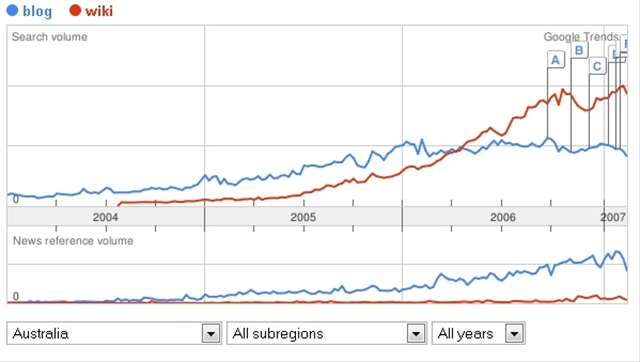
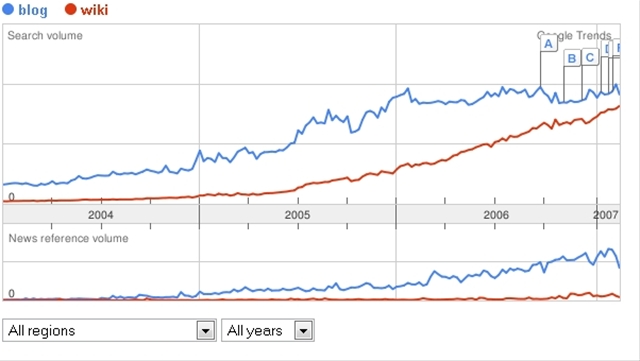
I was playing with Google Trends and their comparison function and noticed that you can now limit searches to regions (ie just Australia, for example). I was playing around looking at the comparative popularity of ‘blog’ versus ‘wiki’ and found something interesting: cumulatively, global searchers are still typing in ‘blog’ more, but in Australia, ‘wiki’ is a more popular term, and has been since the third quarter of 2006. Since there’s no scale on Google Trends, I’ve no numbers attached to these trends, but the results are interesting nevertheless.
Australia is looking for wikis…
While the world is looking for blogs…
[Click either image to expand.]
I’ve no idea why wikis are more popular in Australia … perhaps something to do with Wikipedia? I note in the News trends (the smaller bottom graph), blogs are still mentioned a lot more in the mainstream media. I wonder what it is about wikis and Aussies?
V-Tech Massacre: Tasteless Videogame based on the Virginia Tech Massacre
 A 21-year old Sydney man, Ryan Lambourn, has sparked outrage by creating a game based on the Virginia Tech Massacre. The game, called V-Tech Rampage, is far from technically impressive, but has nevertheless understandably upset quite a few people. One of the real difficulties is that while there have been a number of important political games and simulations which have tried to ‘speak’ about political issues (from September 12 to Donkey John to World Without Oil) this game – if it does have a point – really doesn’t make that clear. Over at Joystiq, the creator of the game based on the Columbine Massacre is quoted, citing his disappointment with the V-Tech game:
Danny Ledonne, creator of Super Columbine Massacre RPG, writes on Lambourn’s site, “It would appear to me that Ryan has no intention of doing much other than making money and gaining immediate recognition after the Virginia Tech shooting. Inevitably, comparisons between SCMRPG and VTech Rampage are being made right now. Some bloggers despise both games equally whereas others recognize a level of commentary that SCMRPG attempted which was not evident in VTR. For myself I wish to point out that SCMRPG was never a for-profit endeavor and thus I never posted statements like that which is on the VTR game’s homepage”
Adding fuel to the Lambourn posted a notice say he would only remove the game if he received $2000 in donations. This sparked even more vitriolic comments on the game, but in those comments Lambourn defends the donations statement, say it was a further aspect of satire:
PiGPEN – May 15th 2007
Danny, the donation thing is there as a joke against all the people commanding me to take my game down. I didnt think anyone would donate money to it and so far my paypal account has proven me right (BUT I COULD USE SOME FUCKING MONEY THANKS!).
And i’d appreciate if you didnt use the name “Ryan”. That name is reserved for my close friends and family… i cant help the people that gleaned personal information from my website but i would hope you would have the courtesy to not disrespect me in such a manner on my own website…Danny.
Of course, the irony of courting controversy and then being surprised when it results in negative public sentiment (and the post of Lambourn’s full name, address and phone number in numerous locations online) is pretty thick. On the web, even thought two wrongs don’t make a right, they’re never far from each other!
See The Age for more details.
Update (17 May, 2:25pm): The ‘official’ version of the game hosted by Lambourn (and this whole website) have been taken down. (That said, given the nature of digital culture, if anyone looked I’m sure they’d find another copy somewhere”¦) Lambourn’s website now sports a “This Account Has Been Suspended” notice.
Update 2 (4 June 2007): After reviewing the case, Australia’s Office of Film and Literature Classification gave the game an MA15+ rating, not banning the game as had been suggested.

Tama Leaver dot Net by Tama Leaver is licensed under a Creative Commons Attribution-NonCommercial-ShareAlike 4.0 International License.