Home » australia (Page 44)
Category Archives: australia
Gail Jones shortlisted for the Miles Franklin Award
 A huge congratulations to my UWA colleague, Gail Jones, on being shortlisted for this year’s Miles Franklin award for her new book Dreams of Speaking; Vintage (Random House Australia). Her competition this year is pretty impressive, too: Careless by Deborah Robertson; Carpenteria by Alexis Wright; and Theft: A Love Story by Peter Carey.
The winner will be announced on June 21st.
24 Hours of Flickr
Today 05.05.2007 (which is one of those lovely dates which makes sense on both US and normal people’s calendars), photography sharing and community building uber-site, Flickr, is running an event called 24 Hours of Flickr. The details:
To celebrate this global community, we invite you to join us in “24 Hours of Flickr” – a day-long global photo project. On May 5, 2007, grab your camera and whatever else you need, and chronicle your day in pictures. The group’s photos will be featured at Flickr events around the world this summer and in a companion book, which will contain a selection of photographs chosen from the group…
While the day is just beginning in the US, it’s well into the night here in Perth. I’ve remembered to carry my camera some of the day, but a lot of what I did wasn’t photography-friendly (I didn’t think taking pictures in the screening of Spider-Man 3 would be overly well received!). I’ve taken a few shots of my day in a set here. Thankfully, the paucity of shots today meant is was rather easy picking my one decent shot for the Flickr pool. The only better candidate was a photo of Emily’s work-in-progress painting of Tulips, but I it seemed wrong to post a photograph of a painting for a photography pool! So here’s the image I settled on …

It’s called Wrecked Angles (oh, I do love a good pun); it’s all rectangles, unfinished painted walls, security-wired windows and cracked glass. And yet, in black and white, aesthetically quite fascinating. (It was taken in Subiaco, Western Australia, but by no means indicative of the suburb!) It doesn’t really look that impressive scaled down, but take a look full-size and see what you think.
I can’t wait to see what other photos emerge during the day! 🙂
“We’re sorry, but the clip you selected isn’t available from your location:” Watching Battlestar Galactica in Australia and the Tyranny of Digital Distance
I just submitted an abstract for the Media International Australia special issue ‘Beyond Broadcasting: TV for the Twenty-first Century’. Here it is:
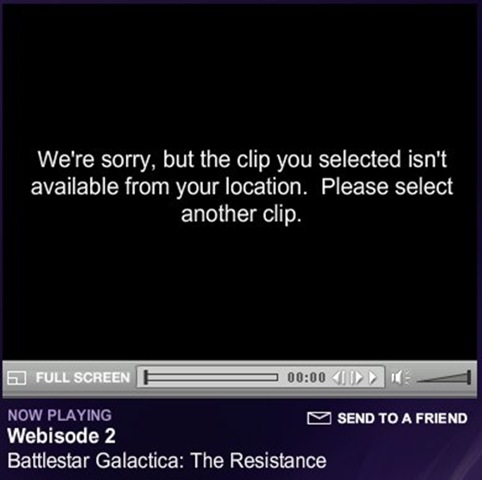
“We’re sorry, but the clip you selected isn’t available from your location:” Watching Battlestar Galactica in Australia and the Tyranny of Digital Distance
[Figure 1. Screen-capture from http://www.scifi.com/battlestar/, 11 September 2006]
In the late 1960s, conservative Australian historian Geoffrey Blainey coined the term “the tyranny of distance” to describe how the geographic gap between Australia and the centres of the Western world (US, UK) played a fundamental role is shaping the Australian psyche and character (Geoffrey Blainey, The Tyranny of Distance, Sun Books: Melbourne, 1966). Thirty something years later and the world is far more widely considered a global village; the world wide web, email and a million other applications have made real-time information-heavy communication and commerce the norm. However, while information transfers have made ‘distance’ much less of a concern in a number of ways, many policies, practices and systems of commerce still operate as though they are centred on goods moving at the speed of physical shipping, not allowing for information moving at the speed of light down a copper or optical wire. In an era when ‘the tyranny of distance’ means so much less in many contexts, this paper will argue that in the multimedia markets of contemporary society there is, rather, a prevailing tyranny of digital distance which marks out those areas of communication and commerce in which the potential and, indeed, expectation of synchronous global culture (at least for English-speaking countries) leads to constant state of confusion and annoyance – on both personal and legal levels – when those expectations are not met.
The North American-produced television series Battlestar Galactica, re-imagined for the twenty-first century (from an original 1970s series), has consistently been at the cutting edge of television and cross-media. Executive producer Ronald D. Moore and the Battlestar team utilise not just blogs and production-side video-blogs, but also create episodic commentary podcasts, make deleted scenes available online, and have even put two full episodes online for free for viewing. Likewise, Battlestar was one of the first shows available via Apple’s online iTunes Store. Given the amount of extra online content, and the show’s science fiction genre, Battlestar has a large and very active fan community who consume both the television show itself and the officially produced extra material, as well as actively creating and discussing their own derivative ‘fannish’ works ranging from blog commentaries to fan-created videos. Thus, when the show’s producers launched a series of 3 to 4 minutes ‘webisodes’ to re-build interest in the show prior to the launch of its third season, fans across the (wired) globe were understandably excited. However, when citizens of Australia, the UK, Canada or any other country outside the US tried to view these webisodes, they were met with a notice saying: “We’re sorry, but the clip you selected isn’t available from your location.” The owners of Battlestar (NBC) elected to restrict these webisodes to residents of the US only. This decision upset fans across the global Battlestar audience, with US fans quickly circumventing the restrictions and passing copies of the webisodes to their international fellows. In this paper, I will contend that this moment typifies the tyranny of digital distance, exemplifying the legal, ethical and practical issues raised when a globally-promoted television series ‘centres’ on a single national audience. I outline the difficulties of ‘watching’ Battlestar from Australia, and argue for distribution modes which are more in keeping with the technological (and fan-led) potential of digital distribution.
As you might imagine, this paper will draw together my previous thinking about the tyranny of digital distance which you can read about here and here. I’m also finishing off another Battlestar-related paper that stopped being written for a year, but is now being finished off for a new collection. It’s going to be a busy month, but I’m hopeful both of these will be well polished before Emily and I get married on June 9th (presuming this abstract is accepted). Wish me luck!
Update (8 May 2007): The abstract has been accepted! Thankfully, though, full papers aren’t needed until August 1st so I’ll be writing this after Emily and I return from our honeymoon (in Venice!!) :).
Update 2 (21 September 2007): The full version of this paper has been accepted after peer review, and will appear in Media International Australia issue 126, which is scheduled to be released in February 2008.
Update 3 (26 March, 2008): You final version of this paper has appeared, and you can read it following the link from this post.
Apparently I’m in Vogue
 You’ll forgive the title to this post, I’ve never been able to let a good pun go and I doubt I’ll ever be able to use that one again. It’s true, though: I was interviewed about a month ago by Cathrin Shaer, a New Zealand-based writer for Vogue Australia who was writing a piece on life online. She was trying to do an awful lot in one article (talking about MySpace, Flickr, YouTube, Second Life, etc.) but somehow my name came up and I ended up talking with her for almost an hour about the complexities of interaction in different online modes. Clearly the bit that stuck was about Second Life. Here is the snippet from that interview which appeared today in ‘A life less ordinary’ (Vogue Australia, May 2007):
Tama Leaver, a lecturer at The University of Western Australia whose research interests include exploring how humans interact with technology, has used Second Life for business meetings: “Most of the people working in my field are spread across the globe. I’ve participated in teleconferencing, but it’s better of have a conference in Second Life because you’re all in a room together, rather than just disembodied voices.” Apparently, even if you’re meeting with a bunch of serious academics, it doesn’t matter if you look like a cartoon character. “There’s a great parallel in animated films,” Leaver explains. “We understand what’s going on in an animated character’s face — most people understanding what Shrek was saying.”
Not exactly mind-blowing stuff on my part. Also, I suspect there are a few sentences Shaer could have left in since there was somewhat more space and substance between talking about academic discussion in Second Life and Shrek (for the record, I’ve never met anyone online or offline who looks like Shrek – while the facial features might be there, no one I’ve met was actually green). That said, it’s interesting to see interest in social software spreading as far as Vogue. (Although I was a little surprised that they didn’t use any Second Life screenshots for illustration – and what they did use seemed like a bad high school art collage – perhaps the Vogue graphics people didn’t actually make it in-world).
‘Ghosts of blogging’?
In light of the recent tragic chatroom/webcam suicide, I wondered what an article “Ghosts of blogging haunt net cemetery” might have to say about the role of blogs after a blogger’s life. Alas, this has to be one of the worst, ignorant, mainstream-media puff pieces in a long time:
In the latest entry on her personal weblog, Lindsay Lohan, the hard-partying Hollywood actress, was in characteristically bubbly form. “Hey guys, I’m soooo sooo sorry I haven’t written in a while!!” she wrote. She was heading off to New York for two days of photo-shoots, then to Toronto in Canada for a week of filming, then back to Los Angeles again. The entry ended: “I just wanted to check in, I’ll try and write more … xx LL.” It has been a long wait for any Lohan fans who may be hoping for an update. That entry was posted on October 15, 2003.
Lohan’s blog has since taken its place in the internet’s fastest-growing graveyard – of an estimated 200 million blogs that have been started, then abandoned.
The extraordinary failure rate of online diaries and claims that interest in blogging will soon begin a precipitous slide are sparking an intriguing debate about the future of self-expression on the internet and whether blogs, once seen as revolutionary, are destined to become a footnote in the history of computing.
To the embarrassment of millions of internet users – from Hollywood celebrities such as Lohan, Melanie Griffith and Barbra Streisand to countless ordinary parents, workers and would-be poets – the evidence of failed diary-keeping cannot be easily erased from search engines that continue to provide links to blogs that have lain dormant for years.
This article clearly commits many of the most juvenile mistakes about writing regarding blogs — no, not all blogs are online diaries; no, celebrities who blog are no more typical of bloggers than they are of people — but even a journalist who has never read a blog should feel a little silly making the leap to describing the ‘extraordinary failure rate’ of blogs. Or are blogs, unlike regular diaries, or pretty much any other form of narrative or writing – the only form which is supposed to be endless? Blogs have been around for a long time and, like most other things, many blogs have had their natural lifespan, dictated by the purpose for which they were originally constructed. Some blogs are used in education – and thus often have a lifespan of a semester or two; some are issue-driven and may end when that issue is resolved; indeed some are diaries, but like hardcopy diaries, they tend to get left behind after a few years.
All of those gripes aside, the article did make two good points: firstly, that the exponential rise of blogging has to slow soon (because exponential means, quite literally, that there would have to be more blogs than people within a few years at recent growth rates); and secondly that citizens of a digital culture may be shifting their focus to other platforms like YouTube and MySpace. That’s not really an argument about the death of blogging, though – it’s more testimony to the maturing of the world of social software in that many more options available for those many networks of interest and friendship which life online can facilitate.
Of course, I wonder why no one writes about how many MySpace profiles are abandoned? (Far be it from me to points out that the same folk that own MySpace own The Australian).
I guess one has to ask The Australian, if blogs are on the decline, why does your blog section keep growing?
Four Corners: ‘You Only Live Twice’
In conjunction with their purchase of a Second Life Island, the ABC (Australian Broadcasting Corporation) dedicated a full Four Corners programme to exploring the world of Second Life. It was actually quite a fair representation of SL (at least, as I understand it, only having spent a few hours in-world); it was also neatly structured to familiarise viewers who’ve never heard of virtual environments with SL as it began with Ticky Fullerton’s (the journalist’s) signing-up process, and showed both in-world and material-world footage as she developed her avatar, checked out Orientation Island and eventually explored the people, the markets and the inevitable red-light districts of SL.
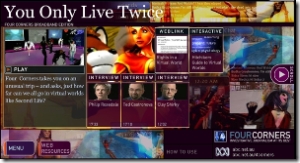 Also of interest was the way in which the programme was presented – it wasn’t just a 45 minute slot, but also has a substantial online presence on the Four Corners website. The layout of the extra material is a little busy for my taste, but the wealth of material is excellent – there are longer versions of the interviews with Philip Rosedale (Second Life’s US creator), Ted Castranova (a well-respected academic voice on Virtual worlds and virtual economies) and Clay Shirky (SL’s most prominent critic). I particularly like these ‘raw’ interviews as you can hear all the questions asked, something that regularly gets lost in the tight editing which happens in putting a 45 minutes show together.
The ABC, like the BBC, is not hampered by trying of extract every last cent for their productions; rather, their mission statement is to disseminate their shows as accessible to Australians as is possible. It means these sort of extended versions are part of their core mission, and I’m quite impressed with the amount online (my only gripe is that it’s all flash video, so not so easy to download – a concern if I wanted to use a few minutes of one of the interviews in a lecture!).
For those who prefer to check out a lo-fi version before spending the time watching the videos, there is a full transcript of the ‘You Only Live Twice’.

Tama Leaver dot Net by Tama Leaver is licensed under a Creative Commons Attribution-NonCommercial-ShareAlike 4.0 International License.