Home » web2.0 (Page 25)
Category Archives: web2.0
Learning Futures: Day One Insights
I’m at the Learning Futures Symposium today and tomorrow. I’m not blogging summaries of sessions because, to be fair, that’s often quite dull. However, I thought I’d take the opportunity to take the conference discussions to springboard some observations or thoughts that occurred during these interactions”¦
Insight #1: There is a reasonable amount of critical distance in terms of the ‘digital natives/digital immigrants’ rhetoric, but the same critical perspective doesn’t stretch to critiquing the idea of ‘web 2.0’. Whereas ideas which supposedly encompass an entire generation are easy enough to pull apart, many educators seem wary of software and claims made about software as they acutely feel that this is one of the few areas in which students know more about this area than they do. I suspect that if the same educators were dipping their toes in a little more they’d realise something commonsensical which seems to have entirely escaped these kind of conversations: that while there are many types of web 2.0 software, there are generic skills to be found in using these tools and platforms. The reason that people can move from Friendster to MySpace to Facebook so easily, for example, is that at a basic level there is a lot of similarity between the way these platforms operate and the skills needed to use them. Sure, the rate of new names of software can be overwhelming, but if we remember that a large section of the skills learnt using one social software platform are viable for the next, super-duper, upcoming must-have web 2.0 tool are transferable, that makes taking the time to learn and teach them a whole lot more important and palatable. And social software platforms are just one example; skills in blogging, using wikis and many other forms of ‘web 2.0’ tools are similarly transferable and, at some level, generic. Perhaps we should be focusing more on what those skills are.
Insight #2: Often the people in the driving position for educational policy aren’t confident to make decisions about ICT – nor should they be!
It’s Going to be a BIG September!
I’m attending four conferences or symposia across the next four weeks. In a perfect world, each will come with details blogging; however, if I don’t get around to writing much for a few weeks, here’s why …
[X] Learning Futures Symposium – 10 & 11 September, Canberra – This is a two-day symposium held at ANU looking at the changing shape of education, pedagogy and learning in general in the face of changes brought on by digital communication under the web2.0 umbrella. The programme (pdf) looks pretty interesting, with showcases of Australian social software educational efforts and some great sessions which are more centred around conversations than too many formal presentations.
[X] Thinking Society, Thinking Culture – 13 & 14 September, Perth – This is an interdisciplinary forum organised by the Institute for Advanced Studies at UWA with the aim of bringing WA’s many academics, researchers, artists across the range of historical and cultural studies, and other social sciences, together the share their work and build fruitful interdisciplinary networks and exchanges. I’m giving my paper “‘We’re sorry, but the clip you selected isn’t available from your location’: Watching Battlestar Galactica in Australia and the Tyranny of Digital Distance” in ‘A Digital World’ session which takes place on Friday, 14 September starting at 10.30; this panel will also feature Toby Burrows talking about ‘e-Research and the Humanities: Current Directions’, Ethan Blue talking about ‘Prison Medical Photography in Early 20th-Century California’ and Jeremy Blank speaking on ‘Past,Present,Futures:Integrating practice in Visual Art studies’.
The keynote is being delivered on Thursday (13th) evening by Ross Gibson from UTS talking on “The Aesthetics of Repletion“; this talk is open to the public, so if you’re in Perth, come along!
[X] PerthDAC – Digital Arts & Culture – 15 to 18 September, Also Perth – DAC has a history of being at the cutting edge of digital arts and media studies and this year looks to be no exception. There’s lots to look forward to, from talks on blogs in education to Axel Bruns on produsage to a host of key names in game studies talking about everything from Second Life to the Wii. DAC is concurrent with BEAP (the Biennale of Electronic Arts Perth) so the theory of DAC will mix with the performance and exhibitions of the latest in digital art which will no doubt be a very rich and exciting four days!
[X] The Australian Blogging Conference – 28 September, Brisbane (Free!)- Sessions will include The Politics of Blogging; Researching Blogging; Blogs, Creativity and Creative Commons; Legal Issues; Citizen Journalism, Blogs and Education; Business and Corporate Blogging; and Building a Better Blog. I’ll be facilitating part of the Blogs and Education session, although I’m not sure how many people will be there since I suspect the concurrent Citizen Journalism session, which includes a focus on YouDecide2007, might prove quite a draw-card. That said, Blogging in Education is certainly fun to talk about and there’s a lot going on in the world of edublogging, so I trust we’ll have some great exchanges in our session, too! To see who’s already confirmed they’re attending, click here; that list will grow substantially across the next few weeks, I suspect!
I’m also chuffed it’s September because that means Jill Walker Rettberg will be joining us at UWA for the month! And let’s not forget that October will also include Australia’s first Podcamp which will also be held in Perth!
Australian Blogging Conference: 28 September 2007
The big news of the day is that The Australian Blogging Conference, a fabulous-looking free one-day event exploring everything about blogging in Australia (including education and Creative Commons!) now has a date: Friday, 28 September 2007 in sunny Brisbane! All of the details are here. I’d write more, but I’m now running around to see if I can get myself from Perth to Brisbane for the day of the conference!
Update: I’ve successfully organised flights and my benevolent university has agreed to part with me for the day (yes, the day, so I’ll be on red-eye flight at midnight Thursday flight!) so Aussie BloggerCon here I come! 🙂
Who Owns Web2.0?
The answer to ‘who owns web2.0?’ should probably be ‘everyone who uses it’, but a recent post by Amy Webb uses a very simple but important image to remind us all that convergence isn’t just a technical or cultural term, it’s an industrial gameplan for everyone from Google and Yahoo to Rupert Murdoch’s NewsCorp:
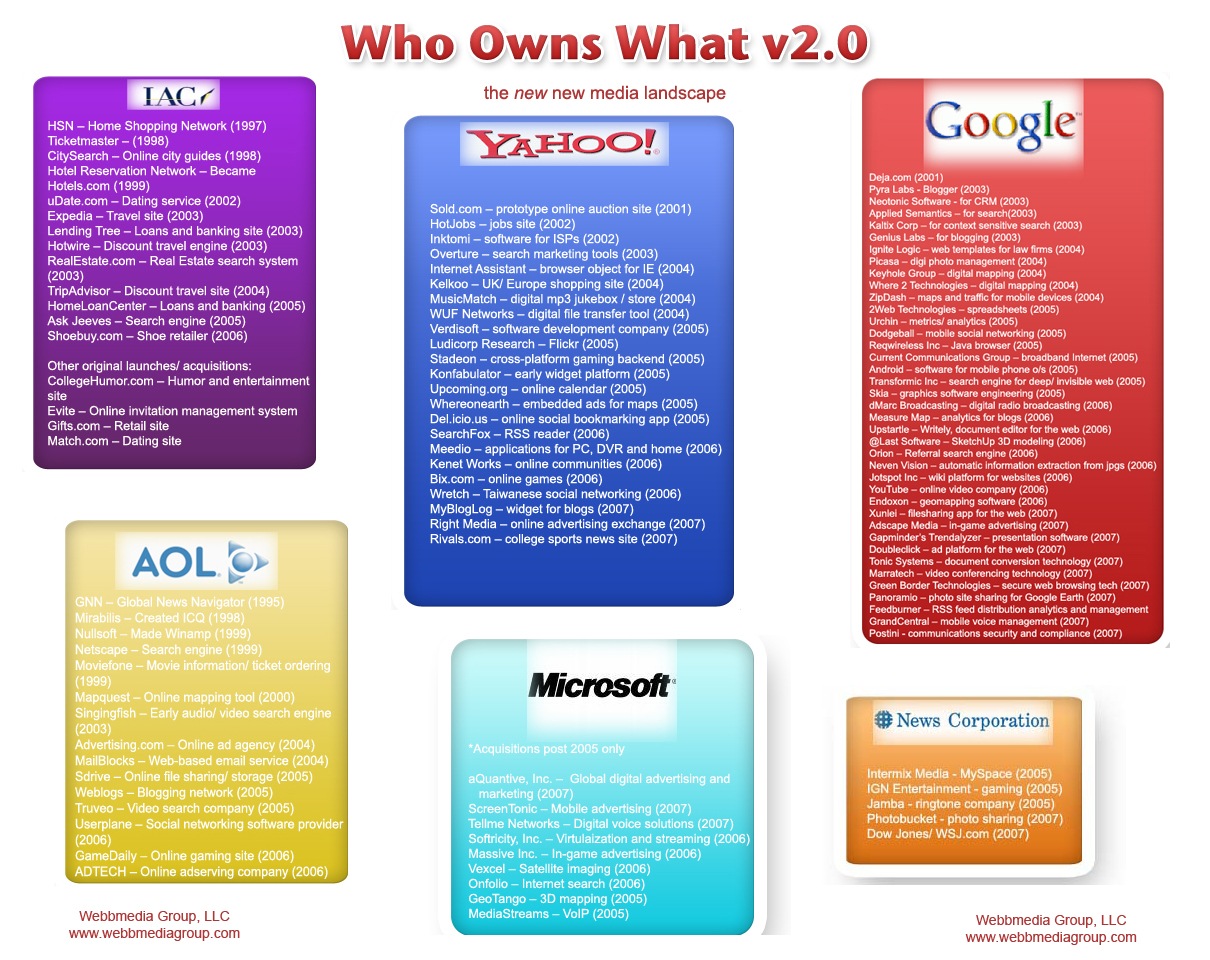
(Click image to expand.)
[Via Steve Rubel & Amy Gahran]
Facebook Off!
Facebook Off … when college social networking turns bad!
(Or: The Perils of Identity Theft for Beginners) [Via Sivacracy]
Kevin 07! (Or: Team Rudd gets its Web2.0 on!)

So, Kevin07 is here! Australian Labor leader Kevin Rudd has gotten all web2.0 and has a new portal website which integrates nicely with Labor and Rudd’s re-vamped MySpace page, YouTube and Facebook. As I’ve discussed in the past month, Labor has already shown far more success in using MySpace and Facebook than the Liberal party. Liberal leader and current PM John Howard has tried to use YouTube, but each video clip led to the deleting of comments and each video also seems to have less and less viewers.
Kevin07 was launched today, so for historical archival purposes, here is a full screenshot from day one:
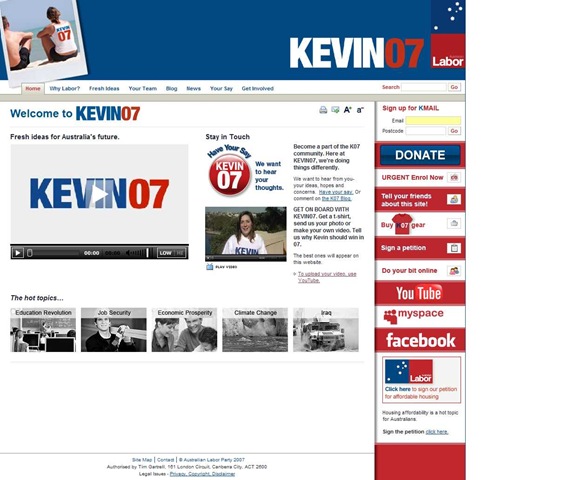
The layout is fairly straight-forward and is clearly based on a the design of both the Hillary08 (screenshot) and Obama08 (screenshot) campaigns for the 2008 US Presidential election. There is a little danger in Australia in pushing the individual (Kevin) over the party (Labor) since Australians are still less comfortable with celebrity politics (hence, among other things, no Australia President) but I’ve got to say I think the Labor media advisors have done a very decent job on this portal. In an article in PerthNow, Rudd’s team certainly seem to be making the right noises about how social software would work during the election campaign:
“Kevin07 will encourage supporters to interact with one another, participate in blogs and stay in touch with what is happening on the campaign trail,” Labor’s campaign director Tim Gartrell said.
On the negative side, ABC News has a story about some very strongly worded responses from Liberal Party faithful:
But Assistant Treasurer Peter Dutton says voters will eventually see the light, and has labelled Mr Rudd’s approach as a “load of crap”.
“People at the moment are looking at Kevin Rudd like they’re looking at a promo for Big Brother,” he said.
“I mean it’s exciting, it’s fresh and when the big night comes, and people actually have a closer look and they look at the detail and they get a better understanding about what the show is about, they actually realise that the show is a load of crap.”
“The thing I say to Australians is please, don’t just look at the media tart, look at the policy detail.”
However, what Peter Dutton fails to understand, is that a generation who started watching Big Brother when they were 13 are old enough to vote this year. More to the point, dismissing the web, which is a central social space for those in the late teens and twenties, is clearly alienating the majority of a key demographic group. On more stable ground, The Age has tried to take Team Rudd to task for not registering all the possible Kevin07 variant domains (.net, .org etc) but if that’s the only issues the mainstream media can find, then I’d have to say Kevin07 is a winner in terms of design and its connectivity with voters.

Tama Leaver dot Net by Tama Leaver is licensed under a Creative Commons Attribution-NonCommercial-ShareAlike 4.0 International License.