Home » web2.0 (Page 26)
Category Archives: web2.0
LonelyGirl15 is over … for the season!

So … Bree’s dead, then. Or, that should be “Bree’s dead” since her character supposedly had all of her blood transfused to someone else, but you’re not dead on television, or in videoblogs (which, in this case at least, looks like they want to be television) until your head comes clean off! If you’ve no idea what I’m on about, LonelyGirl15, the poster-child for videoblog commercial success in the YouTube era, has come to an end for this ‘season’. To be honest, I never thought the creators of LonelyGirl15 would be referring to their work in ‘seasons’, in the same terms as a TV production; for some reason it seem like a backward step to use this terminology when half the point of the project was to expand the bounds of where meaningful drama could be found, made and enjoyed! That said, since the creative property of LG15 seems to have been the heart of many a sales pitch recently, perhaps a first season (of 260 episodes, no less) is a useful way of packaging a product.
For those joining the game late, LonelyGirl15 shot to fame after the seemingly innocuous clips of 16-year old, home-schooled Bree raised the eyebrows of a few viewers who noted the slightly-too-professional look of a few episodes. There were a few tears when fans who thought Bree was real discovered she was just a character, but after the controversy died down, the series has continued to engage viewers and command a loyal following in its format of 3 to 5 minute episodes. The LG15 ‘gang’ expanded recently to include another 4 people (originally only Daniel was a regular character, and the ‘explanation’ for the show’s neat editing), and it seems that “season two” will continue the drama in the aftermath of Bree’s death (and, I wouldn’t be surprised, her shock, not-so-dead return somewhere toward the end of season two). Jessica Lee Rose who played Bree has gone on to bigger and better things (proving that videoblogs could be a jumping on point to ‘make the name’ of an actor), so her departure was inevitable.
On the commercial front, LG15 seems to have become a very successful commercial project. The rights to distribute (but not control production) of LG15 were finally won by MySpace for the 12-part season finale (and subsequent season), and as Liz Gannes this shows the robustness of the videoblog as a commercial model.
I can’t say I’ve watched the last 100 or so episodes of LonelyGirl15 that closely, or at all in many cases, and I certainly thought Bree’s demise was a little over-the-top (which you can now view on YouTube, too, here) but the overall endeavor points to a very viable alternative production model which could well see many creative teams get their feet wet before taking on the mainstream media world!
Talking Facebook, MySpace, Australian Politics and Class … on the radio
Yesterday I was interviewed by Laura Miller on RTR FM’s radio programme ‘Morning Magazine’. Laura and I spoke about about MySpace, Facebook, Australian politican’s using social software, and the recent interest in these spaces in terms of ‘class’ on the back of danah boyd’s work. For the two or three people in the world who would be interested in hearing me talk about these things, you can listed to an mp3 recording of the interview (which clocks in at just under 10 minutes) here.
Incidentally, Laura completed her Communication Studies degree at UWA last year and was part of a team who put together the wonderful comic exploration of the role of the Peacock’s at UWA and that video is viewable here (fans of Laura’s may want to focus around 2:18 in, which features a 1970s Laura cameo!).
Happenings from and about Creative Commons in Australia
On the back of a lot of really interesting work and events last year, Creative Commons Australia have released their “Unlocking the Potential Through Creative Commons” report which examines the role (and potential roles) of Creative Commons licensing in Australia. It’s an easy read and has lots of examples, so very useful for artists, media producers, educators and many others who are thinking about the Creative Commons as the right copyright for their work!
Also in Australia, the CC Au blog looks at a recent controversy which has arisen due to Virgin Mobile in Australia using Flickr images licensed under Creative Commons terms. It appears Virgin may have ignored a CC ‘non-commercial’ clause in at least one case, but also on the table is the moral question of getting the permission of people who actually appear in the photos, especially since some of the advertisements put out by Virgin Mobile are clearly mocking in the people in the pictures. That said, clearly this is a very mainstream use of CC-licensed work and that’s definitely welcome. It’s also noteworthy that at least some of the photographers are delighted to see their work appearing as part of this campaign. For some of the more vitriolic comments which highlight the grey areas between intent and use, see the comments of these two Flickr images. It’s also worth checking out the online arm of Virgin’s campaign using these images (which, I have to say, is actually quite a clever use of some of these pictures!)
More broadly, last month Mary Taylor Huber from the US Carnegie Foundation for the Advancement of Teaching gave a series of guest talks here in Perth (you can hear Mary’s lecture here) and focused on what she calls building the ‘teaching commons’ which is, essentially, shared ideas and resources about teaching and learning across the globe. In our conversation after her public lecture, we were talking about the Creative Commons as the mechanism by which the actual resources of a teaching commons could be shared. Following that idea, I was absolutely delighted to see Creative Commons central announce that their CC Learn – “the education division of Creative Commons” – has gone live, with this fantastic mission statement:
* With legal barriers, we advocate for licensing of educational materials under interoperable terms, such as those provided by Creative Commons licenses, that allow unhampered modification, remixing, and redistribution. We also educate teachers, learners, and policy makers about copyright and fair-use issues pertaining to education.
* With technical barriers, we promote interoperability standards and tools to facilitate remixing and reuse.
* With social barriers, we encourage teachers and learners to re-use educational materials available on the Web, and to build on each other’s contributions.
Obviously CC Learn is in its early stages, but the mission is definitely a very important one and I can’t wait to see CC Learn grow!
Update (8.50am, 28 Jul 07): I’ve been reading more about the Virgin Mobile use of Flickr CC images and these posts are worth reading: “Uh, I thought YOU got the release . . .” by Carolyn E. Wright, looking at the need for model release forms for commercial use of people in photos; a post from Ian Wilson who was quite happy to see his image used by Virgin Mobile; Agency Spy’s “Flickr Is Going To Cost Virgin Mobile Millions Of Dollars“; and a longer conversation on Flickr “Virgin Mobile advertising campaign using Flickr photos“.
The US Presidential Race ’08 is now a pillow-fight between bikini-clad crush girls!
As Chuck and a quite a few others have pointed out, Barely Political have released another viral video, this time featuring an MTV style showdown between the singing, dancing political spokesmodel* Obama Girl and her political nemesis, Giuliani Girl:
I rather like Chuck’s description of this clip as a “a singing and dancing competition on the streets of Brooklyn that suggests a spiced up version of West Side Story, with a little politics thrown in.” As with the Obama Girl and Hott4Hill clips discussed earlier, the question as to whether these clips actually have any meaningful place in promoting political awareness is an important one. The lyrics certainly presume some knowledge of politics and of the candidates, but I suspect the demographic most likely to be watching the videos in YouTube are probably not of voting age.
As Craig Rubens from NewTeeVee asks:
Is this the “Happy Birthday Mr. President” of the YouTube era? The ladies of Barely Political owe quite a bit to the imitable Marilyn Monroe. Or is this more the Jib Jab of the 2008 election, whose This Land traveled in very much the same media circles back on ’04?
I like the comparison with Jib Jab, as it certainly reminds us that US politics has already had its first election (’04) with viral video input, and the Crush Girl vids have some sort of history. That said, I also worry with Rubens that for all the cynicism about politics in the US, given such a narrow ranges of choices at the end of the day, these clips really could make a difference in an apathetic voter’s mind:
So, will Barely Political work its way up to political punditry levels of Stewart/Colbert? Likely not, but it’s broken new ground with the powers of viral videos, coming out with multiple iterations of a successful formula. I’d like to think that my vote won’t be influenced by Hooters girls chanting political candidates names, but like I said before, I am a member of an easily swayed demographic. So, while maybe not the most cerebral of political commentaries, Obama girl very well might be the most primal.
In a clearer light, it’s great to see Taryn Southern (who didn’t just perform, but also wrote the Hott4Hill clip) bemused by the fact that many commentators are missing the that fact that her clip, at least, is definitely satirical:
I’m still surprised at the number of people who don’t realize the video is a parody. Between Hillary’s face in Mt. Rushmore and my bikini body superimposed on George Washington crossing the Delaware, how could it get anymore silly?
Meanwhile, on the home front, the Oz in 30 Seconds citizen-produced political video campaign in Australia (run by GetUp) has entered the voting phase. Nothing as racy as the US clips, but some really impressive political commentary to be seen here!
* I’ve loved the term spokesmodel ever since hearing it for the first time in the wonderful film LA Story. I’m so pleased to finally have an appropriate context in which to use it!
Australian Politicians on MySpace this week…
The Australian ran a couple of stories today about Australian politics finding another outlet in MySpace’s ‘Impact’ website (the Australian version).
In Nicola Berkovic’s ‘Kevin has more ‘friends’ than John’, she points out that Labor is doing much better in MySpace than the Liberal Party. As Berkovic notes:
Yesterday afternoon, the Opposition Leader had more than 800 friends, while the Prime Minister had a measly seven. And most of them were fellow Liberal MPs. However, it is also a risky strategy for politicians, who are used to their minders having some degree of control over their image and political message. […]
Many of Mr Rudd’s MySpace friends are preoccupied with the issues that interest many young people: drinking, smoking and sex. […] However, Mr Rudd said, provided that people did not post defamatory or profane comments on his site, he was relaxed about losing control over his image on the internet. “It’s just life in the fast lane,” the Opposition Leader said.
I’d say Kevin Rudd’s attitude is probably a sensible one (and its not like any of the politician on MySpace are actually likely to see their own profiles). That said, in ‘MPs cast cyber net in hunt for votes’, Cath Hart points out that:
The emergence of e-campaigning in Australia is set to mirror the trend in the US, where presidential candidates have embraced the internet – for fundraising and profile building – as the 2008 race moves into full swing. Speaking at the launch of MySpace’s new political channel, Impact, yesterday, Mr Rudd described the site as the “public meeting place for the 21st century”, where his goal is “to get 50per cent … plus one more friend than Mr Howard”. “It’s a good shot in the arm for Australian democracy to keep it alive into the next century.” […]
But media and internet experts have warned Mr Rudd and the swag of other “e-MPs”, or online politicians, that social networking sites can be a double-edged sword. Internet networking expert Joanne Jacobs said the sites offered access to the “student market” of people under 24. “The trouble with these networking sites is that … they open the writer up to criticism. It also means you don’t have a moderating path to vet out unpopular comment,” she said.
Following Joanne Jacobs’ comments, I suspect the real test of Rudd’s take on social networking websites will come when he does something massively unpopular and has to deal with the backlash!
For today, thought, lets look at MySpace friends:
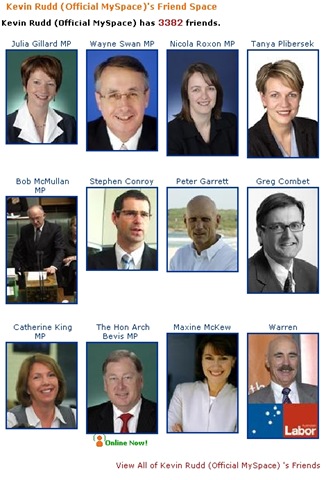 Labor leader Kevin Rudd, has 3382 friends;
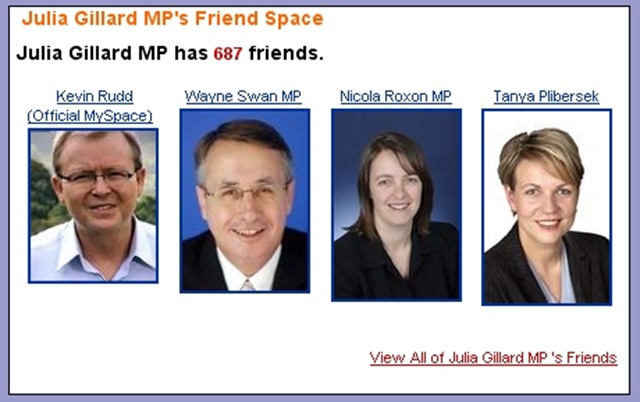 Julia Gillard (Deputy Leader for Labor) has 687 friends.
In the middle, Bob Brown (leader of the Greens) has 173 friends, while Democrat Senator Andrew Bartlett has 163 friends (although, already being Australia’s most web2.0-savvy politician, Bartlett already blogs extensively and has clearly stated that he only has time to treat MySpace as a re-posting space for his blog);
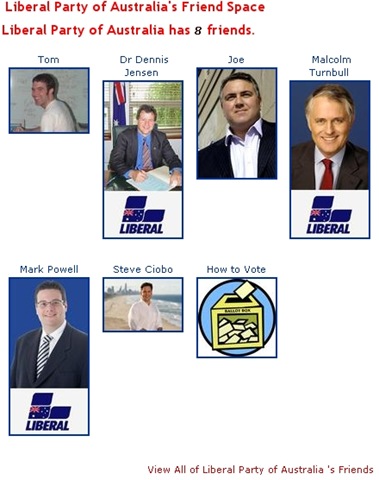 Meanwhile, Australian Prime Minister John Howard only has 8 friends (and Peter Costello, oddly enough, isn’t one of them!). While the generation gap is clearly one factor, I strongly suspect that Howard’s camp simply aren’t checking friend requests (and thus Howard will probably never have more than 8 friends!). This is similar to what Jill mentions about politics in Norway, in that candidates are using online networks like MySpace or YouTube without having teams literate in how these websites actually work. (Another argument for the importance of digital literacies right there!)
Incidentally, the popularity of certain politicians doesn’t seem to be rubbing off on the youth arms of either major party: on MySpace the Young Liberals currently have 50 friends while Young Labor isn’t doing much better with 110 friends.
Returning to Australian Politics on Facebook discussed last week, Kevin Rudd is up to 1296 friends, while there still doesn’t appear to be a real John Howard. I’ll leave you to draw your on conclusions on that front!
(All friend counts and screenshots were taken between 3pm and 3.40pm Perth Time on 13 July 2007.)
Putting the Sex (back) into American Politics?
The process by which different US Democrats and Republicans vie for the right to be their party’s candidate for presidency has always fascinated me (admittedly, from afar, safe in the knowledge I don’t need to vote for any of these people). The race for 2004 bought out some impressive efforts in participatory culture (remember Jib Jab’s ‘This Land’?), and this years’ Hillary 1984 video promised more in the race for 2008. While the creativity is definitely out there, one trend which has been a little unexpected is the “I’ve got a crush on…” videos attached to the Democrat candidates.
First there was the self-styled ‘Obama Girl’ with her “I’ve Got a Crush on Obama” video:
The clip and the Obama Girl herself have gained a fair amount of attention in US media, most of which is linked to from Obama Girl’s website. The girl in the clip – Amber Lee Ettinger – didn’t create the concept (or sing the song; she’s lip-synching) but has become one of the key faces in Obama’s campaign. The story behind Obama Girl is found at the Barely Political website. Now, along similar lines but a little more disturbingly, Chuck Tryon has drawn my attention to the “Hott4Hill featuring Taryn Southern” clip, which runs a fine line between representing Hillary Clinton as a politician or a sexual icon(!):
And, of course, there’s a Hott4Hill blog to emphasise Taryn Southern’s efforts.While I’m still thinking about how all of this works (and wonder if these clips have the potential to damage campaigns as much as make them appealing for younger proto-voters) you might want to have a read of ‘The Power and Playfulness of Parody: Obama, Hip Hop and Misunderstanding’ by Bernie Heidkamp in Pop Politics which gives some context and perspective to the Obama Girl clip.

Tama Leaver dot Net by Tama Leaver is licensed under a Creative Commons Attribution-NonCommercial-ShareAlike 4.0 International License.