Home » web2.0 (Page 27)
Category Archives: web2.0
LOL Theorists
In a fit of silliness, I find myself using the LOL CATS builder for terrible, terrible, theorist humour …
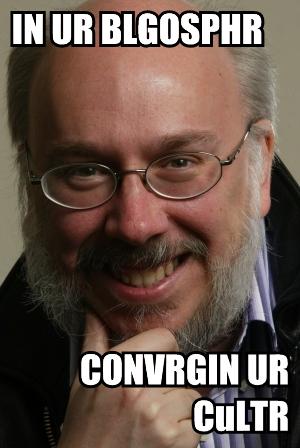
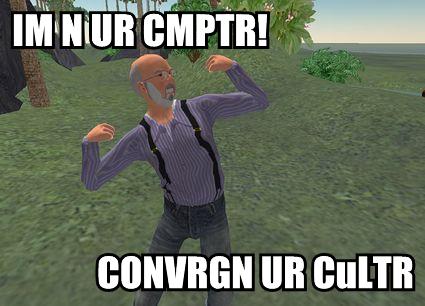
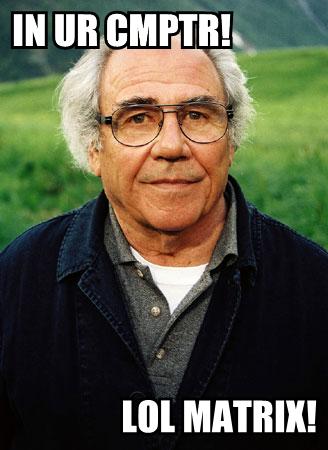
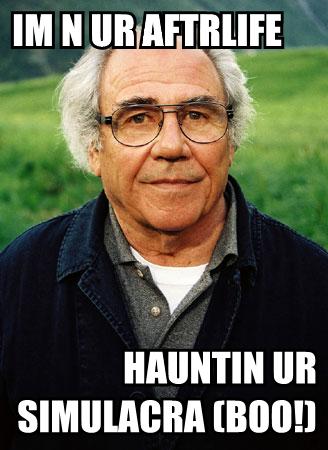
Where did this insanity come from? I blame Jean (Burgess, not Baudrillard!). (More here.)
Update: Henry Jenkins linked to the LOL Theorist mashups of himself! 🙂
Academic Ethics, Privacy and Transparency … all coming soon to YouTube!
Australia’s QUT has been in the grip of a very public controversy recently which dovetails between issues of freedom of speech, academic ethics and the transparency of university processes. The controversy came to light and media attention on 11 April this year when two QUT academics, John Hookham and Gary MacLennan, published an article in The Australian entitled ‘Philistines of relativism at the gates’. In it, Hookham and MacLennan very publicly took issue with the ethics of work being done by PhD candidate, Michael Noonan:
A time comes when you have to say: “Enough!”, when you can no longer put up with the misanthropic and amoral trash produced under the rubric of postmodernist, post-structuralist thought. The last straw, the defining moment, came for us when we attended a recent PhD confirmation at the Queensland University of Technology, where we teach. Candidate Michael Noonan’s thesis title was Laughing at the Disabled: Creating comedy that Confronts, Offends and Entertains. The thesis abstract explained that “Laughing at the Disabled is an exploration of authorship and exploitation in disability comedy, the culmination of which will be the creation and production (for sale) of a six-part comedy series featuring two intellectually disabled personalities. “The show, entitled (Craig and William): Downunder Mystery Tour, will be aimed squarely at the mainstream masses; its aim to confront, offend and entertain.” (Editor’s note: the subjects’ names have been changed to protect their privacy.) Noonan went on to affirm that his thesis was guided by post-structuralist theory, which in our view entails moral relativism. He then showed video clips in which he had set up scenarios placing the intellectually disabled subjects in situations they did not devise and in which they could appear only as inept. Thus, the disabled Craig and William were sent to a pub out west to ask the locals about the mystery of the min-min lights. […]
At the seminar we were told there was a thin line between laughing at and laughing with. There is no such thin line. There is an absolute difference that anyone who has been laughed at knows. We must admit with great reluctance that at the seminar we were alone in our criticism of the project. For us, it was a moment of great shame and a burning testimony to the power of post-structuralist thought to corrupt. It is not our intention here to demolish the work of Noonan, an aspiring young academic and filmmaker. After all, ultimate responsibility for this research rests with the candidate’s supervisory team, which included associate professor Alan McKee, the faculty ethics committee, which apparently gave his project total approval, and the expert panel, which confirmed his candidacy. […]
What we have instead is the reality that cultural studies is in the grip of a powerful movement that we call the radical philistine push. It is this same movement that has seen the collapse of English studies and the consequent production of graduates who have only the scantiest acquaintance with our literary heritage. It is also undermining the moral fabric of the university.
So, what starts with ethical questions about a particular thesis, quickly becomes a much more generic complaint about the corruption of education by poststructuralist and postmodern theory and approaches. I know nothing of the people writing or mentioned in this article, but have to say after reading the piece I wasn’t swayed; my sympathies were more with Michael Noonan than anyone else, because as a PhD candidate I know I would have been almost destroyed by such public denouncing of my work. This, I should add, is not a comment on the quality on the work being or proposed – I know nothing beyond the article above and the surrounding debate, and haven’t seen any of the footage mentioned – but rather a comment on the process and the reasonable expectation that any criticism of a candidate’s work be handled within the university as long as possible. I’m not saying there is never a case for ‘going public’ with dismay about certain research, but from what I’ve read I believe Hookham and MacLennan took that step far too early. More to the point, combining criticism of a specific project with a very generic attack on a particular body of theory and its influence on teaching seems a less than generous way of dealing with the work of a PhD candidate.
The issues raised here also beg serious questions about transparency and universities. There is a lot of talk about the need to transparency of research outcomes since (most) Australian universities are at least partially publicly-funded. I quite agree with that notion. However, I think the idea of the processes of a university being taken public under the rubric of transparency tend to skew what makes it into the public arena. Selectively releasing aspects of a process (such as an ethics review process and confirmation of candidature) around research which clearly relies on careful contextualisation is bound to produce a one-sided picture. Tellingly, when Hookham and MacLennan’s article was republished in Online Opinion, the were comments from a student – using the handle WWSBD – who’d had Noonan (the candidate) as a lecturer, praising his efforts to educate student about people with disability. Moreover, this is the only place I’ve seen Noonan himself comment publicly:
I am at the student at the centre of Hookham and MacLennan’s attacks.
I thank WWSBD for understanding and appreciating my work in its context. I appreciate the words of Anecdote, who understands that a work must be seen and placed in context before it should be attacked. And I am disappointed for bedwin, who has lost all respect for me on the basis of an uninformed and incorrect article.
Much has been assumed about my project, my integrity and my intentions. Very little of it is based on truth. The simple facts are these: the excerpts I showed at my PhD confirmation seminar were presented in the context of exploring and discussing issues of authorship and representation in disability. My project seeks to empower the disabled, to give them a voice through comedy. Each clip was prefaced with my own thoughts about whether or not this had been achieved.
As a sessional staff member at QUT, I can think of nothing more deplorable than attacking a student’s incomplete research in a public forum. Hookham and MacLennan have made no effort to read my PhD confirmation document (it was offered) and they rejected my attempts to meet and discuss their concerns.
To date I have not sought to respond to their attacks in print. But I refuse to be further bullied and vilified before the public, my peers and my students.
However, the story doesn’t end there. Earlier this month The Australian report that Hookham and MacLennan are now facing a disciplinary hearing at QUT for their public comments, with the university arguing that the two unfairly attacked the candidate and his supervisory team. Now, whatever their views, Hookham and MacLennan seem to have a reputation as inspirational teachers themselves, and the news of their censure galvanized some of the QUT student body to defend their actions on the basis of free speech. The student campaign is visible through it’s “Save Our Lecturers” MySpace page. Moreover, over at Martin Hirst’s blog, he has posted ‘Freedom of Speech disabled at QUT’ which points to this documentary which is now available at YouTube:
(Hirst is a friend of Hookham and MacLennan’s, and his post also contains the full text from Hookham and MacLennan’s original article in The Australian, as well as some additional commentary from The Australian and subsequent letters to editor.)
The YouTube documentary clip, by QUT student Adrian Strong, is very compelling; Hookham and MacLennan both come across as intelligent, compassionate teachers and academics who have good cause for concern. My point here is not to judge the debate being documented in this clip – although I imagine it would be extremely compelling for many people. Rather, in the era of participatory culture and digital media, this clip is indicative of a very profound change which can see debates and arguments that once would have remained closed suddenly being open to public viewing and public debate. In such an era, digital literacy is extremely important – the ability to create, edit and share such a clip is a key part of the ability to make a case in the public eye. It’s no surprise that QUT, which has Australia’s most renowned Creative Industries faculty, should be the source of the first such debate in Australia (to my knowledge, at least).
Illustrating my point, I just noticed another posted by the same YouTube user who posted the clip above (and thus, I presume, also be Adrian Strong) which talks in even stronger terms about a perceived campaign of censorship at QUT:
(Again, let me reinforce, I don’t know enough about the other things going on to really judge this debate, but I do know that the perception of censorship certainly doesn’t add to the reputation of any university. However, like the first clip, without any further rebuttal, this clip is likely to be very persuasive to viewers.)
Update: In ‘Dissenting dons out in the cold’, Andrew Fraser reports in The Australian that the saga ended with Hookham and MacLennan both being suspended without pay for 6 months from QUT.
The 4400 Goes Viral (Marketing)
The 4400 has taken to viral marketing dramatically in order to build the word before the upcoming fourth season of the TV show. According to AdWeek:
To promote the new season of The 4400 on USA Network, Campfire has created a wide-ranging interactive world consisting of 80 videos that run from 30 seconds to five minutes and six Web sites. […] The 4400 follows 4,400 people who are abducted, taken away and then returned to planet Earth. After their return, many of them discover they have superpowers. As the fourth season begins on June 17, the plot follows the development of a drug called Promicin: it gives the users superpowers, if it doesn’t kill them. Three different factions emerge around the drug: pro, anti- and neutral.
On YouTube, for example, one of the show’s stars, Billy Campbell, appears in character as Jordan Collier, advocating Promicin and the decrying the government’s attempts to ban the drug. Here’s Jordan Collier dispatch #3:
Elsewhere on the net, we can find the Promicin Power website, which argues that Promicin is the key to world peace and a sustainable relationship with nature. Here’s one example that looks like it could be have been a United Colours of Bennetton advertisement in a past life:
At the other extreme, there’s also Promicin Terror which sees the drug as the biggest threat to the US since Al Qaeda. Clearly building on the famous ‘Daisy‘ political ad of the 60s (which was recycled in the US debates about the War with Iraq), this is an example of a clip campaigning to ban the drug:
I quite enjoyed the last season of The 4400 and am heartened to see the show’s producers so actively embracing the potential of video-sharing and online word-of-mouth. The clips are a little over-produced, but given the state of a lot of TV advertising today, I’m sure they could easily be mistaken for the ‘real thing’.
Visualising the User-Driven Web
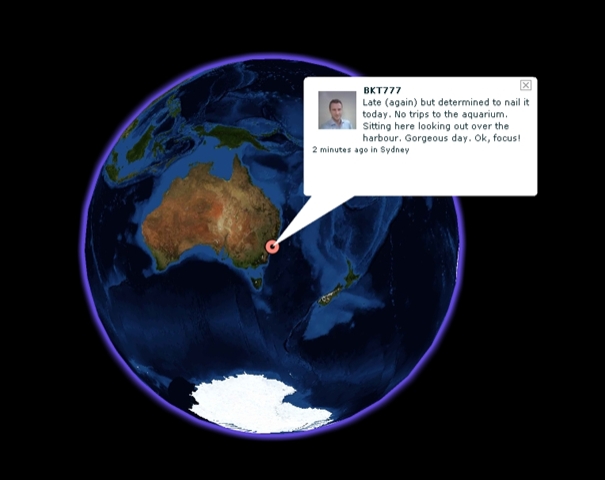
I was just pointed to Flickrvision, and I’m impressed. Flickrvision, and its older sibling, Twittervision, are program mashups by David Troy which combine the visualisation of Google Maps with the user-created data flowing out of Flickr and Twitter. There’s a ‘standard view’ in which individual Tweets or Flickr images are posted on a flat world map, but even more impressive for those visually-minded is the 3D version which inserts Tweets and Flickr photos continually onto a global map (which spins as needs be to show the origin of each post).
An example of Twittervision:
An example of Flickrvision:
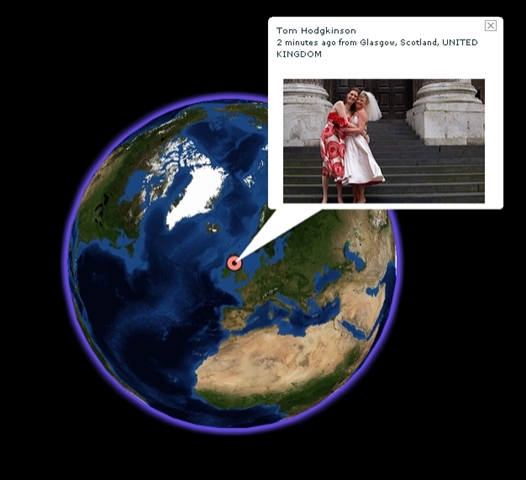
Watching these globes spin, each showing a fragment of life around the world, is incredibly engaging. This is the user-driven web at its most visually enticing. I have to say, were I in charge of a Communications Studies or Media Studies department (which I’m not) and I could find a couple of spare monitors and computers (which, in all fairness, departments probably couldn’t), then I’d leave these running 24/7 in the front foyer; the best advertisement for the studying the user-driven web is watching it happen in all its visual glory, right in front of you!
Six Twitter Questions
Last week danah boyd posted a few questions about Twitter use. Since I answered each one in my head, I figure I’d post my answers here on the (very off) chance someone else is interested in my answers. danah’s questions are in italics …
First, the practical question. Can i quote you?
[X] Yes, and you *must* use my real name.
1. Why do you use Twitter? What do you like/dislike about it?
I love the immediacy of Twitter. I also like the fact that since Tweets are so small, people often write more personal things, letting you – over time – build a more holistic sense of them as a person not just as an academic (or whatever role that person has as their more careful public face, the face that is often more carefully maintained through other forms, such as blogging).
I don’t like the fact that, so often, I turn to Twitter only when I’m trying to procrastinate or distract myself from what I should “really” be doing!
2. Who do you think is reading your Tweets? Is this the audience you want? Why/why not? Tell me anything you think of relating to the audience for your Tweets.
I’ve got two discernable groups – firstly, Perth folks who Twitter and who knowingly form a sort of semi-web2.0 ensemble (the same folk you’d see at Perth Blog Meetups); secondly my academic and pseudo-academic ‘friends’ (and I use the quote marks since I’ve not physically met a number of the people I’d imagine in this category) who I share some interests with – be it digital culture, film, participatory culture or some combination thereof. These are both the people I imagine are reading me (or have subscribed to my Tweets) and also the people I read.
3. How do you read others’ Tweets? Do you read all of them? Who do you read/not read and why? Do you know them all?
As at 2. The only time I read new Tweets, now, is when someone I’m already reading either points to someone/something interesting or is engaged in one side of an interesting conversation and I want to hear the other half!
4. What content do you think is appropriate for a Tweet? What is inappropriate? Have you ever found yourself wanting to Tweet and then deciding against it? Why?
Inappropriate is a hard call – I’ve seen all sorts of colourful language and that seems in keeping with the immediacy and personal aspects of Twitter, but at the same time I wonder if those, aggregated, would be the sort of thing people want to be a reflection of themselves. I guess links to porn or other potentially offensive material has to be flagged as such – the use of TinyURLs means you’re less able to predict the contents of a link by it’s URL and so the onus (I think) is on the Twitterer to make it clear what they’ve linking to.
5. Are your Tweets public? Why/why not? How do you feel about people you don’t know coming across them? What about people you do know?
Mine are at present. I’m considering making them private as I’ve caught myself (only once so far) writing and then deleting a Tweet since it was venting about the workplace and the workplace could – at some distant point in the future – notice. That said, I’m never really sure how private ‘private’ turns out to be.
6. What do i need to know about why Twitter is/is not working for you or your friends?
Twitter, to me, works best in tandem with other forms. Most of the Twitterers and Twitterati I read are already bloggers, but their Tweets add a level of personality and personal depth which often isn’t visible in their blog posts (which are often more careful, especially because blogs and ‘personal profiles’ so often are synonymous in academia).
The Virginia Tech Shootings and Unintentional Citizen Journalism
I woke this morning to the news that 33 people were dead at Virginia Tech university in the US due to a gunman’s “shooting rampage” . Apart from the tragedy itself one line which struck me as odd in initial report I was reading from the BBC (and I struck, literally, hundreds more when I started working through the posts in the eight hours since I last looked at the aggregated news in Google Reader) was this:
Eyewitnesses said some students jumped from classroom windows to escape the gunfire, which triggered panic on campus.
Some of those locked down inside the university buildings were using the internet to try to glean information about what was happening and many e-mailed the BBC News website. [Emphasis added.]
Why would Virginia Tech students turn to the BBC for information on a real-time event happening around them in the United States? While the BBC was certainly a focal point in the aftermath of the 2005 London Bombings, this line struck me as just odd (and uncharacteristically self-important for the usually quite staid BBC). Looking a little further around the BBC website, I found this story from Virginia Tech student Nikolas Macko which describes the experience of staying inside one of the classrooms while gunshots could be heard nearby. The BBC was certainly quick off the mark with this story, so I guess if students didn’t find anything on the BBC, perhaps they sent their stories in by email or the other means the BBC has set up to highlight reports from everyday folk.
Reading further, Dan Gillmor of Citizen Media points out that most of the news stories on US television feature a cameraphone video taken by a VT student in which gunshots can be clearly heard, but not seen (the video is, of course, now available on YouTube, found via NewTeeVee).
A number of mainstream media outlets have also turned to blogs to find eyewitness and VT student testimonials. One blogger, ntcoolfool aka Bryce Carter, had mainstream media producers requesting help finding cameraphone videos after he posted a videoclip of police cars heading to the scene of the massacre. There was also a request from someone at the Boston Herald for Carter’s thoughts on social software, given that the paper was “wondering if online communication is the best way to stay in touch during a crisis“.
One of the things that stood out to me when reading some of the blog posts from Virginia Tech students, including Carter’s, was how people reacted when their blogged personal thoughts suddenly became mainstream media soundbites. For example, Carter later posted this:
As this blog has received international attention, I find myself wondering what the world has come to. The media watch dogs, no offense, have jumped on this story and on me for, as one anonymous user said, ‘exploit my emotions’. At this time I do not believe this is so, because to put it simply: I’m willing to share my experience. This is nothing special. I don’t deserve any credit. I went to class as any other student would. I just happened to be on the other side of campus when the shots were fired later in the day. But isn’t that just it? What is remarkable about this story is that this is the story of an average student at this great school. Stories of horror, bloodshed, and death are soon to come from the victims of this horrible catastrophe and the limelight will shine onwards, for that is what the public thirsts for.
For those that are interested, I will write a more complete narrative of my experiences of today later, once the media frenzy has died down and I have a minute to better reflect. As of the time I am writing this I have done a radio interview with BBC and talked with a reporter from the LA Times. CBC Newsworld, the Boston Herald, Current TV, and MTV have asked for interviews and further information. As I said I intend to share my experiences with everyone, but I want to reinstate that I am just an average student and I don’t want to be made into something I am not.
Furthermore, upon looking at a few of the posts made on this blog, I want to declare that I am OFFENDED that people are allowing this to become a political debate. People are dead. My friends could be dead. Forget bickering about trivia. Now is not the time or the place. It is the media’s job to report to the public these stories. Take it as you wish. I’m not the media. I’m just me.
A few minutes ago I walked in the hallway of the dorm frustrated with the constant contacts of media coming in every minute. In my arrogance and limited perspective I walked into a friends room while in discussion and yelled out “I hate livejournal!”, which, concerning the current emotions of campus, was not the best thing to do. Understandably, they kicked me out. [Link Via Washington Post Blog Roundup]
Carter, I have to say, seems to be handling his edge of the media spotlight rather well. His comments really emphasise that despite the ideals of citizen journalism, many forms of social software tend to allow ordinary folks to become more like eyewitnesses who are harassed into sharing their perspectives with the mainstream press, far more so than being intentional ‘reporters’ in their own right. That said, Carter’s commentary on the process itself will, I guess, have much more prominence in the aftermath of these tragic shootings. I suspect I might end up talking about Carter’s livejournal experience in a lecture in the near future, when trying to get students to ponder the difference between the initial and intended use of social software and online presence, versus what these textual (another other) online artifacts might, at some point, be used for.
Xeni Jardin’s post about the shootings at Boing Boing has lots of relevant links to citizen-produced commentary (much intentionally so), links and blogs and is a solid starting point if you’re looking to see how reportage about the VT Shootings — both mainstream and otherwise — has grown across the world wide web.
Finally, though, I wanted to share a screenshot posted to the Flickr Virginia Tech Shooting pool. This image is far from graphic, but really hit home because it’s the sort of notice which looks so banal, but says so much. The screenshot is from the Virginia Tech website and reads “Campus Advisory: Gunman on Campus; Classes Canceled“:
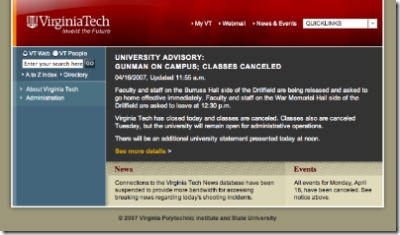
This left me wondering, if such a tragic event happened at my university, how would we react? I guess, at some level, that’s the thought that runs through most people’s minds and what makes these shootings feel so visceral to so many people – sympathy, of course, but empathy, too.

Tama Leaver dot Net by Tama Leaver is licensed under a Creative Commons Attribution-NonCommercial-ShareAlike 4.0 International License.